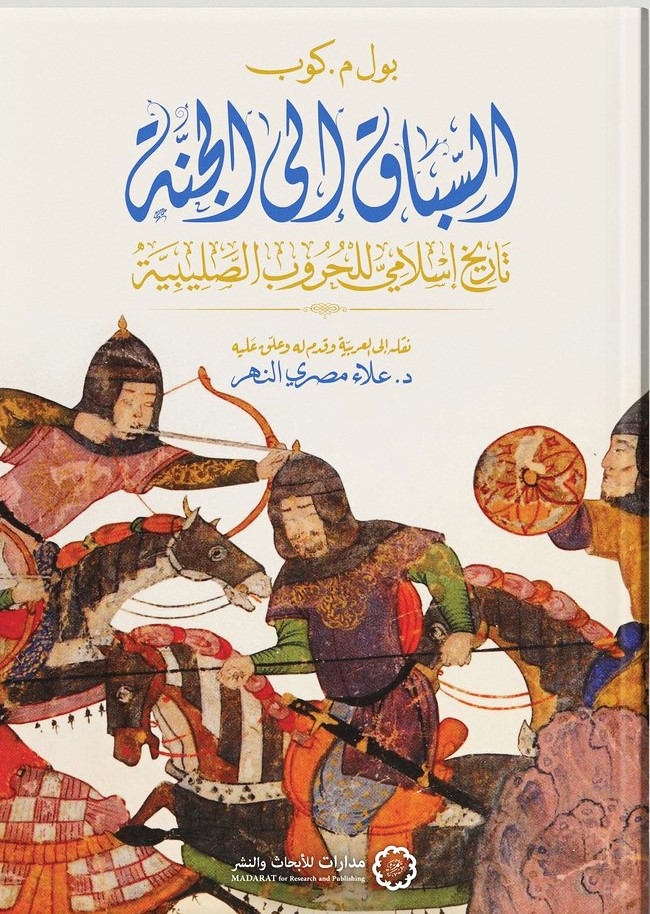
The race to paradise Islamic history of the Crusades
69ر.س
Out of Stock
Product description
The Race to Paradise: An Islamic History of the Crusades
How does "The Race to Paradise" rewrite the history of the Crusades?
Paul Cobb / Alaa Masry Al-Nahrim
Like the book "The Race to Paradise... An Islamic History of the Crusades" in its Arabic version, it is a distinguished addition to the library of historical studies, as the author Cobb reconstructed the historical narrative of the Crusades through the perspective of Islamic sources, revealing precise political and cultural dimensions. The translation by Dr. Alaa Masry Al-Nahrim increased the work's distinction, which will enrich understanding and open new horizons for researchers and interested parties.
The awaited Arabic translation of "The Race to Paradise... An Islamic History of the Crusades" was received by readers in the second half of September 2025.
Author Prof. Dr. Paul M. Cobb, a professor of Near Eastern history and civilizations at the University of Pennsylvania, dedicated the Arabic translation to clarify the perspective and importance of Arabization. It was followed by a scientific introduction by Dr. Alaa Masry Al-Nahrim, a historian and specialized translator, who won second place in the Sheikh Hamad Award for Translation and International Understanding for his translation of "Saladin and the Fall of the Kingdom of Jerusalem." It highlights translation efforts, the methodological framework of the work, and its critical analysis. The translation focused on accurately capturing the text, sourcing references, and providing an in-depth critical dimension that adds significant academic value to the Arabic edition.
Contents of "The Race to Paradise... An Islamic History of the Crusades"
The material is divided into an introduction titled "Damascus's Crossroads," nine chronologically ordered chapters, followed by a conclusion and various appendices including abbreviations, a bibliographic chart, sources and references of the translator, an index of jurisprudence and history, and lists of maps and illustrative figures.
The chapters begin with an overview of the roots of conflict, through the depiction of Saladin in Damascus as an introductory narrative linking past and present, and deconstructing the contemporary myth of Saladin by re-reading primary sources. Then, it reviews the sequence of events from the Dar al-Islam to the Mediterranean as the theater of conflict, followed by the political fragmentation narrative, the emergence of the jihad idea, the rise of the Zengids, Saladin’s strategy, the campaigns of the Franks and Mamluks, and finally the rise of the Ottomans and the decline of Muslims in the West.
Prof. Dr. Paul M. Cobb, author of "The Race to Paradise"
Damascus's Crossroads
Cobb begins his book with the statue of Saladin in Damascus, emphasizing that "the common narratives, triumphant and lamenting, are not an accurate summary of that experience," as Dr. Alaa Masry Al-Nahrim states in his introduction: "Following the saying 'Inas before Ibasas,' Cobb adorned his book with an opening... in which he mentions Saladin, who won the best arrow; it is the centerpiece, and his rightful place wherever he goes."
He rejects the traditional chronological framing of the Crusades and redefines the starting point, from Andalusia and Sicily through decades before the Clermont campaign, making the Frankish aggression an older and broader phenomenon, and the book becomes a comprehensive attempt to narrate history as understood by the "Crusader Muslims" themselves.
Dar al-Islam
The first chapter details Islamic perspectives on the world and others before the invasion, relying on traveler and geographer accounts to present the concept of "Dar al-Islam," the differences between jihad and holy war, and the status of the martyr, as Dr. Al-Nahrim explains: "It begins with the journey of the prisoner Harun ibn Yahya the Israeli to Constantinople and Rome... and his genuine talk about the difference between jihad and holy war, and the status of the martyr... to his eloquent speech about the Holy Land."
The chapter establishes a historical foundation for understanding Muslims' perception of the conflict; it is a complex civilization with self-awareness and political, economic, and social strength, built on exchange and knowledge rather than siege or negative reaction.
The Mediterranean Sea
The second chapter analyzes the Mediterranean as a stage of civilizational conflict, highlighting the fall of Sicily into Norman hands as a sign of strategic and psychological change in Muslim history. Dr. Al-Nahrim quotes: "Early sources see the Crusades in Syria and Palestine not as a new phenomenon but as the latest phase of Frankish attacks on Dar al-Islam, with the first of these invasions being the loss of Sicily."
Cobb explains how sectarian divisions and the Sunni-Shia Cold War, along with the Andalusian wars, contributed to the prelude to the Crusader invasion, making the East an extension of Western events. The confrontation path is followed through chapters three to seven, narrating the wars in the East, revealing the evolution of Islamic response from chaos and division to resistance reaching its peak with Saladin.
People took up the sword
Chapter three presents scenes of chaos and internal political conflict in the Levant before the first campaign, attributing the Franks' success in Jerusalem to the paralysis and division of Muslim princes, depicting the scene with the pseudonym from primary sources: "People took up the sword," as Dr. Al-Nahrim comments: "He excites us with early accounts of the conditions in the Levant before the First Crusade..."
Fighting the enemies of Allah
Chapter four details the first uncoordinated Islamic reactions to Frankish attacks, focusing on Chezer and Banu Munqidh as vivid examples of local trends of appeasement and resistance. Dr. Al-Nahrim states: "It begins with a talk about the Castle of Chezer and its owners... then proceeds to clarify the initial Muslim reactions to the Franks..."
Let us taste their wrath
Chapter five highlights the emergence of the anti-jihad movement led by the Zengids, employing chronological narration and geographical transitions between Syria, Andalusia, and Sicily to emphasize the simultaneity of events, explaining the role of the Almoravids and Almohads in protecting the Western Islamic world, linking the jihad project in the East with the strategy of recapturing Egypt. Dr. Al-Nahrim says: "He talks about the Almoravids and their role in preserving Andalusia... and about Nur ad-Din’s three campaigns against Egypt..."
The fallen tent
Chapter six focuses on the era of Saladin and the Battle of Hattin, using the peaceful coexistence between Muslims and Franks—such as the story of a Muslim merchant marrying a Frankish woman—to introduce a layer of complexity showing ongoing human and cultural exchange despite the peak of conflict. Dr. Al-Nahrim comments: "He prolongs his focus on Saladin, titling his discussion 'The Cutting Sword'... and includes the story of a Muslim merchant marrying a Frankish woman to demonstrate peaceful and commercial relations..."
From every deep gap
Chapter seven describes the influx of the armies of the Third Crusade and Saladin’s interaction with Richard the Lionheart, analyzing Ayyubid policies after Saladin, where diplomacy and trade became strategic tools. Dr. Al-Nahrim points out the centrality of the Egyptian invasion in Crusader recovery thinking.
Power shifts and the end of an era
In its final chapters, the book depicts a complex geopolitical picture of the end of the Crusades era, where there was no absolute victor or defeated, but rather a major reshaping of power balances in the East and West.
Wolves and lions
Chapter eight introduces the Mongols as wolves and the Mamluks as lions, highlighting the Mamluks’ skill in eradicating the Frankish presence and their organized campaigns culminating in the fall of Acre. It emphasizes that the conflict did not end with the fall of Acre but transitioned into a new struggle in the Mediterranean islands. Dr. Al-Nahrim states: "The Mongols are wolves, and the Mamluks are lions... the chapter begins with an extensive discussion of the Mongols' rise and the Mamluks' defeat..."
Dr. Alaa Masry Al-Nahrim, translator of "The Race to Paradise"
Let them be praise
The end of the era and the transformations of the West and East
In the ninth chapter, Cobb creates a final historical tableau depicting the rise of the Ottomans in the East and the decline of Islam in the West with the loss of Granada and Sicily, giving the end of the periods a geopolitical character rather than a unilateral victory. Dr. Al-Nahrim explains: "He stands before the Ottoman state, linking it to Sicily and Granada... beginning with the conquest of Constantinople and ending with two losses: Sicily and Andalusia."
The conclusion
The conclusion employs the myth of the statues of small Antioch, systematically closing the narrative with a critical approach, notably the analysis by translator Dr. Alaa, who sees that "Europe's military failure pushed it into the battle of knowledge and science," and that "its acquisition of sciences from Dar al-Islam was a hidden punishment and a future retribution," thus paving the way for confronting the modern era with colonialism. This gives the work a spiritual dimension and a historical interpretation connecting the past with the present.
Summary
The book "The Race to Paradise... An Islamic History of the Crusades" in its Arabic version is a distinguished addition to the library of historical studies, as Cobb reconstructed the historical narrative of the Crusades through the perspective of Islamic sources, revealing precise political and cultural dimensions. The translation by Dr. Alaa Masry Al-Nahrim enhanced the work's distinction, which will enrich understanding and open new horizons for researchers and interested parties.

From Dammam