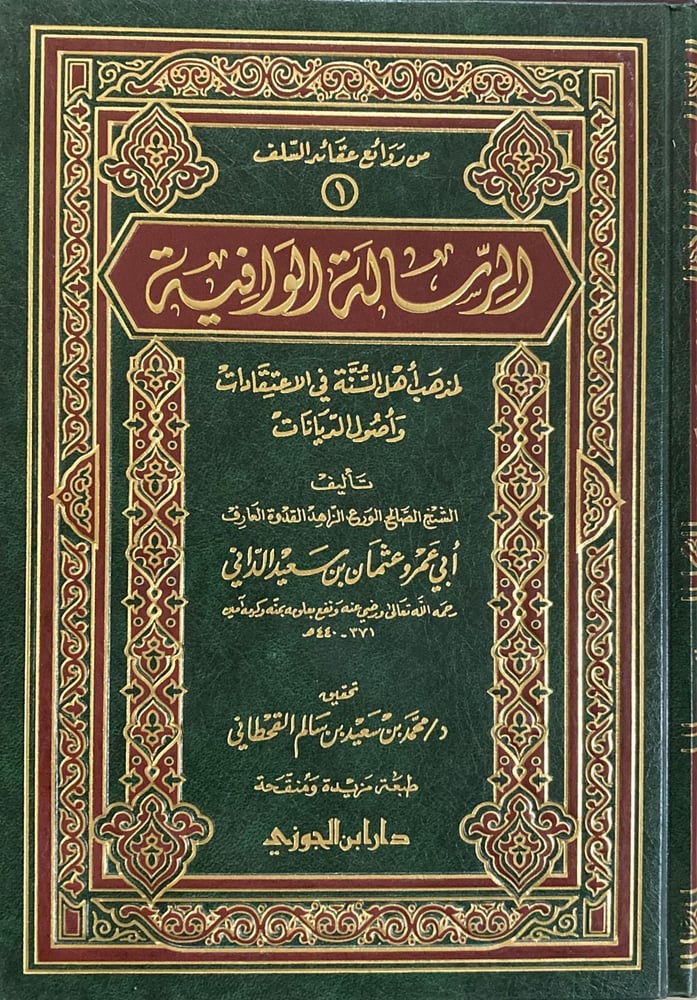

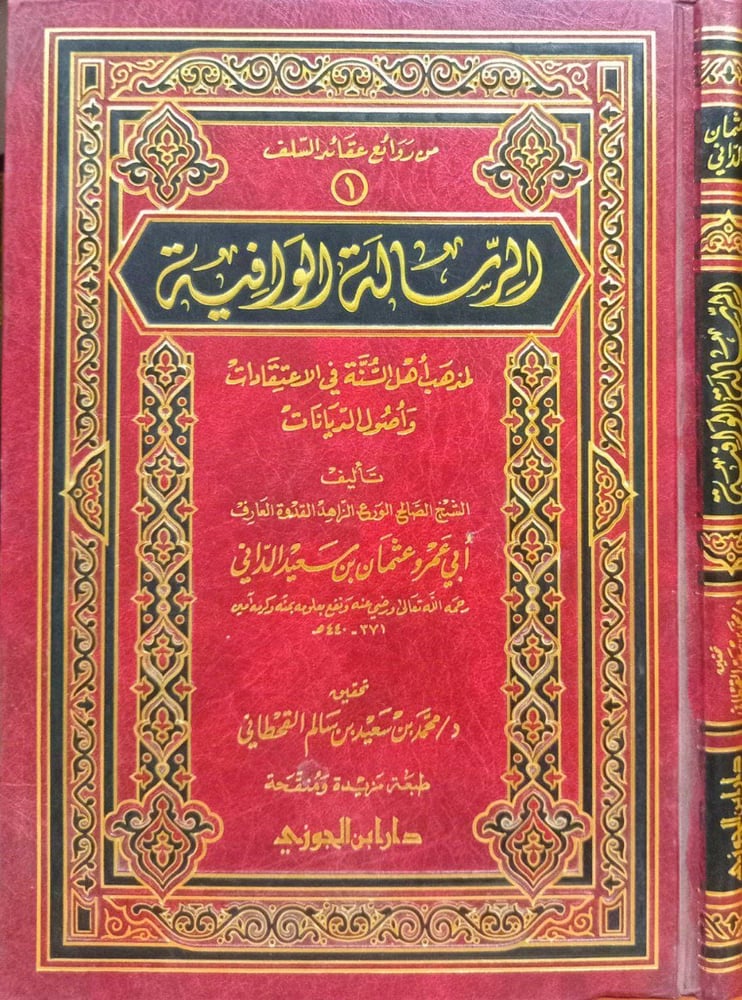
The comprehensive message of the school of Ahl al-Sunnah in beliefs
23ر.س
Product description
The authorship Sheikh Othman Saeed Al-Dani
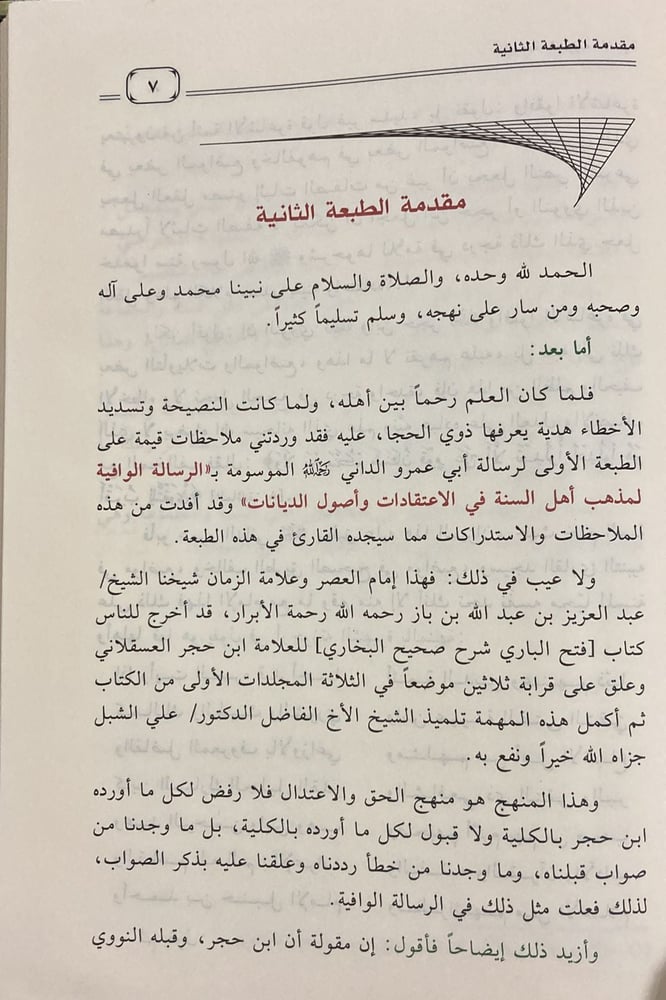
Introduction to the second edition
Praise be to Allah alone, and prayers and peace be upon our Prophet Muhammad, his family, his companions, and those who follow his guidance, and many peace and blessings.
To proceed:
Since knowledge is a mercy among its people, and since advice and correcting mistakes are gifts known to the wise, I received the first edition of the message of Abu Amr Al-Dani, and Allah, labeled as "The Complete Message of the Ahl al-Sunnah in Creeds and Foundations of Religions." I benefited from these observations and corrections, which the reader will find in this edition.
And there is no blame in that: for this is the Imam of the era and the sign of the time, our Sheikh / Abdul Aziz bin Abdullah bin Baz, may Allah have mercy on him, the mercy of the righteous. He published for the people the book [Fath al-Bari Sharh Sahih al-Bukhari] by the scholar Ibn Hajar al-Asqalani, and commented on about thirty places in the first three volumes of the book. Then, this task was completed by the diligent student, Sheikh / Dr. Ali Al-Shibl, may Allah reward him well and benefit through him.
And this methodology is the methodology of truth and moderation; so we do not reject everything Ibn Hajar included entirely, nor do we accept everything entirely. Rather, what we find correct, we accept; and what we find wrong, we reject and comment on it by mentioning the correct opinion. Therefore, I did the same in the "Complete Message."
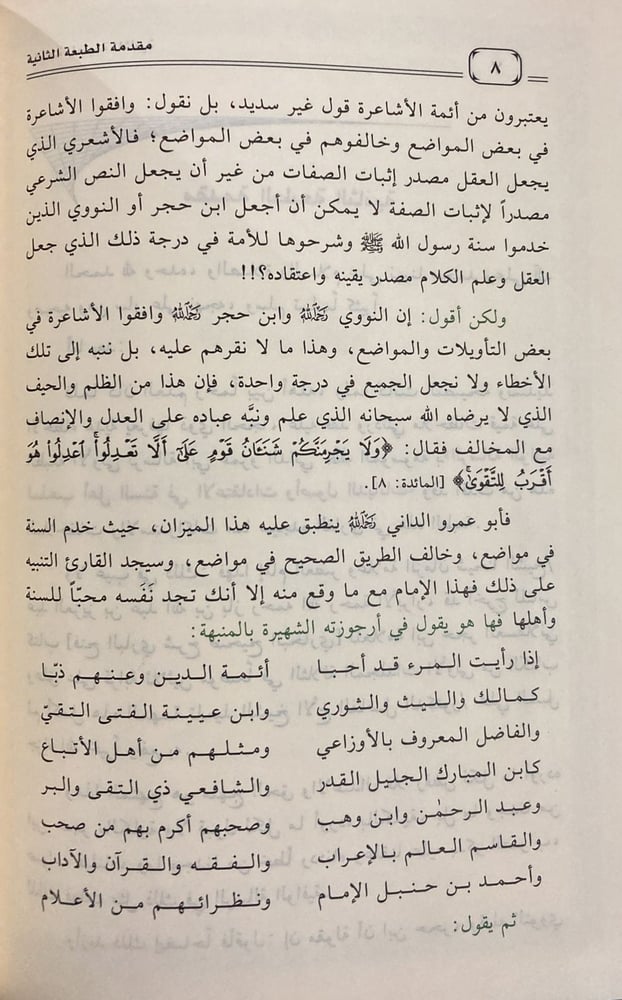
To clarify further: I say that the claim that Ibn Hajar, and before him Al-Nawawi, are considered among the Imams of the Ash'aris is not sound; rather, we say: they agreed with the Ash'aris in some places and disagreed with them in others. The Ash'ari who makes the mind a source for affirming the attributes without making the sacred texts a source for affirming the attribute — I cannot consider Ibn Hajar or Al-Nawawi, who served the Sunnah of the Messenger of Allah, peace be upon him, and explained it to the nation, to be at the same level as those who make the mind and the science of Kalam the source of their certainty and belief.
However, I say: Al-Nawawi and Ibn Hajar, may Allah have mercy on them, agreed with the Ash'aris in some interpretations and places, and this is something we do not approve of. Rather, we point out those errors and do not place everyone at the same level, for this is injustice and unfairness that Allah, the Most High, does not accept, as He taught and guided His servants to justice and fairness, saying:
"And let not the hatred of a people prevent you from being just. Be just: that is nearer to piety." [Al-Ma'idah: 8]
Abu Amr Al-Dani, may Allah have mercy on him, fits this standard, as he served the Sunnah in some places and contradicted the correct way in others. The reader will find a warning about this, for this Imam, despite what occurred from him, is still a lover of the Sunnah and its people. He says in his famous poem "Al-Munabbih":
"Heart, if you see a man who loves the Imams of religion and defends them,
Kamal and Al-Layth and Al-Thawri and Ibn 'Uyaynah, the pious,
The virtuous known as Al-Awza'i, and others from the followers,
Ibn al-Mubarak, the great, and Al-Shafi'i, the pious, and Al-Buraq,
Al-Rahman and Ibn Habbab, with whom he associates, the most honorable of companions,
Al-Qasim, the scholar of grammar, jurisprudence, the Quran, and manners,
And Ahmad ibn Hanbal, the Imam, and their like among the eminent."
Then he says:
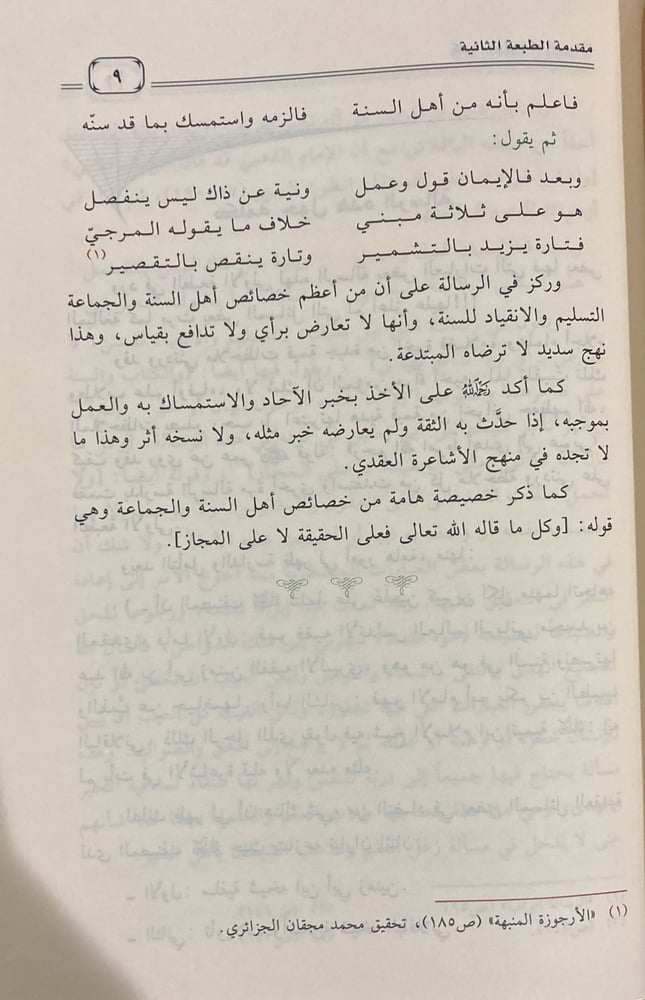
"Know that he is from the people of the Sunnah, so cling to him and hold fast to what he has established."
He also says:
"Faith is speech, action, and intention; from that, it does not separate."
And he states that it is built on three foundations, contrary to what the Mu'tazilites say: sometimes increasing with effort, and sometimes decreasing with negligence.
The message emphasizes that one of the greatest characteristics of Ahl al-Sunnah wal-Jama'ah is their submission and obedience to the Sunnah, and that it does not conflict with opinion nor oppose reasoning through analogy. This is a sound approach that the innovators do not accept.
It also emphasizes Allah's command to accept the hadith of the individual (Khithb al-Wahid) and to adhere to it and act according to it, if it is narrated by a trustworthy person and is not contradicted by a similar report, nor abrogated by a text. And this is not found in the Ash'ari theological methodology.
It also mentions an important characteristic of Ahl al-Sunnah wal-Jama'ah, which is: "And whatever Allah the Most High has said, it is true in reality, not metaphor."

From Dammam