Product description
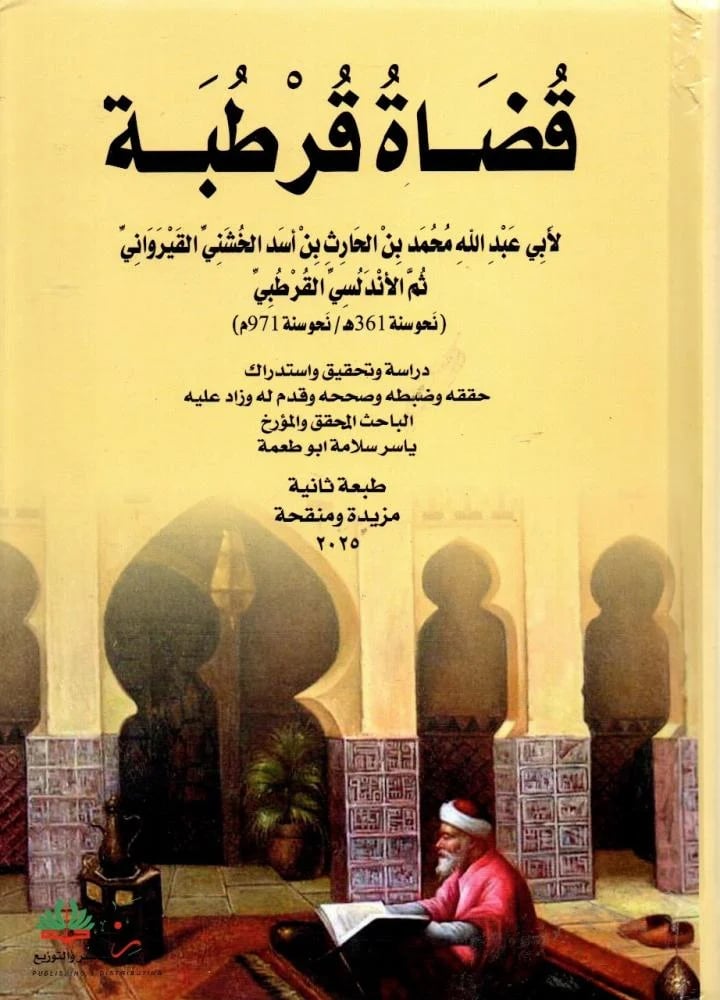
The book of the judges of Córdoba is "Judges of Córdoba" by its author Abu Abdullah Muhammad bin Al-Harith bin Asad Al-Khushni Al-Qayrawani, with correction and verification by Yasser Salama Abu Taima. The title of the book: Judges of Córdoba. The author: Abu Abdullah Muhammad bin Al-Harith Al-Khushni. The verifier: Yasser Salama Abu Taima. The edition: second, increased and revised, issued in 2025. Recently issued, by the writer, researcher, and historian, verifier Yasser Salama Abu Taima, a new work in the field of Andalusian biographies under the title: (Judges of Córdoba), from Dar Rukaz for publishing and distribution, in Amman, in a second revised and expanded edition.
In the new edition of the book, the author added seventeen translations of judges in Córdoba who held the position of (Qadi al-Jama'a), following the same method and approach of the author of the book of judges of Córdoba: (Abu Abdullah Muhammad bin Al-Harith bin Asad Al-Khushni Al-Qayrawani Al-Andalusi), but he did not mention them in the book, and this is new and beneficial for the researcher, the student, the reader, the benefactor, and the seeker of knowledge and increase. It also reveals new judges who judged in Córdoba at the rank of (Qadi al-Jama'a).
The book (Judges of Córdoba) is considered a comprehensive record and a fundamental reference for studying social life, and clarifying its aspects in the land of Al-Andalus in general, and in Córdoba, the capital of the Umayyad state and the seat of the Andalusian caliphate, in particular, from the Islamic conquest around 93 AH / 712 AD until the death of the author of this book around 361 AH / 971 AD. That is a long period.
It shed light on and explained the state of judiciary in Al-Andalus in general, and in Córdoba in particular, the condition of judges, the nature of the relationship between the judge and the ruler, and how the governor, prince, or caliph appointed, dismissed, or replaced the judge, with examples of those who abstained from judging, as well as anecdotes of judges with the rulers from Banu Umayyah, and with the people, clarifying the relationship between the judge and the people, whether those who attend him or those who interacted or encountered him.
For the writer, researcher, and historian Yasser Salama Abu Taima, in the field of study, verification, correction, explanation, and authorship, some of his works include: (Muhammad bin Abi Aamer in Andalusian poetry during the fourth Hijri century), (The conclusion of the eloquence of Andalusian writers), (History of the city of Toledo), (Abu Marwan Abdul Malik Al-Jaziri, writer and poet), (The scholarly, literary, cultural, and intellectual life in Córdoba during the Umayyad era), (The rich man’s wealth in the governance of the pilgrim’s Hajj), (Judges of Córdoba), (The connection in the history of Andalusian scholars). Many other studies in this field are still under printing and publication.
