


The ultimate of the frugal, explanation of the methodology of the wayfarers
103.50ر.س
Out of Stock
Product description
My father, Abdul Rahman Ahmed Abdul Rahman Al-Zouman
Introduction
And praise be to Allah, Lord of the worlds, and after:
The book "Manhaj Al-Salikīn" by Sheikh my teachers, Sheikh Abdul Rahman bin Nasser Al-Sa'di, may Allah have mercy on him, is a concise book that concerns students of knowledge and scholars with its explanation for students in mosques. Allah made it easy for me to explain it more than once in several mosques in the city of Buraidah. I did not find a written explanation of the book, so I sought help from Allah and began explaining the book. Then I learned about the appearance of a شرح (explanation) by Sheikh Abdullah bin Abdul Rahman Al-Jibreen, so I decided to stop continuing to write the explanation. My tongue says: Do not present your mention with their mention, for the correct is not when walking like the dead.
When I came across Sheikh Ibhaaj Al-Mu'mineen's explanation of "Manhaj Al-Salikīn," I found that Sheikh sometimes simplifies the explanation, and the reason is that Sheikh explained it in a summer course in Riyadh in the year 1416 AH, which lasted three weeks. I sought help from Allah and started completing the explanation.
May Allah have mercy on my work in the explanation:
1. I relied in my explanation of "Manhaj Al-Salikīn" on the printed book carefully edited by the investigator: Muhammad bin Abdul Aziz Al-Khudairi, which is the approved version by the Sheikh, as mentioned at the beginning of the book.
2. If the Sheikh cites a proof for an issue, I suffice with it or mention another proof if I see the need. If he does not mention a proof, I mention its proof.
3. I do not deal with the differences of the jurists; I limit myself to what the Sheikh has preferred in this.
4. If I see that the statement mentioned by the Sheikh is weak, I mention the preferred opinion in my view — and it is usually the Sheikh's — with its proof, and I mention who said this opinion from the four schools of thought and others. If this opinion is the choice of Sheikh Al-Islam or Ibn Al-Qayyim or our Sheikh Muhammad bin Salih Al-Uthaymeen, I mention that.
5. If there is a proof from the Book, Sunnah, consensus, or reasoning, I mention that without going into detail about the proofs. I usually suffice with one proof from the Qur'an and one from the Sunnah.
6. I do not digress in mentioning issues; I only mention what I see is necessary concerning the text.
7. I attribute the sayings of the jurists and refer to printed books with part and page.
8. I do not transmit a statement except from its original source unless that becomes difficult for me or hard to do.
9. If the issue is among the consensus issues, I mention the original sources in which the scholars mentioned the consensus.
10. I am keen on the sayings of the Companions in issues where there is no explicit text, or if the evidence is weak, or if there is strong disagreement on the issue.
11. I benefited from Sheikh and his student, my Sheikh Muhammad bin Salih Al-Uthaymeen — may Allah have mercy on them — in paying attention to analogies. If the issue has analogies, I mention them, as this is a good way to understand and recall the issue.
12. I refer to the original book to which the Sheikh attributed the Hadith, and I transfer from it, as there may be slight differences in wording.
13. If the Hadith is in the two Sahihs or one of them, I suffice with citing them. If it is in the four Sunan or in the Musnad of Imam Ahmad, I suffice with that, unless the matter requires it due to a word, a witness, a follower, or other things that strengthen the Hadith. The citation is usually with the number of the Hadith in the book.
14. If the Hadith is weak, I usually review the transmitted Hadiths to strengthen it or to clarify that nothing authentic has been established in the chapter.
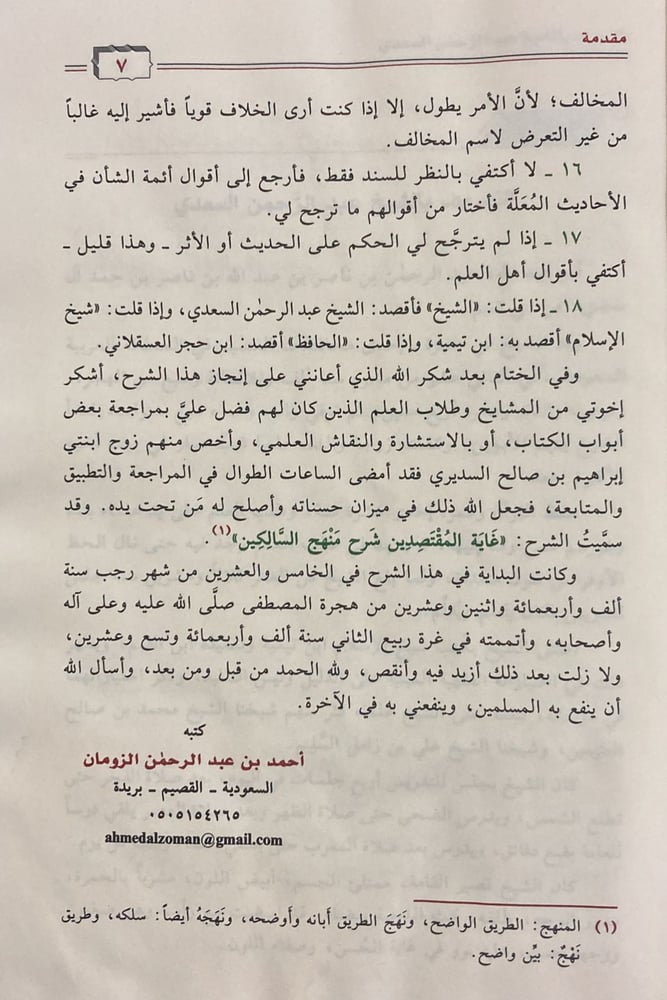
15. I judge the chain if the Hadith or the effect is not in the two Sahihs, and I mention some of those who agreed with me in the judgment from the scholars, and I do not deal with refuting opponents; because that takes time, unless I see that the disagreement is strong, then I usually point it out without mentioning the name of the opponent.
16. I do not rely solely on the chain; I refer to the sayings of the scholars regarding the weak Hadiths and choose what is more likely to me.
17. If I do not find a preference for the ruling on the Hadith or the effect — which is rare — I suffice with the sayings of the scholars.
18. When I say: "Sheikh," I mean Sheikh Abdul Rahman Al-Sa'di, and when I say: "Sheikh of Islam," I mean Ibn Taimiyah, and when I say: "Al-Hafiz," I mean Ibn Hajar Al-Asqalani.
In conclusion, after thanking Allah who helped me accomplish this explanation, I thank my brothers from the scholars and students of knowledge who had a favor on me by reviewing some chapters of the book or by consulting and scientific discussion. I especially mention my son-in-law, Ibrahim bin Saleh Al-Sudairi, who spent long hours reviewing, applying, and following up. May Allah make that in the balance of his good deeds and rectify what is under his hand.
I named the explanation: "The Ultimate of the Moderates" — Explanation of "Manhaj Al-Salikīn."
The start of this explanation was on the 25th of Rajab, 1422 AH, and I completed it on the 1st of Rabi' Al-Thani, 1429 AH. Since then, I continue to add to it and subtract from it, all praise be to Allah, first and last. I ask Allah to benefit Muslims with it and to benefit me with it in the Hereafter.
Written by: Abdul Rahman Al-Zouman

From Dammam