



The clear texts' parts that the rice is divided in the physical zakat
9.20ر.س
Product description
Classification of the author Sheikh Muhammad Saeed bin Abdullah bin Muhammad, investigation by Muhammad Saeed Omeer
Introduction
All praise be to Allah, we praise Him, seek His help, and ask for His forgiveness. We seek refuge in Allah from the evil of ourselves and the bad of our deeds. Whom Allah guides, there is no misleader for him; and whom He misguides, there is no guide for him. I bear witness that there is no deity but Allah alone, with no partner, and I bear witness that Muhammad is His servant and Messenger.
O you who have believed, fear Allah as He should be feared, and do not die except as Muslims. (Al-Imran: 102).
O mankind, fear your Lord who created you from a single soul and created from it its mate, and dispersed from both many men and women. And fear Allah, through whom you ask one another, and the wombs. Indeed, Allah is ever over you an Observer. (An-Nisa: 1).
O you who have believed, fear Allah and speak words that are straight. (Al-Ahzab: 70-71).
He will amend for you your deeds and forgive you your sins. And whoever obeys Allah and His Messenger has certainly attained a great victory.
After that: The truest speech is the Book of Allah, and the best guidance is the guidance of Muhammad, peace be upon him. And the worst of affairs are newly invented matters, and every newly invented matter is an innovation, and every innovation is misguidance, and every misguidance is in the Fire.
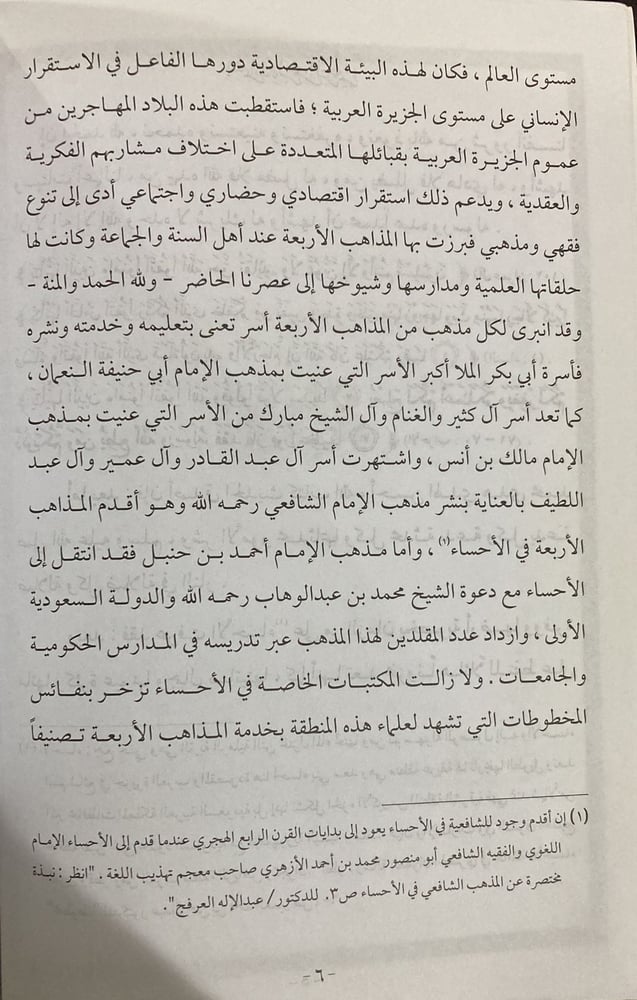
And after: Al-Ahsa has been known throughout time for its fertile land, abundant water, many springs, and beautiful orchards. It is also a huge reserve of oil on a global level. This economic environment has played an active role in human stability across the Arabian Peninsula; it attracted migrants from all over the Arabian Peninsula with its various tribes, differing in their intellectual and doctrinal backgrounds. This is supported by economic, cultural, and social stability, which led to diverse jurisprudence and sects. The four Sunni schools of thought appeared there, with their scientific circles, schools, and scholars up to the present day—praise be to Allah and thanks to Him.
Each of the four schools was supported by families dedicated to teaching, serving, and spreading their doctrines. The family of Abu Bakr Al-Mulla is among the most prominent families concerned with the Hanafi school of Imam Abu Hanifa Al-Nu'man. The families of Al-Kathir, Al-Ghanam, and Al-Sheikh Mubarak are known for their concern with the Maliki school of Imam Malik ibn Anas. The families of Al-Abd Al-Qadir, Al-‘Omair, and Al-‘Abd Al-Latif are famous for their focus on spreading the Shafi’i school of Imam Al-Shafi’i, the oldest of the four schools in Al-Ahsa.
As for the Hanbali school of Imam Ahmad ibn Hanbal, it was introduced to Al-Ahsa with the call of Sheikh Muhammad ibn Abd Al-Wahhab, may Allah have mercy on him, and the First Saudi State. The number of followers of this school increased through its teaching in government schools and universities. Private libraries in Al-Ahsa still contain valuable manuscripts attesting to the scholars of this region serving the four schools through classification and teaching.
Perhaps someone might say: The writings of Al-Ahsa are nothing but repetitions of what scholars of each school have established, and these writings lack originality and renewal.
The answer to this comes from two perspectives: First, that whoever said this spoke without examining the writings of the Al-Ahsa scholars. If they had exerted even a little effort, they would have known that there is creativity in them that refutes his claim. The fatwas of the scholars of Al-Ahsa are evidence of the fatwas of the contemporary scholars of their issues and their rulings.
Second, that classification has purposes, summarized by the scholar Ahmed bin Abdul Aziz Al-Hilali Al-Maghribi, who said: In seven, they summarized the aims of the wise from compilation. Keep them in mind, and you will attain hope. Perfect your expression in summarizing, collecting, arranging, and correcting, O my brother, the noble.
If classification is free of invented additions, or unconnected collections, or completing deficiencies, or clarifying ambiguous matters, or lengthy summaries, or mixed arrangements, or correcting errors—then it is a beneficial effort. The scholars of the entire nation, with their different locations, backgrounds, and eras—Al-Ahsa and Al-Hijaz—do not lack writings that serve these purposes.
O dear reader, what is this message you hold in your hands titled "The Clear Texts’ Gems in That Rice is Sufficient for Zakat of the Body" by Sheikh Muhammad Saeed bin Abdullah Al-‘Omair, except a purpose to clarify the error in understanding the texts of the Imams of Shafi’i regarding the sufficiency of rice in Zakat al-Fitr?
Anyone who knows that the subject of this message is to verify the Shafi’i school’s position on this matter would be motivated to address what is observed in the evidence from Hadiths and traditions. It is established that it lacks a clear picture of how to gather the principles and rules of the issue and their explanations in the books of jurisprudence, and then apply them practically—not to be rigidly stuck to the apparent texts without delving into their depths and understanding their connotations and meanings.
Undoubtedly, such a method in issuing fatwas ensures that Sharia remains adaptable and capable of accommodating changes and events. Therefore, I was determined to serve, verify, and carefully produce this message. My work in verification was as follows:
First: Dividing the study into two sections:
The first section: the biography of the author.
The second section: the name of the manuscript, its attribution to its author, and a description of the manuscript.
Second: studying the manuscript and standardizing its copies as the author intended.

From Dammam