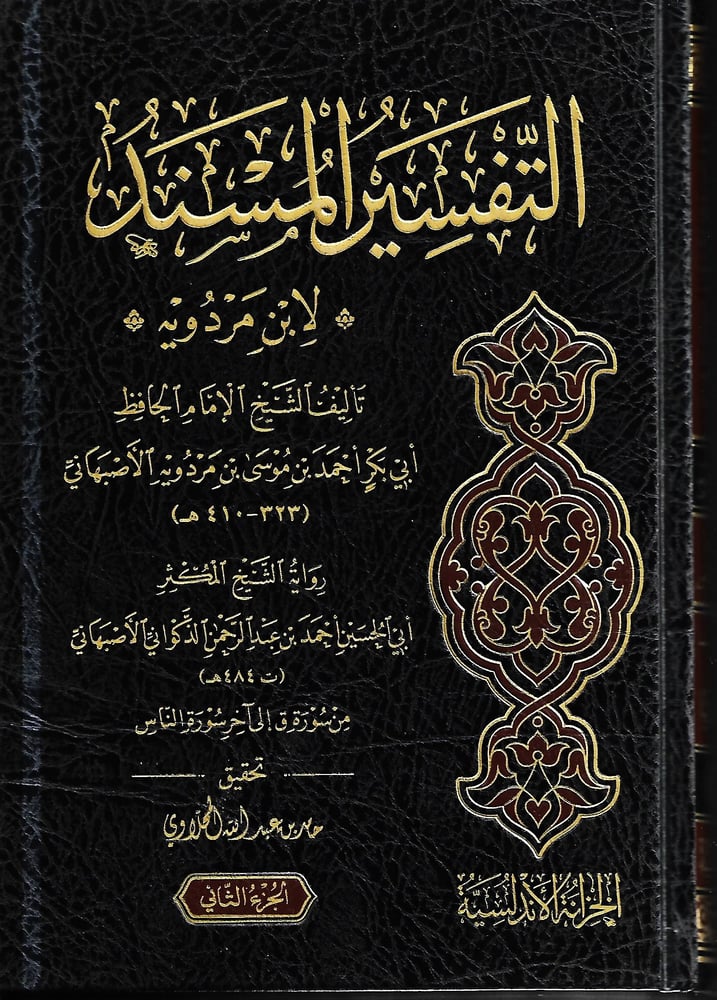
The authenticated interpretation by Ibn Marduyah 1-2
155.20ر.س
Product description
The Explanation of the Supported (Tafsir al-Musanad) by Ibn Mardawayh 1-2
Authored by: Abu Bakr Ahmad bin Musa bin Mardawayh Al-Isbahani
Verification: Hamid bin Abdullah Al-Mahallawi
Publisher: Al-Khizana Al-Andalusiyya
Edition: First 1443 - 2022
Description: Volume _ two parts _ Shamua paper
Tafsir al-Musanad by Ibn Mardawayh narrated by Abu al-Hassan Ahmad bin Abdul Rahman al-Dakwani al-Isbahani | Abu Bakr Ahmad bin Musa bin Mardawayh al-Isbahani from Surah Q to the end of Surah An-Nisa
Tafsir Ibn Mardawayh, by Ahmad bin Musa bin Mardawayh al-Isbahani, who died in 410 AH, and was among the proficient in classification. His tafsir is distinguished by the abundance of raised narrations, as he narrates them through multiple chains, but he does not condition the authenticity of what he narrates, so many strange and false narrations are found in it, and he does not pay attention to mentioning the opinions of previous interpreters.
The tafsir of Ibn Mardawayh is still missing, and his narrations have been collected from other tafsir books. Also, researcher Mohammed Al-Khudairi conducted a study on Ibn Mardawayh’s methodology in tafsir, through his narrations mentioned in available tafsir books.
His methodology in tafsir
From the quotations about Ibn Mardawayh in tafsir books, his methodology in tafsir can be clarified, which includes the following:
His keen interest in the tafsir narrated from the Prophet صلى الله عليه وسلم, which is tafsir of the Quran by the Sunnah, as his tafsir is filled with narrations attributed to the Prophet صلى الله عليه وسلم, and he narrates the hadith through its various chains, which makes him excel over other tafsir books in this aspect.
He did not adhere to the authenticity of the hadiths he narrates; he narrates what he has of hadiths related to the verse without condition of authenticity.
Few quotations from the sayings of the companions, Tabi‘in, and subsequent tafsir scholars, because he focused more on the raised tafsir.
In verses of rulings, he mentions the raised narrations clarifying the ruling indicated by the verse, and rarely is a verse free of a raised hadith explaining the ruling.
Few Isra’iliyyat in his tafsir because most of them are mawquf and maqtu‘, and Ibn Mardawayh does not pay attention to mentioning them, but his focus is on the raised narrations.
He pays attention to mentioning the readings in the verses, similar to other tafsir scholars.
He mentions hadiths related to doctrinal issues.
He cares about narrations regarding the reasons for revelation and clarifying whether the verses are Makki or Madani.
He narrates many sermons and virtues hadiths.
Praise from other tafsir scholars for Ibn Mardawayh’s tafsir
Due to Ibn Mardawayh’s focus on mentioning raised hadiths with different chains and his abundance of such narrations, some specialists in tafsir praised him for that.
Ibn Kathir, for example, praised Ibn Mardawayh for his concern in authenticating some hadiths related to tafsir and extracting them from multiple chains, such as his explanation of the meaning of “al-Sabil” in the verse: {And Allah is Possessor of bounty for the people, and the way (to Him) is accessible to those who seek it}, explaining that the way is: the provision and the ride.
Similarly, in the verse: {The recompense of those who wage war against Allah and His Messenger and strive upon earth corruption is that they shall be killed or crucified or their hands and feet be cut off from opposite sides or they shall be exiled from the land}, Ibn Kathir mentions that: he narrated the story of the Ar-Rahniyyin from the hadith of a group of companions, including Jaber and Aisha, and others.
The great Hafiz Abu Bakr bin Mardawayh paid great attention to authenticating this hadith from many sources, may Allah have mercy on him and reward him.
Ibn Kathir also paid attention to Ibn Mardawayh’s tafsir, filling his tafsir with narrations from Ibn Mardawayh and mentioning them with their chains. He was influenced by his method of collecting narrations through their chains, sometimes narrating from him without indicating so. He also criticized him for including strange and even false or fabricated narrations.
Among the tafsir scholars who paid attention to mentioning Ibn Mardawayh’s narrations are: Al-Suyuti in “Al-Durr Al-Manthur,” Al-Shawkani in “Fath Al-Qadir,” and Al-Alusi in his tafsir.
Criticism of Ibn Mardawayh’s tafsir
Some critics pointed out:
His frequent inclusion of strange hadiths because he focused on mentioning hadiths through their chains, which led to many weak or fabricated narrations, a point also criticized by Ibn Kathir.
His lack of attention to mentioning the sayings of the companions, Tabi‘in, and other tafsir scholars.
His collection of narrations from Ibn Mardawayh in tafsir from other tafsir books, including:
- Narrations from Surah Al-Fatiha to the end of Surah Al-Ma'idah, prepared by Sharif Jibril, a master's thesis at the Islamic University in Madinah, 1414 AH – 1993 AD.
- Narrations from Surah Al-An‘am to the end of Surah An-Nahl, prepared by Ahmad Najeeb bin Abdullah, a master's thesis at the Islamic University in Madinah, 1414 AH.
- Narrations from Surah Al-Isra to the end of Surah Fatir, prepared by Abdul Majid Sheikh Abdul Bari, a master's thesis at the Islamic University in Madinah, 1414 AH.
- A research titled: “Ibn Mardawayh and His Methodology in Tafsir,” by researcher Mohammed Al-Khudairi, published in the Journal of Quranic Studies, No. 3.

From Dammam