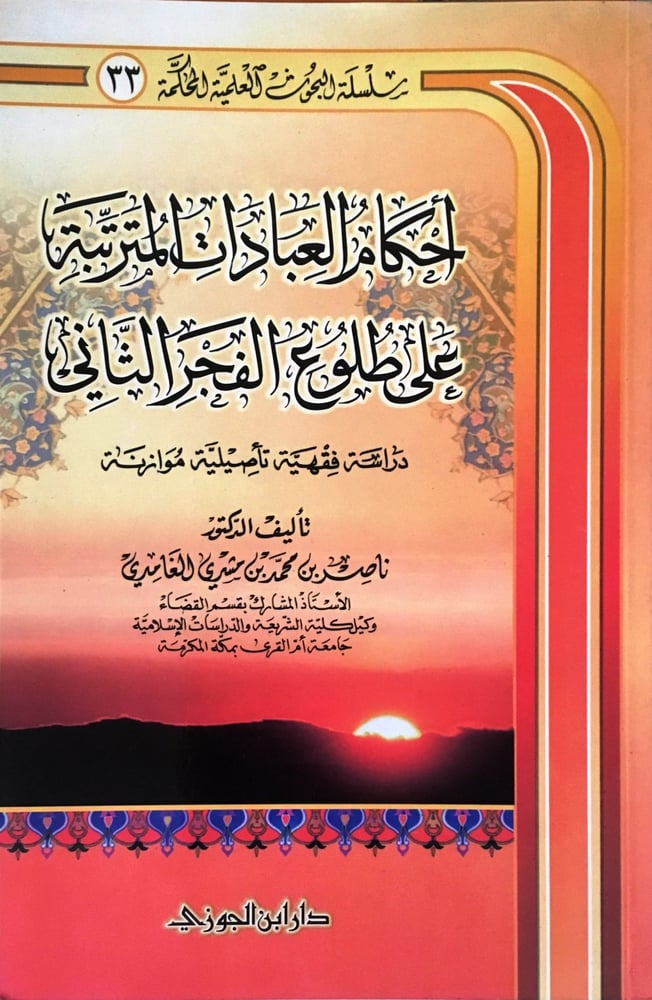
The rulings of worships resulting from the rising of the second dawn
12.65ر.س
Product description
Nasser Mohammed Al-Ghamdi
The rulings of worships resulting from the second dawn (Fajr) — a jurisprudential foundational study and comparison
Title of the book:
The rulings of worships resulting from the second dawn (Fajr) — a jurisprudential foundational study and comparison
Publisher:
Dar Ibn Al-Jawzi
Year of printing:
1429 AH
Type of the book:
Private author
Introduction to the subject of the book:
Indeed, Allah the Almighty linked many acts of worship to specific known times, with defined beginnings and ends, and prescribed a set of rulings on them. He commanded Muslims to perform acts of worship within these times. Therefore, it is not permissible to perform a timed act of worship before its time enters, nor to deliberately perform it outside its designated time. Since the second dawn (Fajr) (the true dawn) has rulings related to acts of worship, Nasser Al-Ghamdi gathered these rulings in a message entitled "The rulings of worships resulting from the second dawn." It was structured with an introduction, five sections, and a conclusion.
Before explaining the Islamic rulings related to the true dawn, it was necessary to define dawn and distinguish between its two types — the false and the true — by mentioning the characteristics of each. He concluded that most of the calendars used for the Fajr prayer are not based on field studies, and there are discrepancies indicating this, as evidenced by the significant variation among these calendars.
He then moved on to discuss the rulings of prayer related to the second dawn, including the first time for the Fajr prayer, the latest permissible time for the Isha prayer, the time for the Sunnah of Fajr, the beginning of the prohibition of voluntary prayers, and the end of divine descent to the lowest heaven.
It is also known that fasting begins at dawn, so he discussed the first time for the fasting person to abstain, the ruling if one doubts the arrival of dawn, the purification of women from menstruation and postpartum bleeding before dawn, what is obligatory for those who engage in intimacy during Ramadan at dawn, delaying Ghusl (ritual purification) until after dawn, intending the niyyah (intention) before dawn, and delaying Suhoor (pre-dawn meal) until just before dawn.
Some rites of Hajj are also related to dawn, so the author mentioned the start and end times for standing at Arafat, the beginning of the departure from Muzdalifah, the time for standing there for those required to stay overnight, the start time for stoning the Jamaraat on Eid al-Adha, and the first time for Tawaf al-Ifadah.
The book concludes with various issues related to the true dawn, such as washing for Friday and Eid prayers, the beginning of the obligation of Zakat al-Fitr, and the start of the time for slaughtering the sacrifice, reviewing the opinions of scholars and their evidence, along with indicating the most likely opinion.
Finally, the conclusion presents the most important findings of the research.
Although this message is brief, it encompasses the most important issues related to the true dawn. May Allah reward the author well.

From Dammam