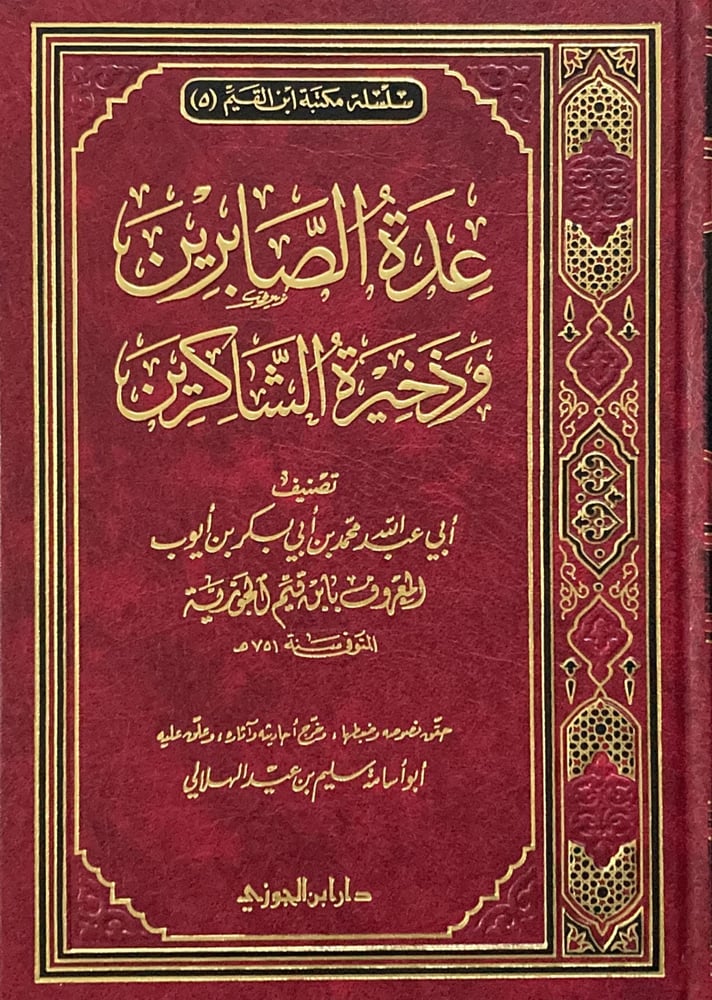



The equipment of the patient and the provision of the grateful, by Ibn al-Qayyim
40.25ر.س
Product description
The son of Al-Qayyim commented on it and produced its hadiths, Salim bin Eid Al-Hilali.
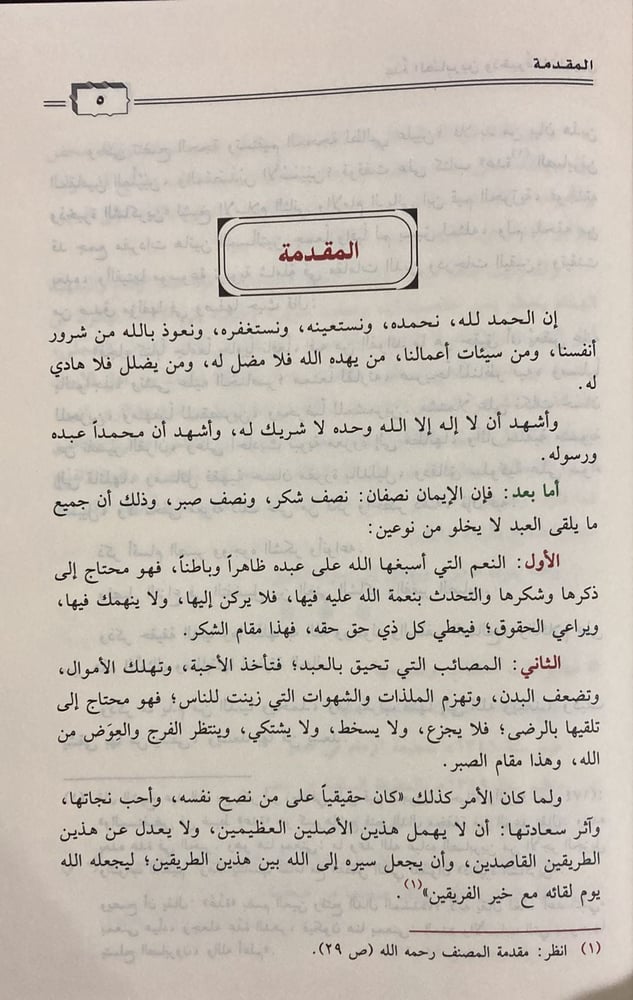
Introduction
All praise be to Allah, we praise Him, seek His help, and ask for His forgiveness. We seek refuge in Allah from the evil of ourselves and from the bad deeds. Whoever Allah guides, there is no misleader for him, and whoever He misguides, there is no guide for him.
I bear witness that there is no deity but Allah alone, with no partner, and I bear witness that Muhammad is His servant and Messenger.
As for what follows:
Indeed, faith is two halves: half thanks and half patience. The thing that the servant encounters is never free from two types:
First: The blessings that Allah has bestowed upon His servant outwardly and inwardly. He needs to remember them, thank Allah for them, and speak of Allah’s blessing upon him in them. So he does not rely on them, nor indulge in them, and he observes rights—giving each his due. This is the station of thanks.
Second: The calamities that surround the servant; they take loved ones, destroy wealth, weaken the body, and diminish pleasures and desires that are beautified for people. So he needs to accept them with contentment; he does not panic, become angry, complain, but waits for relief and recompense from Allah. This is the station of patience.
And since the matter is as such, it is appropriate for those who advise themselves, love their salvation, and prefer their happiness, not to neglect these two great principles, nor to deviate from these two direct paths, and to make their journey to Allah between these two paths; so that Allah makes their meeting on the Day of Judgment among the best of groups.
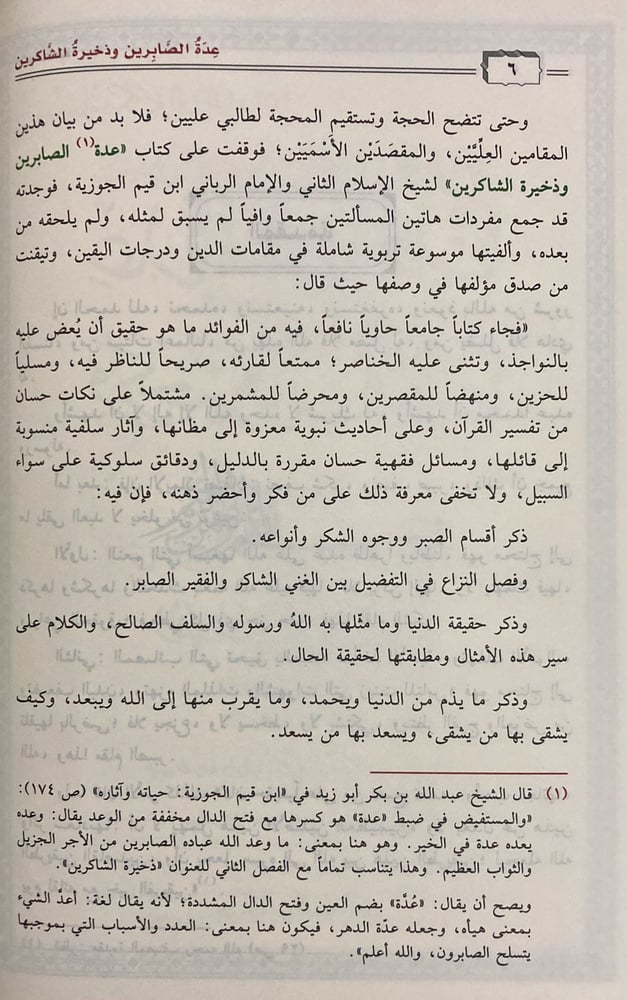
And to clarify the argument and straighten the path for those seeking the highest; it is necessary to understand the two lofty stations and the two highest goals.
I came across the book "The Preparedness of the Patient and the Treasure of the Thankful" by Sheikh Islam the Second and the righteous Imam Ibn Qayyim Al-Jawziyya. I found that he gathered the elements of these two issues comprehensively, in a way that has not been preceded or followed.
I found it to be a comprehensive educational encyclopedia on the stations of religion, the degrees of certainty, and the certainty of the author’s description, where he said:
It is a comprehensive, beneficial book containing benefits that are truly worth holding onto tightly, praising it, and enjoying it. It is straightforward for the observer, entertaining for the sad, motivating for the negligent, and inspiring for the eager. It includes beautiful insights from interpreting the Qur'an, prophetic hadiths attributed to their sources, Salafi آثار (sayings or actions) attributed to their speakers, and well-established jurisprudential issues with evidence, as well as behavioral subtleties on the straight path.
It is not hidden from those who think and remember the sections of patience, the faces of thanks, their types, and their kinds.
It also discusses the dispute over the preference between the grateful rich and the patient poor, and mentions the reality of the world, how Allah and His Messenger and the righteous predecessors have depicted it, and how these examples match the reality, mentioning what is condemned in the world, what is praised, what brings closer to Allah, what distances, and how those who suffer from it are miserable, and those who are happy with it are happy.
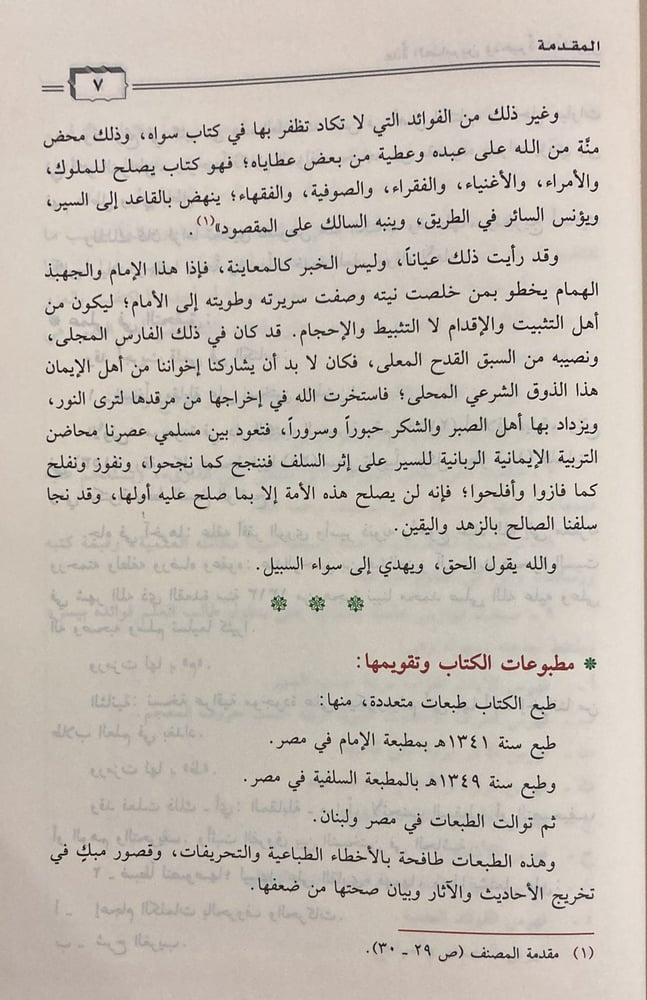
And other benefits that you hardly find in any other book. This is purely Allah’s gift to His servant and a blessing from some of His blessings.
It is a book suitable for kings, princes, the wealthy, the poor, Sufis, and jurists. It encourages the resting believer to walk, comforts the traveler on the path, and alerts the wayfarer to the goal.
I have seen this firsthand, and indeed, the news is not like witnessing.
So, this imam and distinguished scholar steps forward with those whose intentions are pure, and whose inner states and secrets are sincere, to be among the steadfast and brave, not among the hesitant and retreating.
He was a shining knight, and his share of precedence was high.
It was necessary for our brothers among the believers to share this authentic spiritual taste.
I sought Allah’s guidance to bring it out of its resting place to see the light, and to increase the joy and happiness of the people of patience and thanks.
So it returns among our Muslim contemporaries as a nurturing environment of divine faith, following the footsteps of the predecessors, and succeeding as they succeeded, winning and prospering as they won and prospered.
Indeed, this nation will not be rectified except by what its first generation was rectified upon.
Our righteous predecessors succeeded through asceticism and certainty.
Allah speaks the truth and guides to the straight path.
Regarding the printing and editing of the book:
The book has been printed in multiple editions, including:
- Printed in 1341 AH at Imam’s Printing House in Egypt.
- Printed in 1349 AH at the Salafi Printing House in Egypt.
Subsequent editions followed in Egypt and Lebanon.
Many of these editions contain errors in the original text, with interwoven phrases in most places, and misdirection in the author’s speech that takes it away from its intended meaning, leading to false understanding and incorrect opinions.
Therefore, it was necessary to verify the texts of this book, correct them, authenticate its hadiths and آثار, and clarify their grades of authenticity or weakness, serving knowledge and fulfilling the rights of its people.
My work in verification:
I used my pen on the book:
1 - Copying and comparing two handwritten copies:
The first is in the Dar Al-Kutub in Egypt, No. 2159, titled "Religious Morals," consisting of 153 pages, each page about 25 lines, each line about 10 words, written in clear Naskh script.
At the end, it contains a note: "The poorest of the people, the most sinful, and the most in need of Allah’s forgiveness, mercy, kindness, satisfaction, and pardon."
By Abdulrahman bin Abdulaziz Al-Awaid, on Saturday morning in the month of Dhul Qi'dah, year 1313 AH, from the Hijri calendar, from the Prophet Muhammad, peace be upon him, and his family and companions.
Marked as "M".
The second copy is an Iraqi microfilm brought by one of our brothers from Baghdad.
Marked as "Z".
I repeated this process—comparing—to avoid omissions, misprints, errors, or distortions.
Differences between the two copies are noted in the margin.
2 - To clarify the texts for easy understanding:
- Including diacritics and vowels for difficult words.
- Explaining unfamiliar terms.
- Dividing the book into paragraphs according to the meaning, observing punctuation.
3 - Referencing the verses to their sources in the Book of Allah, mentioning their number and surah, and placing this beside them, ensuring they are in the Uthmani script.
4 - Extracting the hadiths in the book and indicating their grades according to the rules of hadith science, relying on the statements of scholars well-versed in this field, both past and present. If the hadith is in the two Sahihs or one of them, I relied on that; as it indicates authenticity unless there is evidence to the contrary.
Some scholars have slight variations.
5 - Extracting آثار and poetry in the book to the extent possible and within capacity.
6 - Translating the mentioned scholars in the book, may Allah have mercy on them.
7 - Adding notes to some places that may confuse the reader or are difficult to understand, or contain remarks on the author.
8 - Providing an intermediate biography of the author, clarifying his scholarly status, the value of his books and messages, and his impact on Islamic sciences.
9 - Creating analytical scientific indexes to facilitate the student of knowledge in benefiting from its contents and easily finding what they need, including:
- Index of Qur'anic verses arranged by surahs.
- Index of the ends of prophetic hadiths arranged alphabetically.
- Index of آثار arranged by narrators.
- Index of narrators and biographical entries.
- Index of places, countries, and regions.
- Index of poetry.
- Index of sects, groups, and tribes.
- Index of scientific benefits.
- Index of sources and references.

From Dammam