
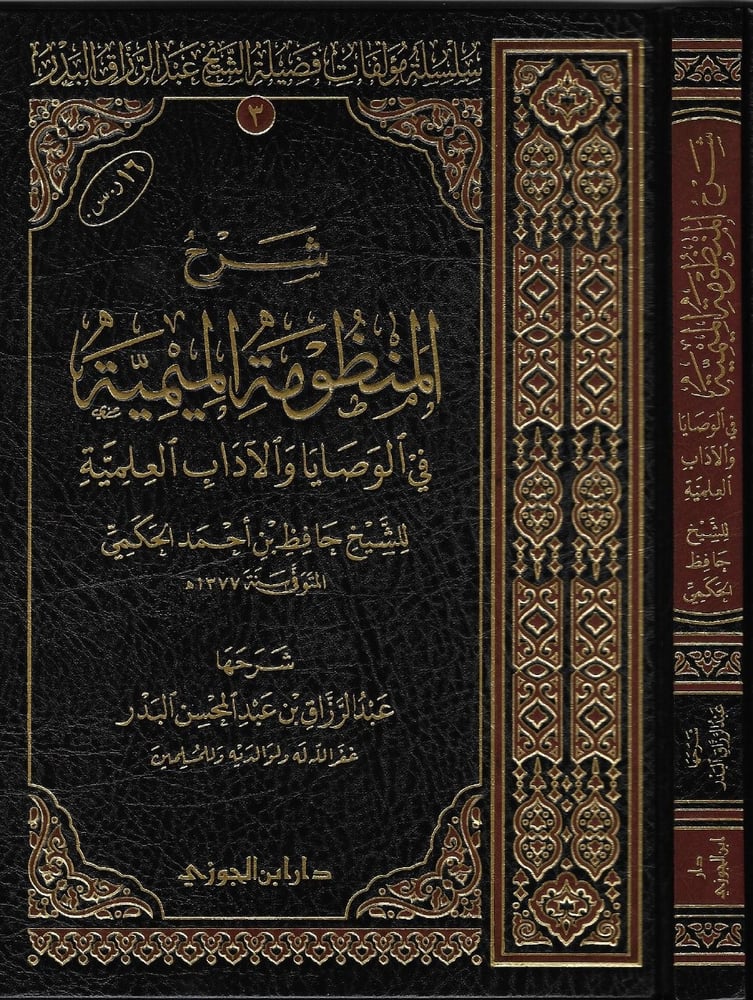

Explanation of the Mīmī system in advice and scientific manners (Saafi)
18.40ر.س
Product description
The explanation of Sheikh Hafez Al-Hakami by Abdul Razzaq Al-Badr
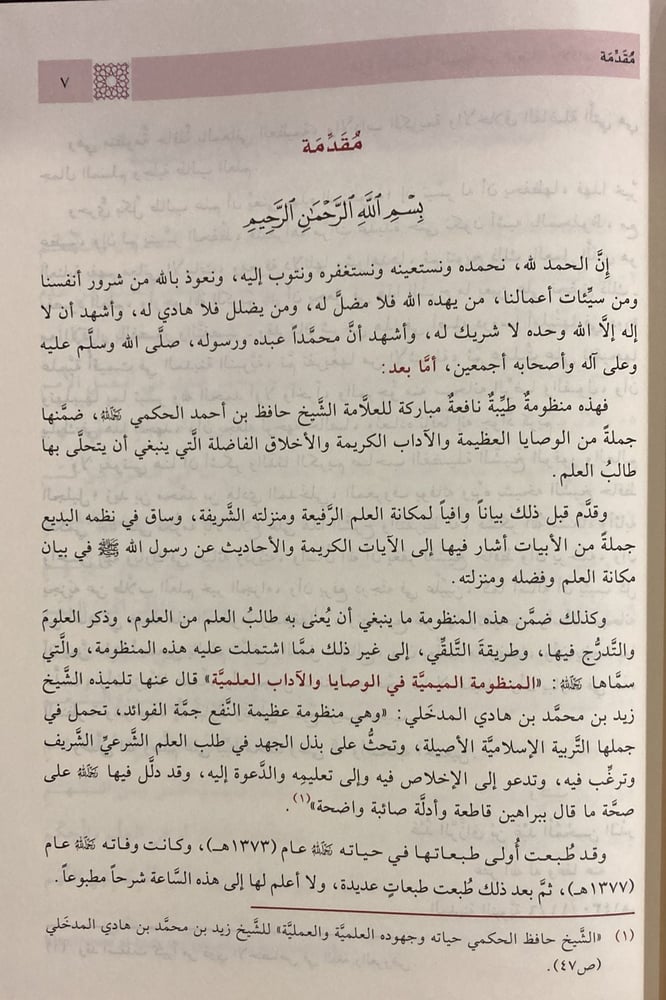
Introduction
In the name of Allah, the Most Merciful, the Most Compassionate
All praise be to Allah, we praise Him, seek His help, ask for His forgiveness, and repent to Him. We seek refuge in Allah from the evil of ourselves and from our bad deeds. Whomever Allah guides, there is none to misguide him, and whomever He misguides, there is none to guide him. I bear witness that there is no deity but Allah alone, with no partner, and I bear witness that Muhammad is His servant and Messenger. May Allah's peace and blessings be upon him, his family, and all his companions.
As for what follows:
This is a good, beneficial, blessed poem by the scholar Sheikh Hafez bin Ahmed Al-Hakami, in which he included a number of great advice, noble manners, and virtuous morals that a student of knowledge should embody.
Previously, he provided a comprehensive explanation of the high status and noble rank of knowledge. In his beautiful poetry, he pointed to the noble verses and the sayings of the Messenger of Allah, peace be upon him, illustrating the importance, virtue, and rank of knowledge.
He also included in this poem what a student of knowledge should care about regarding sciences, mentioning the sciences and the gradual learning of them, the method of receiving knowledge, and other matters contained within this poem, which he called: "The Meem Poetry in Advice and Scientific Manners."
His student, Sheikh Zaid bin Muhammad bin Hadi Al-Madkhali, said about it: "It is a great poem of immense benefit, full of benefits, carrying in its entirety authentic Islamic upbringing, urging the effort in seeking noble Islamic knowledge, encouraging sincerity in it, and calling to teach and invite to it. He demonstrated its correctness with conclusive proofs and clear, sound evidence."
It was first printed during his lifetime in the year 1373 AH. He passed away in the year 1377 AH. Since then, it has been printed many times. I do not know of any printed explanation of it to this day.
It is a poem full of great meanings, noble manners, and virtuous morals, which are the beauty of the Muslim and the adornment of the student of knowledge. Every student of knowledge should pay attention to this poem; if he can memorize it, that is a great good. If memorization is not possible, then he should read it many times until it becomes almost memorized, with understanding of the meanings of the verses, knowing their evidences and supporting proofs. Then, this should be crowned with action, which is the purpose of knowledge. I pray to Allah, the Generous, to make this explanation helpful in achieving that.
Acknowledging my shortcomings and deficiencies — this explanation was originally a series of lessons I recited during an Islamic course held in Madinah. It was transcribed from recordings, then I worked on editing and refining it as much as possible, praise be to Allah, first and last. I hope that Allah is pleased and accepts it, blesses this effort, and makes it sincere for His face and beneficial for His servants. Indeed, He is the Generous, the Noble.
I cannot overlook here thanking our generous father, the esteemed scholar and noble Sheikh Zaid bin Muhammad bin Hadi Al-Madkhali, known for his loyalty and piety towards his teacher, Sheikh Hafez Al-Hakami, may Allah have mercy on him. For his generosity in reviewing this explanation and praising it. May Allah reward him, forgive him, and bless his life and offspring. I ask Allah to forgive Sheikh Hafez, have mercy on him, and reward him greatly on behalf of the students of knowledge. May He elevate his rank among the righteous in the highest Paradise.
I also ask Allah to reward everyone who helped in memorizing, editing, clarifying, and refining this poem, and correcting its explanation. I ask Allah to grant us all beneficial knowledge and righteous deeds, to teach us what benefits us, to benefit us with what we have learned, to increase us in knowledge, and to make what we learn a proof for us, not against us. May Allah bless this poem and its explanation. Indeed, He is the All-Hearing, Near, and Answerer.
May Allah's peace and blessings be upon our Prophet Muhammad, his family, and all his companions.
Abdul Razzaq bin Abdul Muhsin Al-Badr
May Allah forgive him and pardon him
Madinah Al-Munawwarah, 1430/11/6 AH

From Dammam