


When is the start of throwing the Jamarat during the days of Tashreeq
19.55ر.س
Product description
Authored by Yasser Mohammed Fathi Al Eid
Introduction by the Virtuous Sheikh Abdullah bin Abdul Rahman Al Saad
**Introduction by the Virtuous Sheikh Abdullah bin Abdul Rahman Al Saad**
All praise be to Allah, we praise Him, seek His help, and ask for His forgiveness. We seek refuge in Allah from the evil of ourselves and from the bad deeds. Whomever Allah guides, there is no misleader for him, and whomever He misguides, there is no guide for him. I bear witness that there is no deity but Allah alone, with no partner, and I bear witness that Muhammad is His servant and Messenger. May Allah send blessings upon him, his family, and all his companions.
As for what follows:
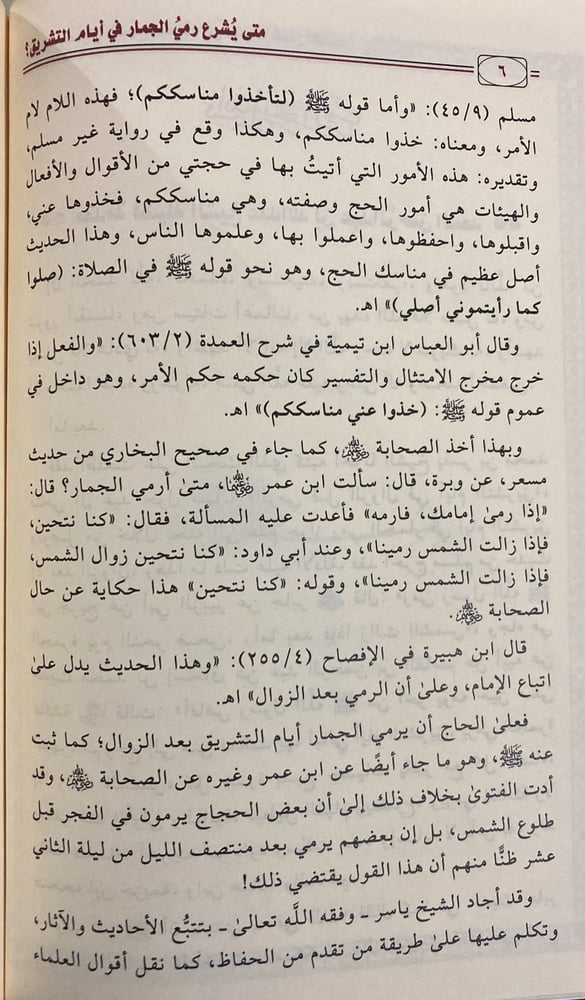
I have reviewed the research written by our brother Sheikh Yasser bin Mohammed Fathi Al Eid regarding the issue of throwing stones before noon on the days of Tashreeq. Through his research, he concluded that it is not permissible to throw the Jamarat on the days of Tashreeq except after noon. This is what the evidence indicates.
Muslim narrated from the hadith of Ibn Jurayj from Abu Az-Zubayr from Jabir, Allah be pleased with him, who said: "The Messenger of Allah, peace be upon him, threw the pebbles at the Nahr (sacrificial animal) at midday, but after that, when the sun has passed its zenith."
In another hadith, Muhammad ibn Ishaq narrated from Abdul Rahman ibn Al-Qasim from his father, Aisha, who said: "The Messenger of Allah, peace be upon him, performed the farewell pilgrimage on the last day after praying Dhuhr, then he returned to Mina and stayed there during the nights of Tashreeq. He would throw the Jamarat when the sun had passed its zenith, each Jamarah with seven pebbles, saying 'Allahu Akbar' with each pebble. He would pause at the first and second Jamarat, prolonging standing and supplication, and then throw the third without stopping there."
This was narrated by Abu Dawood, who remained silent about its chain, but its chain is sound. It has been authenticated by Ibn Khuzaymah, Ibn Hibban, and Al-Hakim.
He commanded us to follow his example in this matter, as in the previous narration of Jabir with the chain mentioned, to take our rites from him.

From Dammam