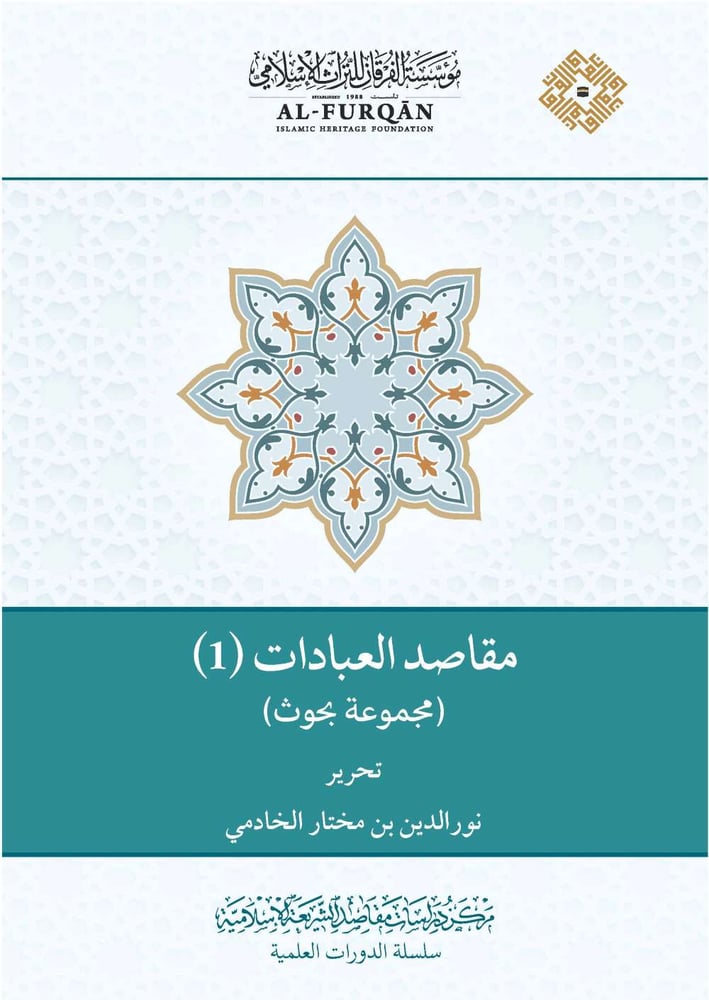
Purposes of Acts of Worship (a collection of research)
46ر.س
Out of Stock
Product description
Objectives of Worships (A Collection of Research)
Al-Furqan Foundation for Islamic Heritage
Objectives of Worships
Nur al-Din bin Mukhtar al-Khadimi
Product code (SKU) 101250
Date: 2025
Language: Arabic
Deposit number: 9781788149204
Cover type: Hardcover
Number of pages: 810
Content
This book includes the outcomes of the scientific course on maqasid (objectives) of Islamic law, titled: "Objectives of Worships," in its first edition, organized by the Center for the Study of Maqasid al-Shariah (London), in cooperation with the Center for Maqasid Studies and Research (Rabat), and in partnership with the Laboratory of Thought and Society Studies at the Faculty of Arts and Humanities at Shouib Dekkali University in El Jadida city. The event took place on Wednesday and Thursday, October 30 and 31, 2024, at the Faculty of Arts and Humanities in El Jadida, with a significant scholarly presence, represented by a group of scholars, a distinguished group of professors, and a large number of students and researchers.
The main goal of the course was to call for "Reviving the sciences of religion," so that their joy and effectiveness are restored through "tawqeed" (linking), i.e., connecting Islamic jurisprudence with the maqasid (objectives) of Shariah and its higher goals in all aspects (teaching, authorship, ijtihad, application); thus, the maqasid become the guiding principle and the true compass in all its issues and matters.
This approach aims to transform fiqh from mere preserved heritage into a "living fiqh," accompanying Muslims daily and serving as a constant advisor in all their affairs, keeping pace with their daily lives. In other words, reviving the maqasid of texts within the souls, with a maqasidic vision, authentic Shariah, a renewal perspective, and a functional, operational outlook.
The course also addressed the maqasid of worships — such as prayer, fasting, pilgrimage, expiations, etc. — in terms of ethics, education, psychology, society, urban development, and values, emphasizing the balance between obligations and concessions in Shariah. It clarified how facilitation in worship is achieved and how to deal with emergency cases through legal concessions, reflecting the maqasid of Shariah in considering reality and customs, and easing hardships for the accountable.
The course highlighted the importance of moderation in worships as a Shariah objective and a devotional methodology that balances the demands of body and soul, avoiding extremism and laxity.
In the field of social worships, the course analyzed the maqasid of Hajj in particular, where the Farewell Pilgrimage reflects the unity of the nation, justice, equality among Muslims, and strengthens social solidarity. It also discussed contemporary worship organization, with a focus on Umrah, and unifying worship with its maqasid, contributing to activating the behavioral and educational effects of Muslims in their daily lives.
The course emphasized the importance of linking the maqasid of Shariah with the practical reality of the accountable, institutionalizing and guiding worship to enhance its impact on individuals and communities, thereby increasing the effectiveness of worship and achieving balance between spirituality and practical life.

From Dammam