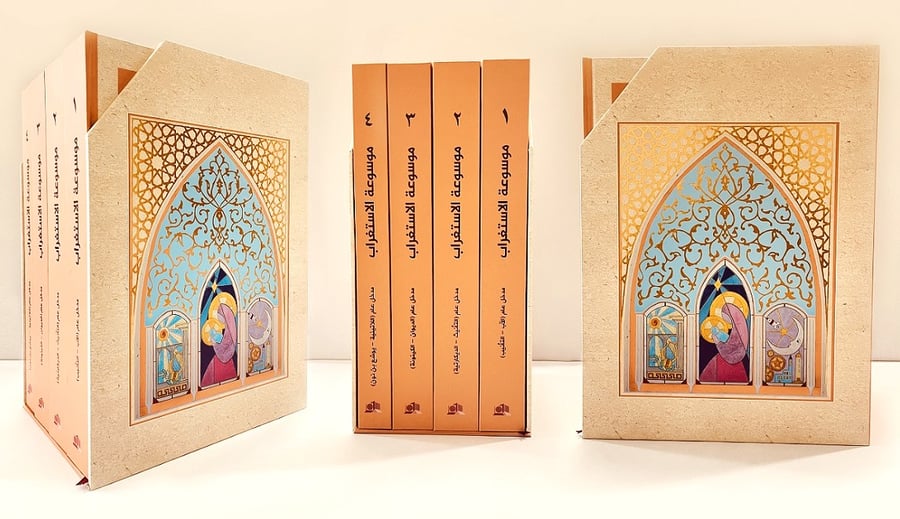
Encyclopedia of amazement 1-4
600ر.س
Out of Stock
Product description
Encyclopedia of Westernization 1-4 Qatar University announced Qatar University Publishing House and College of Sharia and Islamic Studies at the university about the issuance of "Encyclopedia of Westernization" which was accomplished efficiently and competently by the ISESCO Chair for the Alliance of Civilizations stemming from the college in cooperation and support of both the Islamic World Educational, Scientific and Cultural Organization (ISESCO) University Union of the Islamic World for Education, Science and Culture, and the Qatar Committee for the Alliance of Civilizations at the Ministry of Foreign Affairs. This edition is represented in the first part of the encyclopedia, which is the first encyclopedia in the Arab world that monitors the West with all its cognitive, scientific, religious, and social manifestations, and with its terminology, and its civilizational, historical, ethnic, and political terms. Although what the publishing house puts today in the hands of readers is only a general introduction in four parts of large size, totaling about twenty parts, planned to be the complete set of the encyclopedia, with the rest gradually pouring out like an emerald adorns the necklace of knowledge and science in the shadow of their paper and digital revolutions, this section provides a sufficient picture of what the encyclopedia will be like, surpassing its counterparts in form and content, with its unique topics, methodology, style of editing, and extensive sources of reputable scientific references.
This introduction was contributed to by a wide spectrum of researchers and specialists in studying the West intellectually, scientifically, philosophically, psychologically, religiously, politically, and socially, reaching seventy-seven researchers from various fields and nationalities. They exerted their efforts to monitor the West, skillfully surpassing the lexical classification expert to delve into its structural and sociological components, and foresaw its strategies based on its geopolitical heritage, collective mind, and human position.
Such an effort, originating from the land of prophecies and civilizations, deserves minds and experiences refined by science, practice, and exposure to both the West and the East, to radiate from the capital of Islamic culture and dialogue of civilizations, Doha Qatar, whose branches extend to spread tolerance, moderation, and the light of knowledge and science across the world.
In his statement about the encyclopedia, Dr. Hassan bin Rashid Al-Derham, President of the university, praised the synergy and fruitful cooperation between the College of Sharia and Islamic Studies, Qatar University Publishing House, and a prestigious international Islamic organization like ISESCO, and its chair at the university, which was responsible for this massive encyclopedia, and the Ministry of Foreign Affairs of Qatar, which provided logistical support, gratefully, for the project until it saw the light in this wonderful form of a global scientific encyclopedia that monitors the West for the first time, forming a cornerstone in lexical, scientific, and academic knowledge that Qatar University considers one of its proud achievements, and an important accomplishment that we prioritize for its role in supporting and advancing scientific research in Qatar and the world.
For her part, Professor Meryem Al-Muaidid, Vice President of the university for Research and Graduate Studies, highlighted the strenuous efforts made by distinguished researchers from around the world, especially university professors from the College of Sharia and Islamic Studies and the ISESCO Chair, praising highly the efforts of Qatar University Publishing House team in publishing and editing this important scientific encyclopedia in the world of research and various studies that serve diverse knowledge, scientific, and academic fields.
Dr. Ibrahim Al-Ansari, Dean of the College of Sharia and Islamic Studies and General Supervisor of the encyclopedia, pointed out that this achievement is the fruit of effective planning and implementation characterized by wisdom in utilizing available resources despite limited capabilities, considering the size and diversity of its topics. The College of Sharia and Islamic Studies at Qatar University initiated it to achieve strategic goals by including encyclopedias and dictionaries in its research plan, and now the results of joint efforts, supported by national and international institutions, have come to light.
Dr. Ezzedine Maamish, Executive Director and Editor-in-Chief of the Encyclopedia of Westernization, added that the issuance of the first section of the Encyclopedia of Westernization in four parts is a distinguished event in the history of civilizational intercultural dialogue and the foundation for building integrated interdisciplinary knowledge and sciences in the path of civilizational dialogue. It is one of the pillars of excellence characteristic of Qatar and its academic institutions.
In his comment on this massive event, Dr. Talal bin Abdullah Al-Amadi, founding director of Qatar University Publishing House, said: "As Qatar University Publishing House places this rare encyclopedia in the hands of scholars, researchers, and decision-makers in the Arab and Islamic world, and indeed the entire world, in partnership with a reputable specialized scientific entity represented by the ISESCO Chair at the College of Sharia at Qatar University, it affirms Qatar’s firm footing in activating the alliance and dialogue of civilizations, which this encyclopedia translates as an intellectual cornerstone based on objective scientific foundations for studying the other and understanding what promotes humanity’s advancement toward a better tomorrow."
It is worth noting that the publishing house, in its pursuit of opening horizons for cooperation with visual artists, enlisted the artist Wadha Al-Adhba, who reflected through her work the manual work of the encyclopedia cover, blending Islamic and Western connotations. She drew the Islamic window decorated with floral and geometric motifs, and incorporated stained glass windows with drawings inspired by Western glasswork, thus representing the Islamic world overlooking the West and its historical transformations, with each window representing a specific historical era: the left window reflects the era of ancient Rome, the middle window represents the Christian era, and finally, the right window symbolizes the Renaissance and theories of liberation.

From Dammam