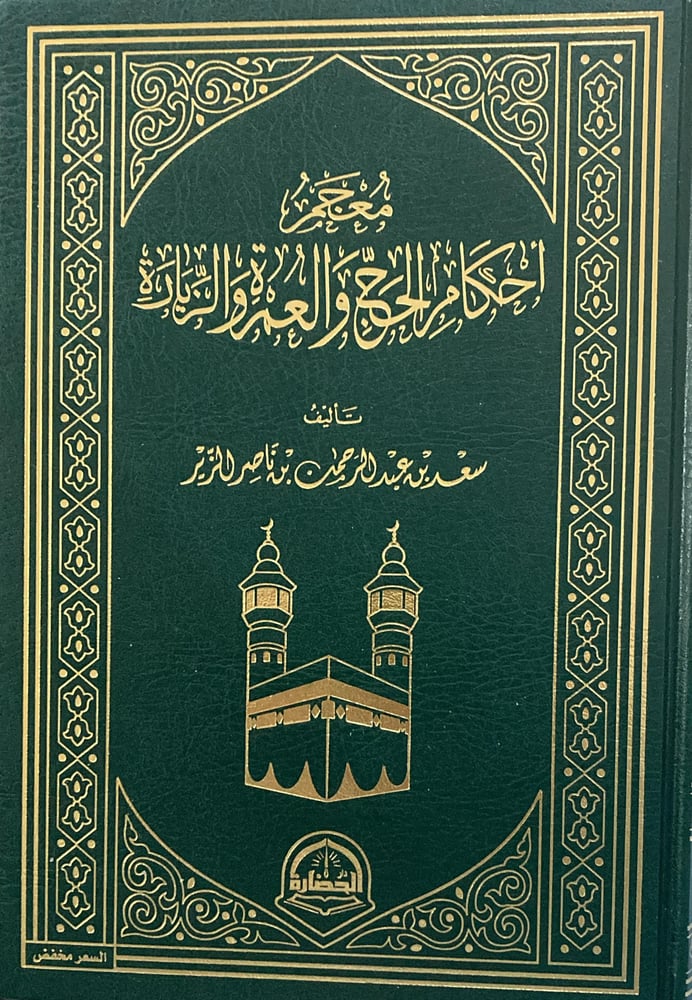

Dictionary of the rulings of Hajj and Umrah
46ر.س
Out of Stock
Product description
Sadd bin Abdul Rahman bin Nasser Al-Zeir
Introduction
All praise be to Allah, we praise Him, seek His help, and ask for His forgiveness. We seek refuge in Allah from the evil of ourselves and from the bad consequences of our deeds. Whom Allah guides, none can misguide; and whom He misguides, none can guide. I bear witness that there is no deity but Allah alone, with no partner, and I bear witness that Muhammad is His servant and Messenger. May Allah send blessings and peace upon him, his family, and his companions, and grant them abundant peace.
To proceed:
Indeed, the pilgrimage to the House of Allah, the Most Holy, is one of the five pillars of Islam, established by the Messenger, peace be upon him, through his words and actions, and transmitted through the narration and understanding of Muslim scholars from the Companions, the Followers, and those after them, the Salaf.
Pilgrimage has been the subject of many writings, ranging from detailed to concise. They are divided into two sections: one that comprehensively covers pilgrimage and Umrah without other topics, and another that addresses a chapter of pilgrimage, a pillar from its pillars, or a matter from its issues—either in a book, a research paper published in a magazine, or otherwise. The agreed-upon pillars of pilgrimage—Ihram, standing at Arafat, and Tawaf—have their share of this, as do some obligatory acts. Moreover, some well-known issues of pilgrimage have a significant share in writing and authorship, such as the issue of stoning the Jamarat before noon and the issue of the first Halq (shaving or trimming hair). Even more detailed issues have been written about, such as the issue of wearing the Ihram watch, which Dr. Al-Sunaydi mentioned in his dictionary (page 315) in a message titled "The Last Hour in the Ruling of Wearing the Ihram Watch," authored by Zakaria Abdullah Bila Al-Makki, consisting of 28 pages. He also mentioned another message (page 134) titled "Avoiding placing the hand on the chest during Tawaf," authored by Ali bin Sultan Al-Qari Al-Harawi, which is two pages long and still in manuscript form.
Because of the extensive writings on pilgrimage, Dr. Abdulaziz bin Rashid Al-Sunaydi compiled a book called "Dictionary of What Has Been Written About Pilgrimage," published by the King Abdulaziz Foundation, consisting of 415 pages, including its introduction and index. I have not found a book that gathers or summarizes these issues or most of them, so I compiled them into a comprehensive book to facilitate the researcher and to make it easier for the seeker of benefit. It aims to mention the issue, clarify the most correct opinion and its evidence—if available—and indicate the differences by presenting other opinions and their proponents without lengthy elaboration or omission. Therefore, I was inclined to this effort, as a contribution to spreading knowledge, which should be the focus of efforts and the race of those seeking reward and reward.
It is important to note the precision of the issues of rites, which do not share this characteristic with other chapters of jurisprudence. Sheikh Al-Islam described this when praising Abu Bakr Al-Siddiq, may Allah be pleased with him, saying: "He was appointed by the Prophet, peace be upon him, to lead the first Hajj performed from the city of the Prophet, peace be upon him."

Questions you might have