
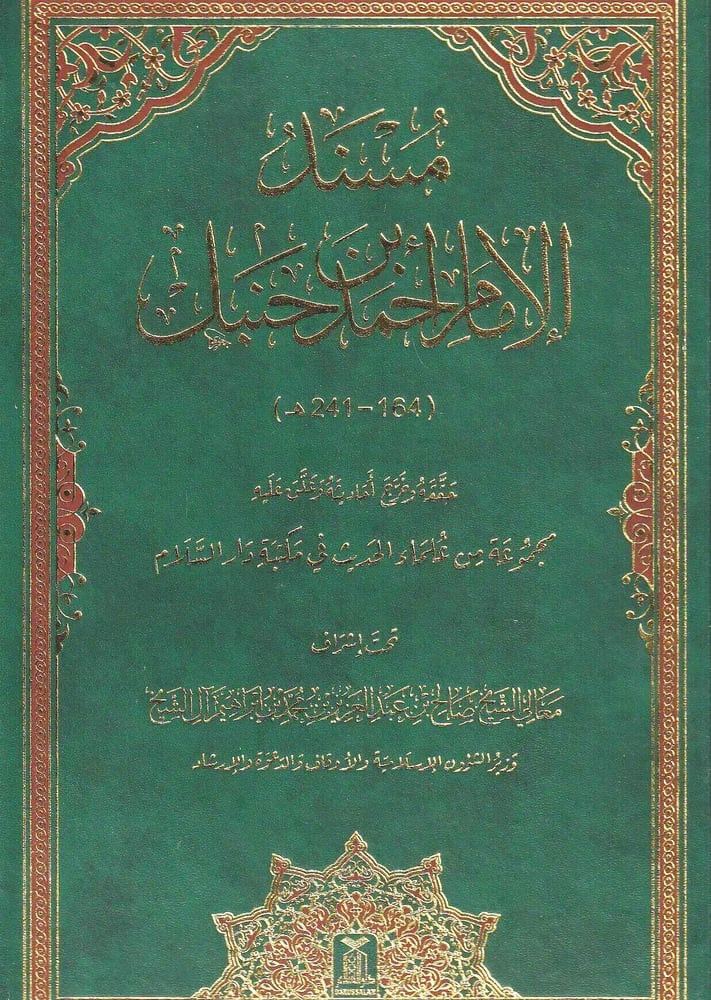
Musnad of Imam Ahmad ibn Hanbal
322ر.س
Product description
Under the supervision of His Excellency Sheikh Saleh bin Abdulaziz bin Muhammad bin Ibrahim Al Sheikh,
The Musnad of Imam Ahmad bin Hanbal, known as Al-Musnad, is one of the most famous and extensive books of Hadith Prophet, which holds a high status among Ahl al-Sunnah; it is considered one of the primary sources of Hadith for them. It is the most well-known Musnad, placed by the hadith scholars in the third rank after the two Sahihs and the four Sunan. It is attributed to Imam Abu Abdullah Ahmad bin Muhammad bin Hanbal Al-Shaybani Al-Dhuhli (164 AH – 241 AH / 780 – 855 AD).
According to estimations by hadith scholars, it contains approximately 40,000 Hadiths, including about 10,000 repeats, arranged by the names of the Companions who narrated the Hadiths. He organized it so that the narrations of each Companion are in one place. The number of Companions with Musnad is 904. The book is divided into eighteen Musnad sections, the first being the Musnad of the ten who were promised Paradise, and the last being the Musnad of Women. It contains many authentic Hadiths not found in the two Sahihs.
Ibn Hanbal disliked categorization because he believed that Muslims should not be preoccupied with anything other than the Quran and Sunnah. However, he preferred to write down Hadith. Ibn Hanbal selected the Hadiths of the Musnad from what he heard from his teachers to serve as evidence for people to refer to. He said about his Musnad in the introduction: "I made this book, an Imam, so that when people differ about the Sunnah of Messenger of Allah ﷺ, they return to it."
Scholars have differed regarding the authenticity of the Hadiths in the Musnad. Some, like Abu Musa Al-Madani, are certain that all in it are proof. Others, like Ibn al-Jawzi, Al-Hafiz Al-Iraqi, and Ibn Kathir, mentioned that it contains authentic, weak, and fabricated Hadiths. Some, like Ibn Taimiya, Al-Dhahabi, Ibn Hajar Al-Asqalani, and Jala al-Din Al-Suyuti, stated that it contains authentic and weak Hadiths close to Hasan, and that it does not include fabricated Hadiths. His son, Abdullah bin Hanbal, added extra narrations not from his father’s narration, known as Zawa’id Abdullah. Also, Abu Bakr Al-Qutay’i added narrations from what he heard from Abdullah about his father, which are additional to the original.
Ibn Hanbal finished compiling the Musnad around 227 or 228 AH. Al-Dhahabi mentioned in Siyar A’lam al-Nubala’ that Abdullah bin Ahmad bin Hanbal heard the Musnad from his father during these two years.
Ibn Hanbal gathered a large amount of material from his teachers during his stay in Baghdad and his travels to the Levant, Yemen, and Hejaz, collecting over seven hundred thousand Hadiths, including mutawatir, mursal, maqtu’, and others.
He used to compile the Musnad on separate sheets and scattered parts, similar to a draft. Before his death, he began to have it read to his children and family. He died before editing and refining it, so it remained in its original state. His son, Abdullah, added similar material he heard, and included from his own listening, what resembled the original.
Al-Qutay’i heard the current copy from his writings. Many Hadiths remained on sheets and parts that were not yet compiled.

From Dammam
Questions you might have