
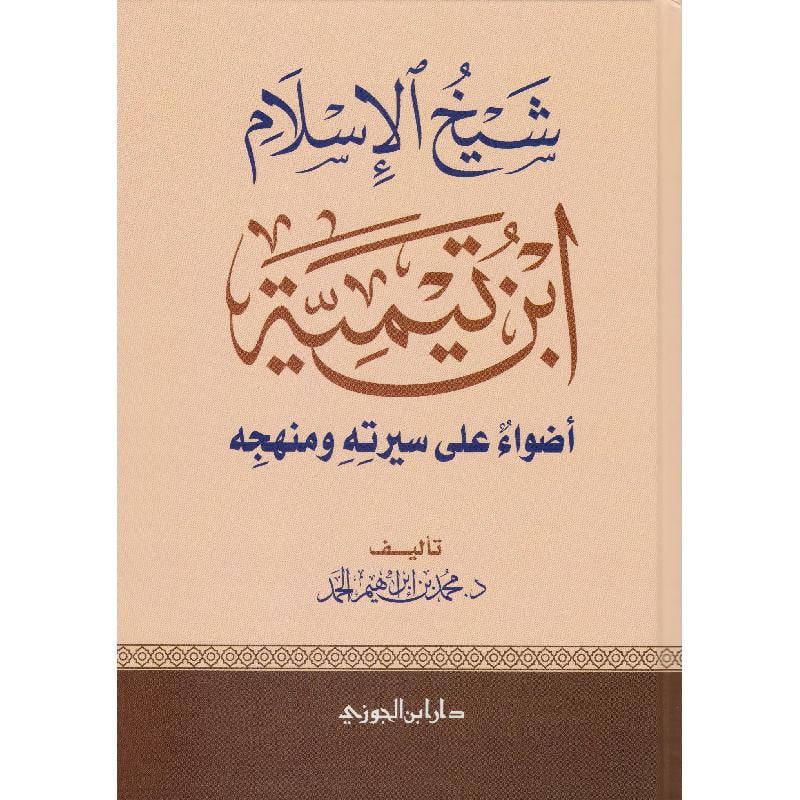

Sheikh Al-Islam Ibn Taymiyyah: Lights on his biography and methodology
20.70ر.س
Product description
Dr. Muhammad Ibrahim Al-Hamdaqi Al-Din Abu Al-Abbas Ahmad bin Abdul Halim bin Abdul Salam Al-Nuwayri Al-Harrani (661 AH - 728 AH / 1263 AD - 1328 AD) known as Ibn Taymiyyah. He was a jurist, hadith scholar, interpreter, and a knowledgeable Muslim Mujtahid from the scholars of Ahl al-Sunnah wal-Jama'ah. He was one of the most prominent Muslim scholars during the second half of the seventh century and the first third of the eighth century AH. Ibn Taymiyyah grew up Hanbali, taking jurisprudence and its roots from his father and grandfather, and he was among the Mujtahid Imams in the school, issuing fatwas on many issues contrary to the established Hanbali view when he saw that it was in accordance with the evidence from the Quran and Sunnah, then based on the opinions of the Companions and the traces of the Salaf. Ibn Taymiyyah was born in 661 AH corresponding to 1263 AD in the city of Harran to the Hanbali jurist Abdul Halim Ibn Taymiyyah and "Settin Al-Ni'am daughter of Abdul Rahman Al-Harrani," and he grew up in Harran. After reaching the age of seven, his family migrated from there to Damascus due to the Tatar invasion, which happened in 667 AH. Upon the family's arrival there, his father Abdul Halim Ibn Taymiyyah began teaching at the Umayyad Mosque and in "Dar Al-Hadith Al-Sukkariyah." During Ibn Taymiyyah's childhood in Damascus, he pursued knowledge, and historians mention that he learned from more than two hundred sheikhs in various sciences including interpretation, hadith, jurisprudence, and Arabic. He began authoring and teaching at the age of seventeen. After his father's death in 682 AH, he took his place in teaching at "Dar Al-Hadith Al-Sukkariyah," in addition to having a lesson for interpreting the Quran at the Umayyad Mosque and a lesson at the Hanbali School in Damascus. Ibn Taymiyyah faced imprisonment and detention several times; the first was in 693 AH / 1294 AD when he was briefly imprisoned by the deputy of the Sultan in Damascus on charges of inciting the public, because Ibn Taymiyyah confronted a Christian who had spoken ill of the Prophet Muhammad. In 705 AH / 1306 AD, he was imprisoned in Cairo with his brothers "Sharf al-Din Abdullah" and "Zain al-Din Abdul Rahman" for eighteen months until 707 AH / 1307 AD, due to issues related to the throne, speech, and descent. He was also imprisoned for a few days in the month of Shawwal in 707 AH / 1308 AD following a complaint from Sufis because he spoke against those who advocate the unity of existence, such as Ibn Arabi, Ibn Sab'in, Al-Qunawi, and Al-Hallaj. He was placed under surveillance in 709 AH / 1309 AD for eight months in Alexandria, and he was released after Sultan Al-Nasir Muhammad bin Qalawun regained power. In 720 AH / 1320 AD, he was imprisoned for about six months over the "issue of swearing by divorce." He was also imprisoned in 726 AH / 1326 until his death in 728 AH / 1328, due to the issue of "visiting graves and traveling to them." Additionally, he was harassed by theologians and rulers because of his creed, which he explicitly stated in the Fatwa Al-Humayriyah in 698 AH / 1299 AD and the Wasitiyyah Creed in 705 AH / 1306 AD, affirming the divine attributes mentioned in the Quran and Sunnah such as hand, face, eye, descent, al-istiwa, and al-‘ulā, while negating their modality. Ibn Taymiyyah lived through the Mongol invasions of Sham and played a role in confronting them. He met in 699 AH / 1299 AD with the Tatar Sultan "Mongke Gazan" after his arrival in Sham, and obtained a security document that delayed the Mongols' entry into Damascus for some time. In 700 AH / 1300 AD, when rumors spread that the Mongols intended to march into Sham, Ibn Taymiyyah worked to urge and motivate the Muslims in Damascus to fight them, and he also approached the Sultan in Egypt, urging him to come and fight as well. However, the Mongols retreated that year. In 702 AH / 1303 AD, Ibn Taymiyyah participated in the "Battle of Shakhhab," which ended with the Mamluks' victory over the Mongols. He worked to motivate Muslims to fight and approached the Sultan for a second time, urging him to fight, and the Sultan responded. At that time, it was believed that fighting the Mongols was obligatory because they appeared to be Muslims, so Ibn Taymiyyah issued a fatwa that it was necessary to fight them, as they were from the sect that refused to follow the Shariah of Islam. Ibn Taymiyyah also participated with the deputy of the Sultan in Damascus in 699 AH / 1299 AD, and in 704 AH / 1305 AD, and in 705 AH / 1305 AD, in fighting the people of "Kasrawan" and "Jard" from the Ismailis, Nusayris, Huwariyyah, and Nusayriyyah, and he mentioned in a letter to the Sultan that their reason was their cooperation with the armies of the Crusaders and Mongols.

From Dammam