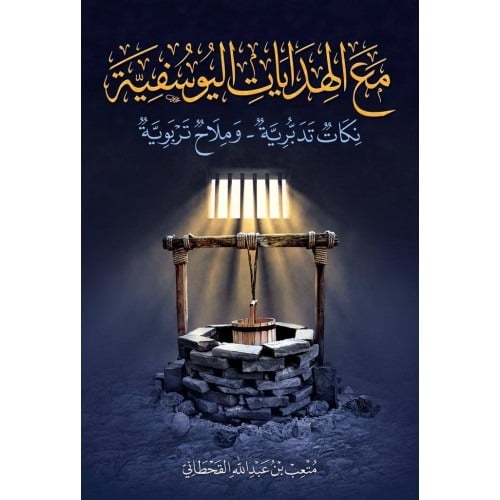
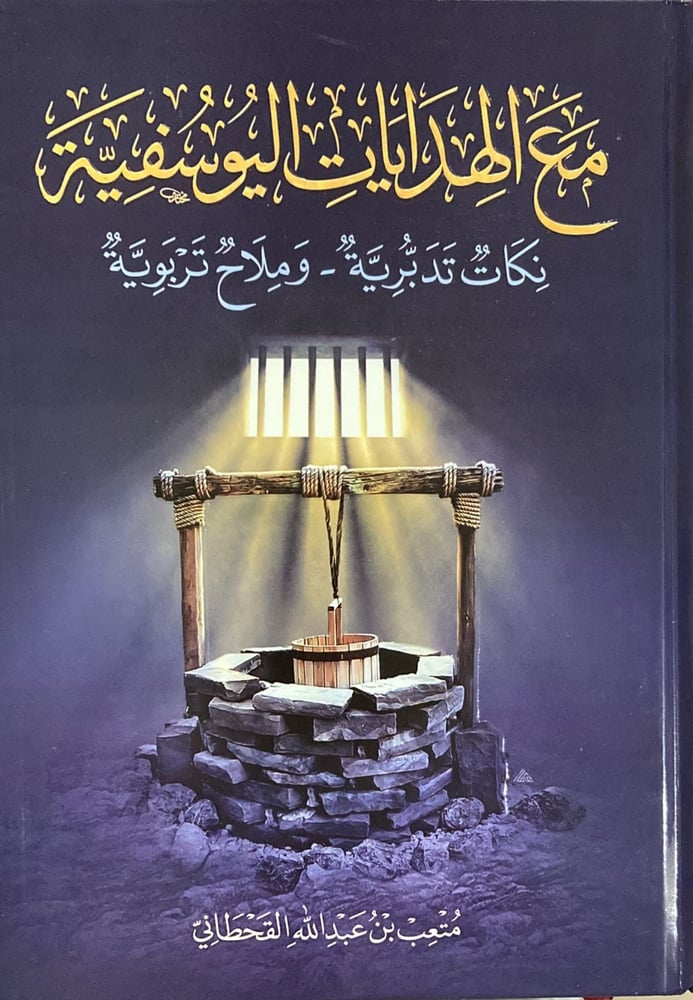

With the Yosifi gifts
32.20ر.س
Product description
Authorship Metab Al-Qahtani
With the guidance of Al-Yousifiya
Anecdotal and Educational Notes
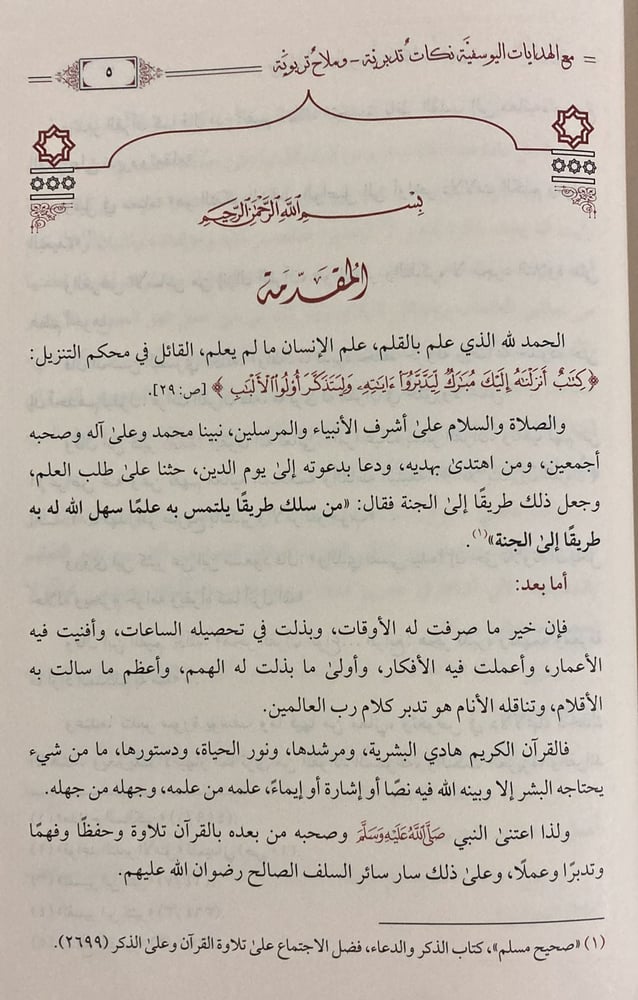
In the name of Allah, the Most Gracious, the Most Merciful
Introduction
Praise be to Allah, who taught by the pen, taught man what he did not know, as He says in the clear Quran: "Recite in the name of your Lord who created — Created man from a clot (blood clot). Recite, and your Lord is the most Generous — Who taught by the pen — Taught man that which he knew not" [Surah Al-'Alaq: 1-5].
And peace and blessings be upon the noblest of prophets and messengers, our Prophet Muhammad, and upon his family and companions altogether, and those who follow his guidance and call with his invitation until the Day of Judgment.
He urged us to seek knowledge, making it a path to Paradise, saying: "Whoever follows a path to seek knowledge, Allah will make easy for him a path to Paradise."
To proceed:
The best of what one spends time on, and the hours spent acquiring it, and the ages spent in it, and the thoughts employed in it, and the efforts of the ambitions, and the greatest of what the pens have flowed for, and what people have transmitted, is to contemplate the words of the Lord of the Worlds.
The Quran is mankind’s guide, its counselor, the light of life, and its constitution. There is nothing that humans need except that Allah has clarified it in the Quran either by a text, an indication, or a hint. Its knowledge is for those who know it, and its ignorance is for those who ignore it.
Therefore, the Prophet (peace be upon him) and his companions after him paid attention to the Quran in recitation, memorization, understanding, pondering, and acting upon it. And the righteous predecessors after them followed this approach.
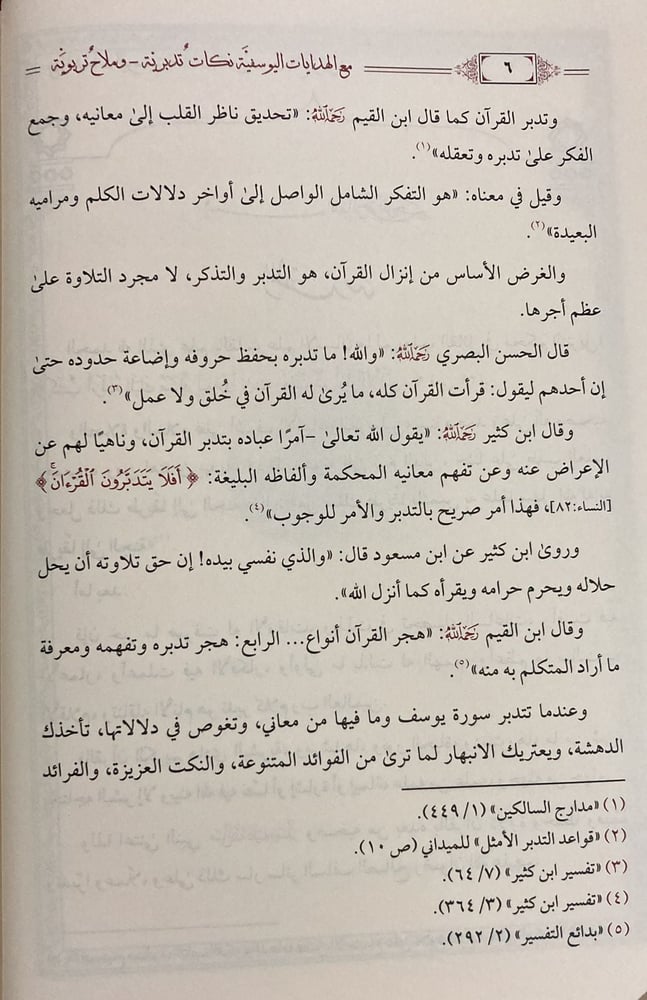
Contemplating the Quran, as Ibn al-Qayyim, may Allah have mercy on him, said: "It is the gaze of the heart fixed on its meanings, gathering thought to ponder and understand it."
It is also said about its meaning: "It is comprehensive reflection reaching the depths of the words’ connotations and their distant purposes" (2).
The main purpose of revealing the Quran is contemplation and remembrance, not merely recitation, despite its great reward.
Al-Hasan al-Basri, may Allah have mercy on him, said: "By Allah, he does not contemplate it by memorizing its letters and neglecting its boundaries, to the extent that one of them might say: I have read the entire Quran, but the Quran is not seen in his character or actions."
And Ibn Kathir, may Allah have mercy on him, said: "Allah commands His servants to contemplate the Quran and forbids them from turning away from it and from understanding its decisive meanings and eloquent words: 'Then do they not reflect upon the Quran?' [An-Nisa: 82]. This is a clear command to ponder, and the command is obligatory." (4)
Ibn Kathir narrated from Ibn Mas'ud, who said: "By the One in Whose hand is my soul! The right way to recite it is to make lawful what Allah made lawful, forbid what He forbade, and recite it as Allah revealed it."
And Ibn al-Qayyim, may Allah have mercy on him, said: "There are various types of neglect of the Quran... the fourth: neglecting its contemplation, understanding, and knowing what the speaker intended by it."
When you contemplate Surah Yusuf and its meanings, and delve into its connotations, you are struck with amazement, and overwhelmed by the various benefits, precious insights, and beautiful rarities. You move from a pedagogical stance to a legal ruling, or a divine wisdom, or a universal Sunnah.
The core material of this book originated from lessons I used to give to a group in my mosque years ago. I revisited interpretations and works of many scholars, and selected and chose from their words what I saw served the idea of contemplation rather than interpretation.
Interpretation has its books and authors, and clarifications and rulings have their specialists and champions. This is merely pedagogical pauses, faith-based guidance, and linguistic hints, gathered from the gardens of scholars and the courtyards of noblemen.
My work, if any, is collection, selection, and arrangement. As Ibn al-Jawzi said about blessings: "Everything has an art, and the art of the mind is good choice. As Abu Ishaq al-Husri al-Qayrawani (d. 453 AH) said: 'There is no pride in his compilation except in good choice, and choosing is a piece of his mind, indicating his backwardness or his virtue.'"
What motivated me to compile and publish this material, despite my limited ability, is the saying of Ibn al-Jawzi, may Allah have mercy on him: "I see that the benefit of writings is greater than the benefit of teaching by face-to-face communication, for I debate in my life with many learners, and I debate with my writings, and their number is countless after them! The evidence for this is that people benefit more from the writings of the early scholars than from what they benefit from their teachers."
The aim is not to gather anything indiscriminately, but rather to reveal secrets Allah may choose to disclose to His servants, guiding them to uncover what is torn apart, arranging what is scattered, or explaining what has been neglected... This is the beneficial classification.
One should seize the opportunity of classification in the middle of life, because the early years are the time of seeking, and the later years are the time of waning senses.
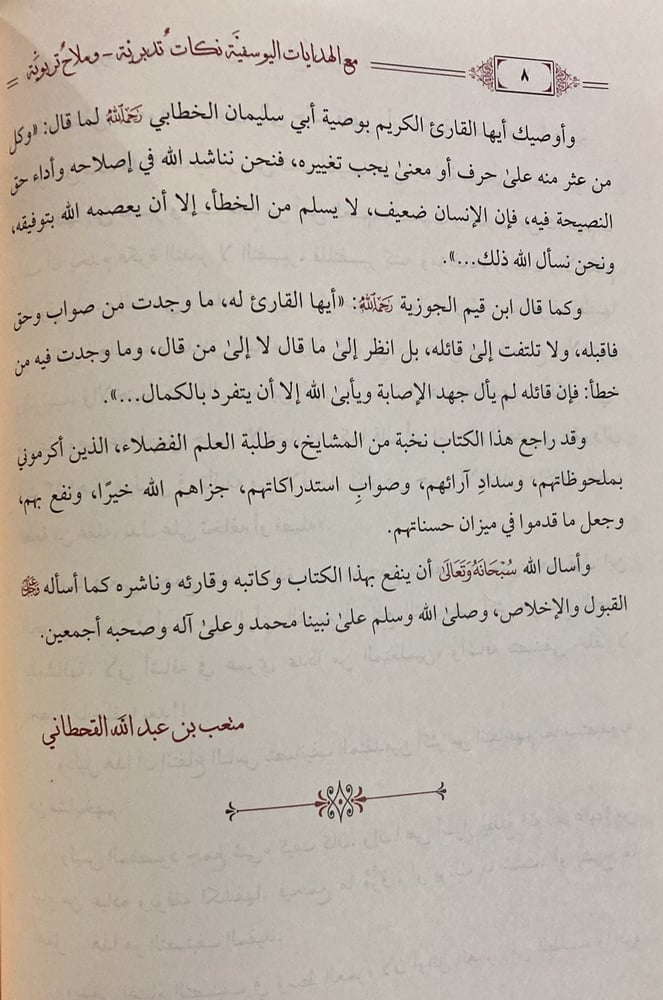
And I advise you, dear reader, with the advice of Abu Sulayman al-Khattabi, may Allah have mercy on him, who said: "Whoever stumbles upon a letter or meaning that needs to be changed, we appeal to Allah for its correction and to fulfill the duty of sincere advice in it. For man is weak and cannot be free from error, unless Allah protects him with His success. And we ask Allah for that..."
And as Ibn al-Qayyim, may Allah have mercy on him, said: "O reader, accept whatever you find of correctness and truth, and do not pay attention to the speaker, but look at what was said, not who said it. And as for what you find in it of errors, its speaker did not spare effort in accuracy, and Allah refuses to be alone in perfection..."
This book has been reviewed by a select group of scholars and virtuous students of knowledge, who honored me with their remarks, sound opinions, and corrections. May Allah reward them well, benefit through them, and place what they have contributed on the scale of their good deeds.
I ask Allah, Glorified and Exalted, to benefit from this book, its author, its reader, and its publisher, just as I ask Him for acceptance and sincerity.
And may Allah's peace and blessings be upon our Prophet Muhammad, his family, and all his companions.
Metab bin Abdullah Al-Qahtani

From Dammam