

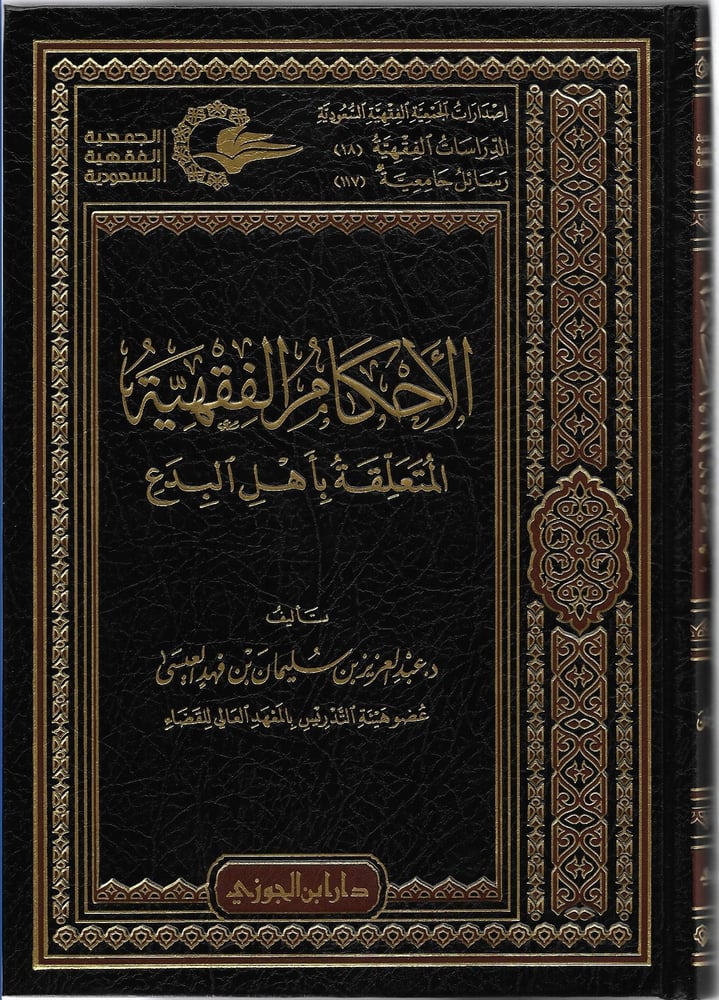
The jurisprudential rulings related to the people of innovation
66.70ر.س
Product description
Abdulaziz Sulaiman Fahd Al-Eisa
Introduction
Praise be to Allah, Lord of the worlds, and peace and blessings be upon the noblest of prophets and messengers, our Prophet Muhammad, and upon his family, companions, and followers with goodness until the Day of Judgment. To proceed:
Among the greatest blessings of Allah upon us is that He chose for us the best Book revealed, honored us with the best Prophet sent, and granted us the preservation of religion; by making in this nation those who preserve its religion after the death of its trustworthy Messenger, from the noble companions, and the followers of them with goodness, and from those who come after them from the Imams of religion, who are the Imams of guidance and the lamps of the darkness. May Allah have mercy on them with extensive mercy. And I ask Allah to join me, my father, and my teachers in their ranks, and to gather us all in their company.
Since obtaining the degree of (Doctorate) requires presenting a scientific thesis, after research, I chose the topic: the Islamic legal rulings concerning the people of innovation. This was through researching issues related to the people of innovation because innovation is a description to which Sharia has attached many rulings, which scholars have discussed in their writings. They have addressed the rulings related to the people of innovation in many chapters concerning worship, transactions, family jurisprudence, punishments, judiciary, and others. This motivated me to gather what has been scattered, clarify what is summarized, and study it through comparative jurisprudence. I wished for it to be the subject of my doctoral thesis, hoping that Allah may benefit me through it and benefit whom He wills from His servants. Before starting to outline the plan, I will clarify the importance of the topic, reasons for choosing it, its objectives, and previous studies on it, so I say, seeking Allah’s help:
Importance of the topic:
The importance of the topic is represented in the following points:
1. The need of a Muslim adhering to the Sunnah to know the rulings related to the people of innovation, so he may be aware of his religion.
2. The frequent affliction upon the people of Sunnah of mixing with the people of innovation in all regions and countries, due to the many divisions and desires, especially in the last days, as our Prophet Muhammad, peace be upon him, informed.
3. The differing approaches of people in dealing with the people of innovation between excess and deficiency, and between transgression and conformity, which shows the need for studying the issues of this chapter according to the evidences of Sharia and the intended objectives.
4. The differing judgments on the people of innovation depending on their innovations; because newly invented innovations in religion are not of one level, but they vary in their severity, the condition of their people, and according to the change of time and place. This necessitates clarifying the rulings concerning the people of innovation and how to deal with each category according to their situation, as established by scholars.
Reasons for choosing the topic:
Among the reasons for choosing this topic are:
1. The scarcity of jurisprudential studies containing its issues.
2. The desire to know the opinions of jurists regarding the rulings of the people of innovation.
3. The dispersion of jurisprudential rulings related to the people of innovation in the writings of jurists, which necessitates collecting and studying them through comparative jurisprudence.
4. The urgent need to clarify the jurisprudential rulings related to the people of innovation.
Objectives of the topic:
1. To gather the scattered words of jurists regarding the rulings of the people of innovation in one compilation, so its benefit reaches researchers and it becomes easier for those wishing to review.
2. To clarify the moderate approach of Ahl al-Sunnah in dealing with the people of innovation.
3. To study jurisprudential issues concerning the rulings related to the people of innovation through comparative jurisprudence, mentioning evidences, methods of inference, and discussions on what is contested, then making a preference based on the accepted rules among scholars.
Previous studies on the topic:
I have not yet come across a scientific jurisprudential thesis specifically addressing the jurisprudential rulings concerning the people of innovation. However, there are some books on this subject within the section of Aqeedah, including Dr. Ibrahim bin Aamer Al-Ruhaili’s doctoral thesis titled: "The stance of Ahl al-Sunnah wal-Jama’ah towards the people of desires and innovations." The researcher completed it in 1412 AH, over twenty years ago. We agreed with him on the following issues: praying behind the people of innovation, repentance from their innovations, marrying them, eating their slaughtered animals, visiting them, attending their funerals, their inheritance, their absence, greeting them, sitting with them, seeking help from them in jihad, and the ruling on working based on their testimony. The rest of what I mentioned in the upcoming plan was not addressed. However, the research on the issues where agreement was reached did not detail their circumstances as outlined in the plan; rather, it covered all issues generally, discussing the original matter without details, and did not include the evidences for the issues. The research was not conducted through comparative jurisprudence; instead, the scholar would mention the sayings of the Salaf from books of Sunnah and narrations, then derive conclusions about the stance of Ahl al-Sunnah towards the people of innovation. Sometimes, he would quote from some jurisprudential writings.
The stance of Ahl al-Sunnah wal-Jama’ah towards innovations and the innovators, authored by Professor Dr. Abdul Rahman bin Abdul Khaleq in 1416 AH.

From Dammam