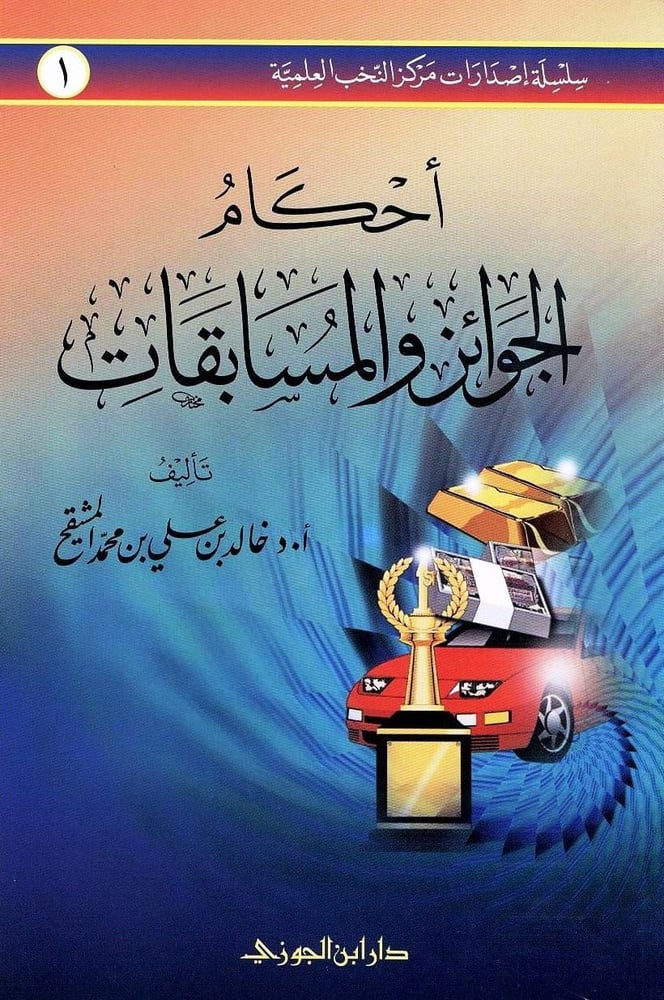
Rules of prizes and competitions
6.90ر.س
Product description
Dr. Khalid Al-Mushaikh
Title of the book: Rulings on Prizes and Contests
Publisher: Dar Ibn Al-Jawzi - Saudi Arabia - Dammam
Edition: First
Year of printing: 1434 AH
Number of pages: 48
Introduction to the subject of the book:
This week's book discusses the rulings on prizes and contests, which are among the issues that have spread, and many forms of their dealings have become common, and there was a need to clarify the Islamic legal ruling on them.
The book originally consists of lessons that the author had delivered as part of a series of scientific lessons, which Sheikh Abdulaziz bin Hawas Al-Shammari transferred, organized, and presented to the author after adding some modern contest examples.
The book begins with defining prizes, describing them as: gifts given by sellers to buyers, and stated that the origin of such prizes and gifts is permissible, as there is consensus on that, based on the fact that the basis of transactions is lawful.
Then, it enumerates their types and details the ruling on them, stating that they are divided into several categories:
The first category: prizes awarded through contests, which include several types:
Type one: the prize is paid by paying fees to enter the contest, and this type is forbidden and permissible.
Type two: the prize is through purchase, so that only those who buy a commodity that the merchant sells participate, and this has two subtypes:
- The first: the prize influences the price, which is forbidden and not permissible, and it is from the maysir (gambling).
- The second: the prize has no effect on the price, and there is a difference of opinion on this, and the author inclined to the opinion of permissibility.
Type three: the prize is through contests that aim to educate and guide people, and the author mentioned that there is a disagreement among scholars about whether it is permissible to take compensation for scientific questions or not, and the author favored permissibility.
The second category: prizes related to goods, and the author stated that they also include several types:
Type one: the prize is from the seller without condition or restriction, and this is a permissible prize.
Type two: the prize is a known gift to the buyer, and this is also permissible.
Type three: the gift is unknown because it is inside the commodity, and there is a detailed discussion: if it affects the commodity, it is forbidden and not permissible; if it has no effect, it is permissible and there is no problem.
Type four: the prize is in some goods and not others, so this is a conditional prize.
Type five: the prize is money, and there is a difference of opinion on this; the author inclined to the view that if the money is easy to handle, it is permissible, and if not, it is not.
The third category: sweepstakes vouchers for prizes, and the author mentioned that this category is disputed among later scholars, and clarified that the closest opinion is permissibility if two conditions are met:
- First: the value of the goods is not increased.
- Second: the purchase of this good is for the need, not for the prize.
Then, the author discussed discount cards, defining them as: a small plastic card, or other material, on which the beneficiary's name is written, granting a discount on prices of goods and services from specific institutions and companies, with the card's validity period.
The author noted that, based on research, these are divided into three types:
General discount cards: defined as: cards that benefit the consumer or client by reducing prices or services at various commercial entities.
He explained the difference between these and private cards, stating that most scholars consider them forbidden and not permissible.
Private discount cards: defined as cards used only at one discounting entity, and scholars have differed about them, and they are considered lighter than general discount cards.
Free discount cards: defined as cards provided by commercial entities to consumers as a reward for dealing with them or encouraging them to deal, and the Permanent Committee for Scientific Research issued a fatwa permitting such cards, and there is no harm in them.
Then, the author moved on to discuss contests and games, defining them as: a contract between two individuals or two teams in an academic, military, or sports field, to determine the faster or better.
The author stated that racing is permissible based on the Qur'an, Sunnah, and consensus in general, but contests in Sharia are divided into three categories:
First: lawful contests: defined as those explicitly mentioned by the Prophet (peace be upon him) in the hadith of Abu Hurairah (may Allah be pleased with him), where he said: "There is no race except in a spear, or a shoe, or a track," and clarified that taking compensation in them is permissible absolutely, whether from the ruler, one of the participants, or a third party, and this is considered a form of gambling with concessions from Sharia.
Second: forbidden contests: defined as any contest that results in harm to religion, either by neglecting an obligation, committing a forbidden act, or causing harm in worldly matters, whether to bodies, wealth, or reputation, and clarified that they are forbidden and that taking compensation for them is not permissible, whether from either participant or a third party.
Third: permissible contests: defined as any contest that results in a benefit and does not cause harm, with three conditions for their permissibility:
- First: they should not cause harm to religion by abandoning an obligation or committing a forbidden act.
- Second: they should not cause harm in worldly matters, whether to wealth, reputation, or bodies.
- Third: the individual should not overdo them.
Regarding the ruling on taking compensation for this category, the author clarified that it is permissible if taken from the ruler or a third party, but not permissible if from the contestants or one of them.
The author concluded the book by discussing scientific competitions, stating that there is a difference of opinion about taking compensation for them, but he inclined to its permissibility, equating them with legitimate contests, so that both contestants can give compensation, and if the compensation is from the ruler or a third party, it is also permissible.
However, the author set three conditions for the permissibility of taking compensation in scientific contests:
- First: the contests should be in Islamic scientific issues, not in permissible scientific matters, as compensation in the latter is not valid.
- Second: the one organizing the contest should not seek profit or trade, but rather aim to educate and guide people.
- Third: to warn against gambling after establishing the contest.
Although the book is small in size, it contains important issues that are widespread among people, often dealt with without knowledge of their Islamic rulings.

From Dammam