
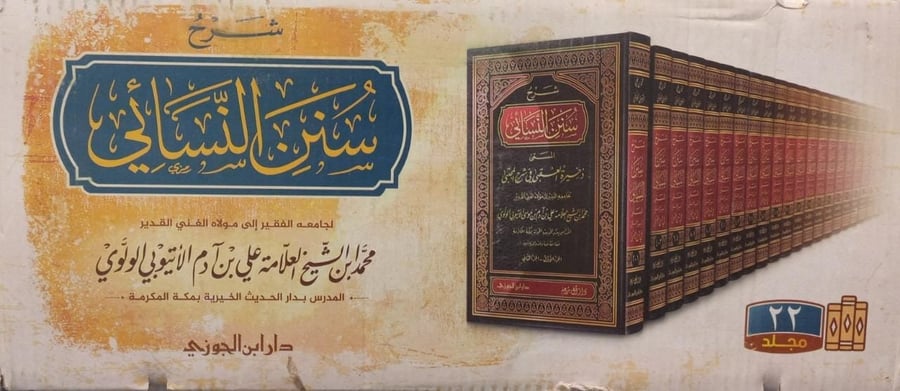

Explanation of Sunan An-Nasa'i, Thakhirat Al-'Uqba 1-22 (Pure)
1150ر.س
Product description
Explanation of Sunan An-Nasa'i (Al-Zakhira Al-Aqba fi Sharh Al-Mujtaba) 1-22
The Sign: Muhammad Ali Adam Al-Atiyubi
22 Volumes
Explanation of Sunan An-Nasa'i called Al-Zakhira Al-Aqba fi Sharh Al-Mujtaba | Muhammad Ali Adam Al-Atiyubi
The Sunan Al-Sughra known as Sunan An-Nasa'i is one of the six books of Hadith, compiled by Imam Ahmad bin Shuayb An-Nasa'i who died in 303 AH in the city of Ramla in Palestine. Some scholars of Ahl al-Sunnah wal-Jama'ah consider it the third of the six books in terms of authenticity. Sheikh Al-‘Alama Muhammad bin Ali bin Adam Al-Atiyubi explained them.
Its author is Muhammad bin Sheikh Ali bin Adam bin Musa Al-Atiyubi Al-Wulaywi, a contemporary and currently a teacher at Dar Al-Hadith Al-Khayriyah in Mecca.
Al-Zakhira Al-Aqba is a very detailed explanation, expected to reach forty volumes, because according to his words, he finished volume twenty-eight explaining six parts out of eight, and so far only nine volumes have been printed, these nine are roughly five or fewer of the six Sunan.
In the introduction of the book, it says: "Afterward: The poorest of the people say to the mercy of Allah, Muhammad bin Sheikh Ali Adam Al-Atiyubi, when I saw the Sunan of Imam Al-Hafiz Al-Hujjah Abu Abdul Rahman Ahmad bin Shuayb An-Nasa'i -may Allah have mercy on him- called (Al-Mujtaba) with a B, or (Al-Mujtana) with a N, I found no explanation that properly solves its words, clarifies its meanings completely, discusses the men of its chains of narration and the hidden meanings of its texts, and derives rulings from it, for beneath each Hadith are secrets and within each news are hidden lights." Then he said: "And how not, when it is the speech of one endowed with comprehensive words, and he summarized speech concisely, صلى الله عليه وسلم." He says: "I rolled up my sleeves with earnest effort, cast laziness and boredom behind me bitterly, and called out the meanings loudly and openly, so I was answered from every side with a pen full of words from our researcher." He says: "So I sought help from Allah, and I said: My success is only from Allah, upon Him I rely, and to Him I turn." Until he said: "And I named it (Al-Zakhira Al-Aqba fi Sharh Al-Mujtaba), and if you wish, say: (The ultimate wish in explaining Al-Mujtana)."
After that, he said: "Notice," then he listed some notes, the first of which is: "In truth, I am not an author with detailed editing, nor a compiler with polished writing, but I am merely gathering the sayings of the researchers, relying on what I see from them that agrees with the apparent text, so I am collecting those sayings and arranging them according to what suits them from the Hadith, then examining them and their coherence based on proximity and distance from it, and depending on what is likely in my limited understanding and faint mind. Therefore, I do not leave from the narrated sayings according to each Hadith except what I am unaware of its proof, if there is a proof beside it, and even if I see it weak in my view, perhaps others will see it as correct due to a proof that strengthens it, either from the same Hadith whose reason I did not see, or another text that is stronger. Perhaps the one who conveys more comprehends better than the listener." Then he mentioned the benefits of repetition and elongation in explanation, quoting from Al-Nawawi in his explanation of the introduction of Muslim, then he listed his sources in his book, relying on books of men (al-jarh wa al-ta'dil) then listing them, and books of terminology, then mentioning the explanations of Hadith whether for Sahihayn or others, and the texts, margins, language, strange words, jurisprudence, grammar, morphology, and others. Then he translated Imam An-Nasa'i, mentioning his writings, his madhhab in criticism and praise, his methodology in classification, and the high and low levels in his Sunan. Then he discussed his major Sunan, the narrators of the Sunan from An-Nasa'i, and the care of the Hafiz for them. Then he talked about the minor Sunan and compared them with the major ones, explaining why An-Nasa'i chose the minor from the major, and the increase of the major over the minor and vice versa. Then he discussed the naming of the book as Al-Mujtaba or Al-Mujtana and the scholars' care for it. Then he mentioned a complete message by Al-Sakhawi on concluding Sunan An-Nasa'i, called (Bughiyat Al-Raghib Al-Mutamanni fi Khatm Sunan An-Nasa'i by Ibn Asni). This message took about seventy pages of the introduction, nearly half of the introduction, which is about 150 pages. Then he discussed Al-Tahdhib Al-Tahdhib for its great reliance on it, especially in the biographical evaluations of narrators, relying mostly on Al-Tahdhib, and imitating the Hafiz in his judgments, though it is better and more appropriate to strive in his judgments on the men; but it is impossible to strive on every narrator while collecting this huge amount of sayings of scholars about the hadiths and the ranks of narrators.
He concluded the introduction by clarifying the methodology of this explanation and its terminology, saying: "Know that the methodology of this explanation is as follows: writing the translation mentioned by An-Nasa'i, then explaining this translation; writing the hadith with its chain and text; discussing the biographical notes of the narrators; mentioning subtle points in the chain of narration; explaining the text; then some issues related to the hadith, the degree of the hadith, clarifying where it is mentioned by the compiler in the minor and major Sunan; identifying who narrated it from the original sources; explaining the benefits of that hadith; mentioning the scholars' opinions if there is a disagreement in ruling on that hadith, then favoring the most likely opinion; and if there are remaining matters related to that hadith, I mention them in a sixth, seventh, eighth question, and so forth."
This approach may vary with additions or omissions for some reason. Then he mentioned the terminology of the explanation and its symbols, followed by the chains of the author to An-Nasa'i - may Allah have mercy on him.
The Sheikh limited himself in balancing the biographical notes because the biographical notes of An-Nasa'i are mainly about the defects in the hadiths and disagreements among narrators.
Undoubtedly, the book is valuable and very beneficial for students of knowledge, especially since Sunan An-Nasa'i has not been served by earlier scholars in a manner befitting the book. It elaborates in explaining the hadiths extensively, which may tire the reader unfamiliar with reading, but reviewing when needed is easy and simple. Because reviewing requires elongation, but someone who wants to read the book from start to finish with this length might almost give up on reading it. However, the book is full of benefits, most of which are transferred from explanations, whether of the two Sahihs or others.
The Sheikh - حفظه الله - has made it easier for students of knowledge, gathering the material comprehensively. The student can look at what has been written and summarize a commentary from it, which is very beneficial.
The importance of this book stems from the fact that the original book is not served by previous efforts, so we all should pay attention to this book.
Nine volumes of the book have been printed — as I mentioned — and the rest is being printed. The printed part equals about one-fifth of the book, and it is expected that the entire book will be completed in forty volumes. If six of eight volumes (three-quarters of the book) are in twenty-eight volumes, it is expected to reach about forty or thirty-eight volumes. He told me that he has reduced this length to about half.

From Dammam