




Explanation of the introduction of ease for the sciences of the revelation by Ibn Juz
40.25ر.س
Product description
Her explanation, Dr. Mosaad Al-Tayyar, was supervised by Badr bin Nasser bin Saleh Al-Badr.
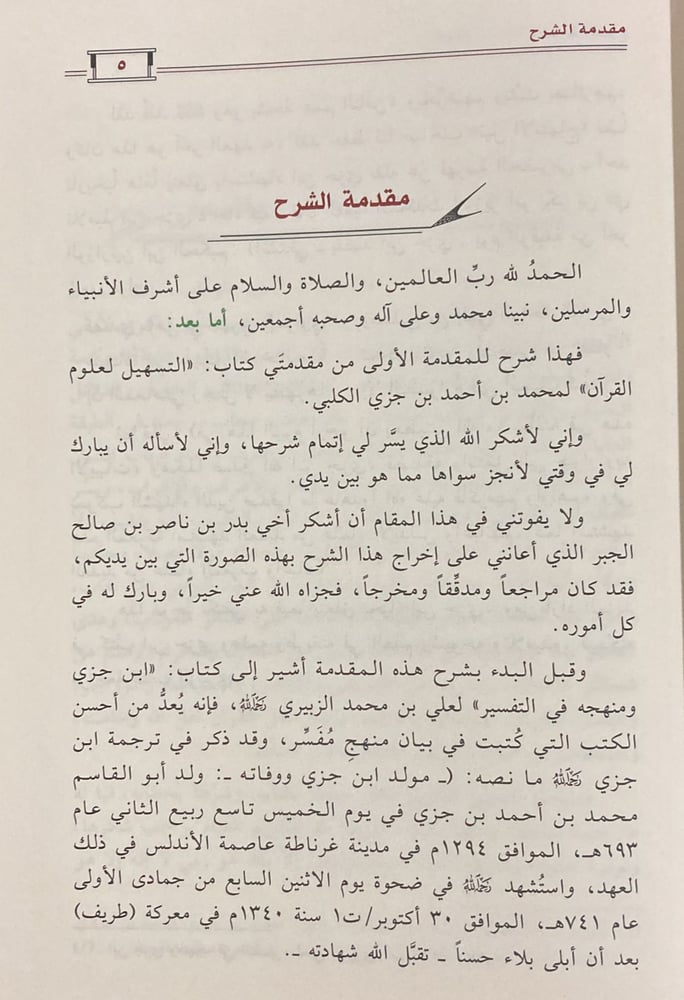
Introduction to the explanation:
Praise be to Allah, Lord of the worlds, and blessings and peace be upon the most honorable of prophets and messengers, our Prophet Muhammad, and upon his family and companions all together.
To proceed: This is an explanation of the first introduction of the two introductions of the book: "Ease of the Sciences of the Qur'an" by Muhammad bin Ahmad bin Juzī Al-Kalbi.
And I thank Allah who facilitated for me the completion of its explanation, and I ask Him to bless my time so I can accomplish other things that are before me.
And I cannot miss in this position to thank my brother Badr bin Nasser bin Saleh Al-Jabr, who assisted me in producing this explanation in the form you see before you. He was a reviewer, verifier, and producer, so may Allah reward him well, and bless him in all his affairs.
Before starting to explain this introduction, I refer to the book: "Ibn Juzī and His Method in Tafsir" by Ali bin Muhammad Al-Zubayri, may Allah have mercy on him. It is considered one of the best books written to clarify the methodology of a mufassir (interpreter).
In the biography of Ibn Juzī, it is mentioned:
(He was born and died – Abu Al-Qasim Juzī Muhammad bin Ahmad bin Juzī – born on Thursday, the 9th of Rabi' al-Thani, 693 AH, corresponding to 1294 AD, in Granada, the capital of Al-Andalus at that time. He was martyred, may Allah have mercy on him, on the bright morning of Monday, the 7th of Jumada al-Awwal, 741 AH, corresponding to October 30, 1340 AD, in the Battle of Turaif, after he fought valiantly – may Allah accept his martyrdom.
He passed away while he was inspiring people's spirits, urging them, and strengthening their insight. This was his last encounter with us.
He preserved for us a significant historical text about the martyrdom of Ibn Juzī, transmitted from Al-Fahrī’s catalog – one of Ibn Juzī’s students – which states:
The jurist, the minister Abu Bakr bin Dhī Al-Wizaratayn, son of Al-Hakim, recited to me – referring to Ibn Juzī – on the day of the battle, from his last poetry, saying:
"My aim is hopeful in my outward and inward state, and my request from my One God, the Creator,
Testimony in the way of Allah, pure, erases my sins and saves me from the fire.
Sins are filth that only swords can cleanse, in the oaths of disbelievers."
Then he said:
"On this day, I hope that Allah will grant me what I asked for in these lines."
Thus, Allah fulfilled the promise to Ibn Juzī, and He fulfilled him, and he moved to the companionship of the martyrs who fulfilled their covenant with Allah.
He honored them and sheltered them.
Many scholars and notable figures of Al-Andalus were martyred in this battle, as well as many scholars and notable figures of Morocco.
This is a brief summary regarding the life of Ibn Juzī.
For those who want more, Ibn Juzī wrote about himself, his knowledge, his method in science, his teachers, and his students. They can review the book by Al-Zubayri.
(1) Ibn Juzī and His Method in Tafsir by Ali Al-Zubayri, pages 169-170.

From Dammam