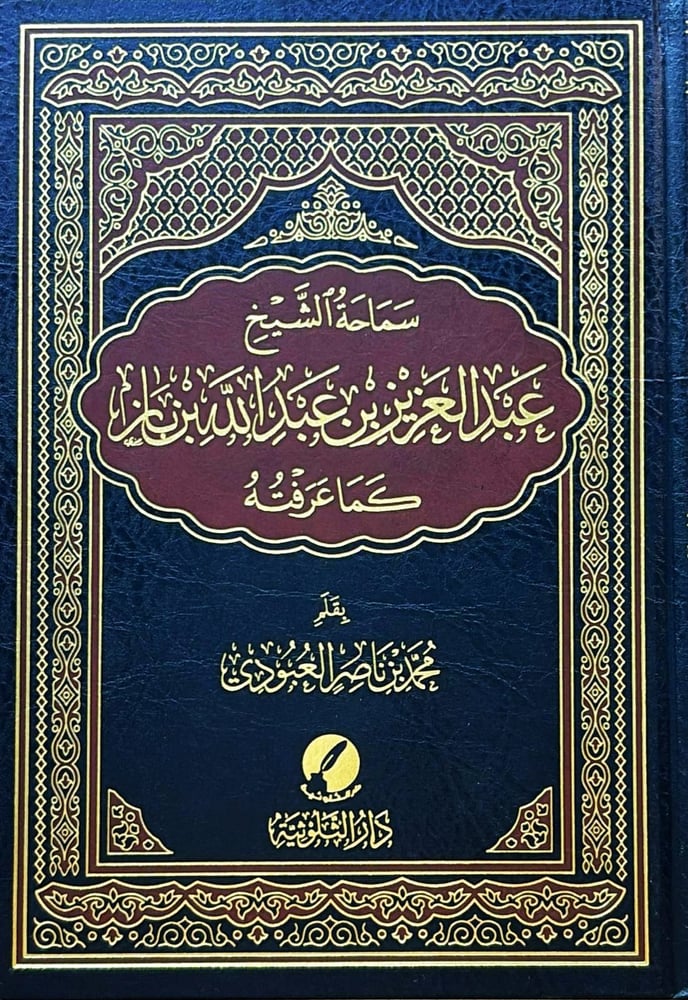


The noble Sheikh Abdulaziz bin Baz as I knew him
34.50ر.س
Out of Stock
Product description
A jewel in the necklace of loyalty. My dear brother and shining friend, culture and literature, Dr. Muhammad bin Abdullah Al-Mashouh, kindly gifted me a copy of the book (Mashallah Sheikh Abdulaziz bin Baz as I knew him) authored by the scholar Sheikh Muhammad bin Nasser Al-Aboudi, who is considered a towering peak in knowledge, literature, history, geography, and genealogy, and everything revolving around science and knowledge. He is a unique scholarly personality, a broad-minded researcher, deep thinker, who spends his day in reading, reviewing, researching, and writing. He is one of the pioneers who crown our country with knowledge, culture, and literature. His book about Mashallah Sheikh bin Baz was published by Dar Al-Thuluthiya in its first edition in 1439 AH - 2018 AD, and it spans 345 pages. The book is preceded by the publisher’s introduction, in which he pointed out the author's approach in his biographical writings, noting that he features innovative approaches in translation, focusing on analyzing personalities, their environment, and their culture, extending to find in his biographies a connection between the subject and the translator, both practically and emotionally. There is no doubt that this act is a pinnacle of loyalty from Sheikh Al-Aboudi in documenting biographies of those who lived with, interacted with, and sat with him, benefiting from their knowledge and experience firsthand. He has memories, meetings, scholarly dialogues, and conversations with them, just as he did with his great sheikh, the esteemed Sheikh Abdullah bin Muhammad bin Hamid, Chief Justice of Al-Qassim and Head of the Supreme Judicial Council; Sheikh Abdulaziz bin Saleh, Imam of the Prophet’s Mosque and Member of the Senior Scholars Council; Sheikh Muhammad bin Ali Al-Harakat, Minister of Justice and later Secretary-General of the Muslim World League. As mentioned in the introduction on page 10, (Sheikh Al-Aboudi focuses in his talk about the scholar he translates on his personal verified knowledge, and he is keen to benefit from documents related to Sheikh bin Baz to prove them. He has adopted this approach in other books, such as his book about the tribes of Buraidah and the tribes of Unaizah, relying heavily on documents, which is a prominent feature of the author. This approach is of great importance in understanding many aspects related to the biographee. His book about Mashallah Sheikh bin Baz contains many documents, including letters exchanged between him and Sheikh bin Baz and others involved. These letters number sixty-one, some published and others handwritten. Most of these letters concern matters related to the missionary work carried out by Sheikh Al-Aboudi, some are intercessions for those in need, some are Islamic legal consultations, and scientific benefits. The most prominent in these letters are requests for intercession, because Sheikh bin Baz - may Allah have mercy on him - was among those who valued people's need for intercession in what pleases Allah and achieves the legal interest or brings benefit to those in need and deserving. The author discussed this aspect under the title (Intercessions for those with needs), and on page 107, he pointed out that Sheikh bin Baz was famous for responding to those seeking intercession... and he saw no one more eager for intercession than him, based on the saying of the Messenger, peace be upon him: (Intercede and you will be rewarded). Sheikh Al-Aboudi’s book articulates what its title (As I knew him) aims for, because he was close to him when he worked with him at the Islamic University for twelve years starting from 1381 AH. This connection, which began in 1367 AH, extended for nearly sixty years. Such a period surely allowed Sheikh Al-Aboudi to become familiar with the conditions, biography, and journey of Mashallah Sheikh bin Baz in science, calling to Allah, and diligent work in serving Islam and Muslims across the East and West. The book also mentions Sheikh bin Baz’s kindness towards Sheikh Al-Aboudi. For example, on page 17, it mentions when he sent him a letter mistakenly mentioning his father’s name as Abdulrahman when he said it was Abdulaziz bin Abdulrahman. Sheikh bin Baz replied: “O beloved, you mentioned my father’s name (Abdulrahman), but his name is Abdullah. I am Abdulaziz bin Abdullah bin Baz,” and that was in 1367 AH. The book also notes Sheikh bin Baz’s keenness to research sources for some issues requiring his fatwa, and if he did not find knowledge on a matter, he would answer: “I do not know.” The author also discusses Sheikh bin Baz’s efforts to reunite couples in cases of divorce by three, and reads about a wonderful act of loyalty from Sheikh Muhammad Al-Aboudi to his sheikh, Sheikh bin Baz, during his work at the university. This is evident in Al-Aboudi’s efforts with King Faisal, requesting his promotion to university president and increasing his salary, much of which was spent helping the needy, supporting calls and preachers abroad. He wrote a letter to King Faisal, may Allah have mercy on him, and the result was approval of what Al-Aboudi requested. Through reading this book, the reader will learn many important details about the life of Mashallah Sheikh bin Baz, such as his origin, lineage, family, the time when he lost his sight, his pursuit of knowledge and his teachers, his daily schedule, his relationships with some scholars, his relations with Muslim scholars outside Saudi Arabia, his writings, his activities in calling to Allah, his concern for Muslims and Islamic minorities, as well as the relationship between the author and Sheikh bin Baz, including Sheikh bin Baz’s encouragement for the author to focus on the dictionary of the Qassim region, and his recommendation for him to write about his travels to Muslim countries. The book also discusses Sheikh bin Baz as a judge, a hadith scholar, an advisor to rulers, ascetic, and his facilitation for people regarding divorce by three. Ultimately, the author includes writings about Sheikh bin Baz after his death, may Allah have mercy on him, and what was said about him in elegiac poems. Before I conclude, I should mention that I wrote an article about Sheikh bin Baz shortly after his death titled (Mashallah Sheikh Abdulaziz bin Baz and a glimpse of his morals and traits), published in Al-Bilad newspaper, Heritage Supplement, issue 15651, Thursday, 12 Safar 1420 AH. I discussed his morals and traits, which include piety, asceticism, sincerity to Allah, reliance on the Book of Allah and the Sunnah of His Messenger, conscious study and wise methodology in his sayings and fatwas, adherence to leniency and easing for people according to Sharia, his comprehensive view and fatwas addressing the issues of our time and emerging matters, respect for scholars and students of knowledge, humility towards all people, patience and endurance for the comfort of others, his relationship with rulers based on appreciation and mutual respect, attentive listening to opinions and issues raised, captivating listeners with his good speech and lofty ideas. No wonder he is among the scholars who are the lamps of guidance, and with their light derived from the guidance of the Book and Sunnah, people’s lives are illuminated by their enlightened thought and knowledge. They are the heirs of the prophets, the people of Allah’s fear, striving for His pleasure; angels spread their wings over them, mercy envelops their gatherings, and Allah - glory be to Him - mentions them in the highest assembly. Yes, he is among these scholars, because he is a noble scholar guided by Allah’s light, drawing from the lamp of prophecy, and inspired by the well of the righteous predecessors. He spent his entire life serving Islam and the issues of Muslims; a learner, scholar, guide, and counselor. Whoever reflects on his blessed life journey of nearly ninety years will find it full of virtues, noble and great traits in the fields of knowledge, goodness, piety, righteousness, guidance, fatwa, calling to Allah, generosity, leniency, dedication in serving Islam and Muslims, humility, noble morals, and supporting preachers worldwide. These virtues and traits are beyond the reach of eloquence and fluency to fully praise and mention. And Allah is the grant of success.

Questions you might have