
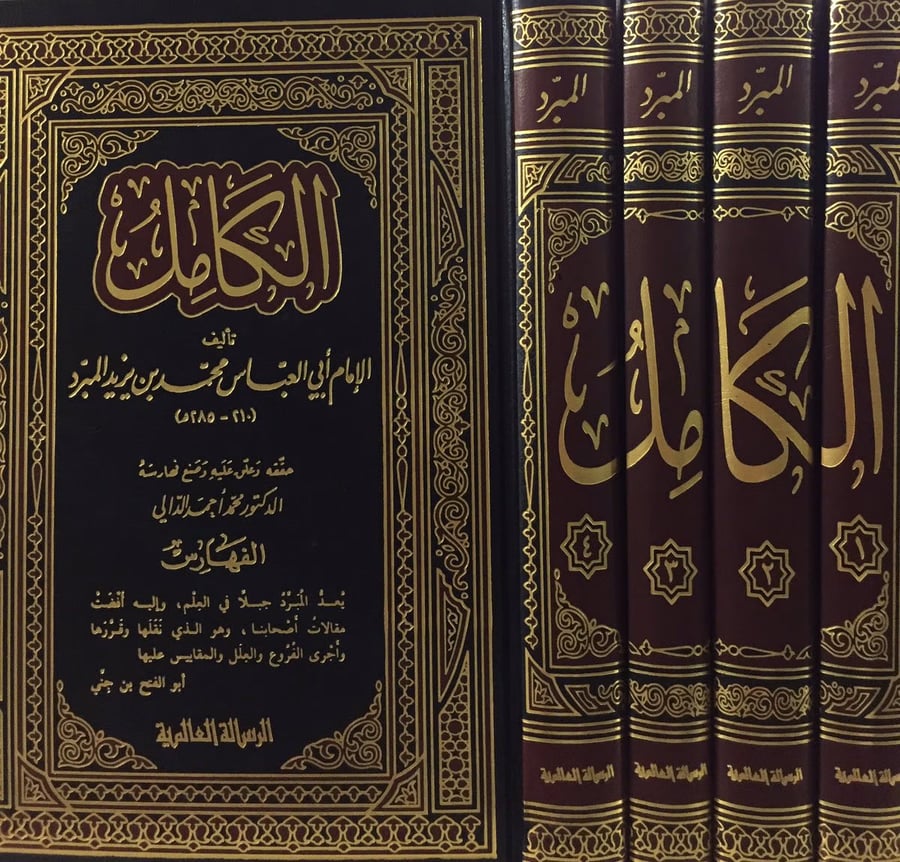
The complete 1-4
195.50ر.س
Product description
Achieved it and commented on it. Dr. Muhammad Ahmad Al-Dali
The book Al-Kamil is originally one of the fundamentals of the science of literature and a pillar of its pillars, and scholars and students of literature have eagerly read and copied it, some of whom explained it and others commented on it.
The book is considered one of the latest works written by Al-Mubarrad, and one of his most important books in general because it contained a large selection of poetry, prose, and news, and it includes many linguistic explanations and grammatical opinions.
The scholar Ibn Khaldun mentioned in his introduction the concept of the science of literature and its foundations, then he said: "We have heard from our teachers in educational gatherings that the roots of this art and its pillars are four anthologies: namely, Kitab Al-Adab by Ibn Qutaybah, and Al-Kamil by Al-Mubarrad, and Kitab Al-Bayan wa Al-Tabyin by Al-Jahiz, and Al-Nawadir by Abu Ali Al-Qali Al-Baghdadi. Anything beyond that is a follow-up and branches from them."
And Judge Al-Fadil said: "I have read it seventy times, and each time I gain more benefits from it."
Abu Al-Faraj Al-Ma'afii bin Zakariya also spoke about the importance of the book in his work (Al-Jalis Al-Salih Al-Kafi wa Al-Anis Al-Nasiha Al-Shafi), saying: "And Abu Al-Abbas Muhammad bin Yazid Al-Nahwi made his book called 'Al-Kamil' and included in it news and stories many of which have no chain of narration, and he included in it what comes from his derivation of language, explanation, and revealing its secrets, understanding it, and what is similar to it, due to his vast knowledge, strong understanding, subtle thinking, and pure talent. And from the clear grammar and syntax, and the obscure, there are few who can match him."
The book Al-Kamil is an important source for studying the news of the Khawarij, as it included a large number of their news and digressed in quoting their poetry, speeches, and mentioning their sects, wars, and leaders in a separate chapter in which he explained his method of mentioning the news of the Khawarij, saying: "And the news of the Khawarij is long and numerous, and our book is not exclusive to them, but we mention from their matters what has meaning and literature, or some striking poetry, or speech from a well-known and selected sermon." Al-Mubarrad followed this chapter with several others in which he spoke about them in a lengthy detailed discussion, sometimes mentioning other matters before returning to talk about the Khawarij. He apologized for the length of his discussion about them after finishing, saying: "And we did not start this chapter to connect the news of the Khawarij, but perhaps something connects to something, and the talk is full of excitement, and the proposer suggests what breaks the resolve of the author and distracts him from his path and removes him from his way."
The book also contains important rhetorical signals, as he discusses metaphor and its types, allegory and its kinds, metaphor and its forms, irony and its types, and elaborates on simile, dedicating a special chapter to it. He explains that "the Arabs resemble in four types: an exaggerated simile, an accurate simile, a near simile, and a distant simile that needs explanation and cannot stand alone, and is the roughest speech." He emphasizes brevity, calling it conciseness, and limits it with understanding. He also discusses amplification, describing it as grandeur, and dedicates another chapter to it, mentioning various types of Arab expressions that are clear, close, understandable, well-described, and beautifully arranged.
The book is also distinguished by numerous linguistic issues, studied, discussed, and cited throughout its pages, explaining each text with accuracy, depth, and detailed analysis. It contains many Arabic proverbs, explaining seventy-five of them, with their origins and the occasions they are used in.
Al-Mubarrad also included many sayings of wise men and their stories, even dedicating a chapter titled: "A summary of the news of the wise men."
The book also deals extensively with grammatical issues, which is evident throughout, as Al-Mubarrad—the leading Basran grammarian of his time—discusses grammatical matters in the context of explaining texts and mentioning their linguistic issues.
A charming feature of the book is that it is sprinkled with jokes and anecdotes, which the author occasionally includes, providing the reader relief from fatigue or boredom, and motivating them if they become tired or bored. These jokes are not vulgar or indecent; all the anecdotes are lively, delightful, and refreshing.
It is one of the most enjoyable books of Arabic, as it enriches the soul, refines the spirit, sharpens the mind, broadens horizons, and develops in humans a love for knowledge.

From Dammam