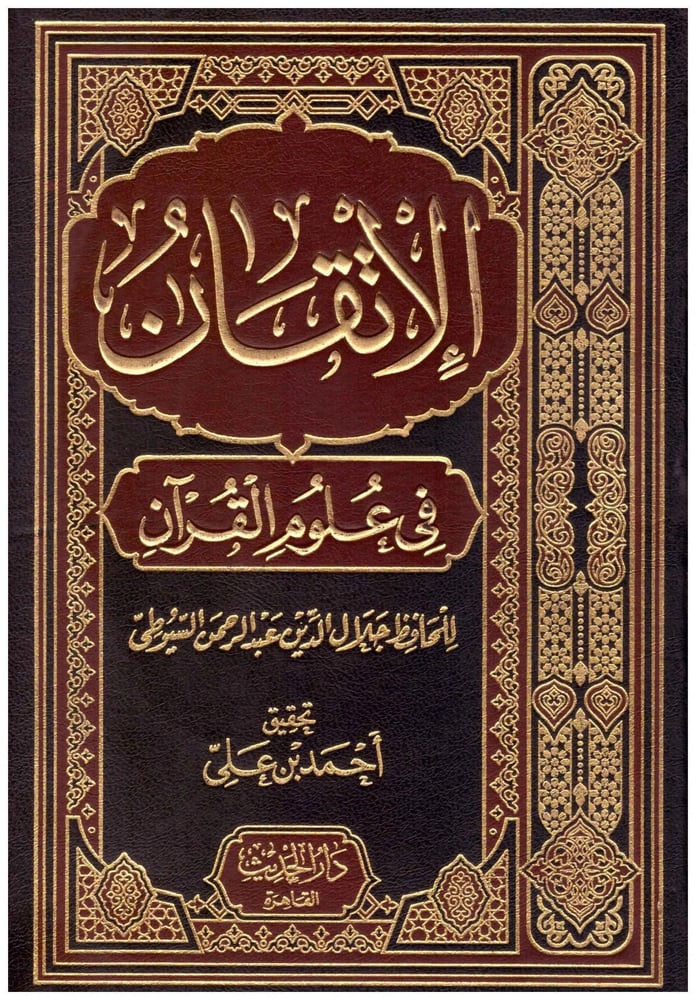

Mastery in the sciences of the Quran
69ر.س
Out of Stock
Product description
Achieved by Ahmed bin Ali
Perfection in the sciences of the Quran and with it the marginal notes of Al-Salawi | Jalal al-Din Abdul Rahman bin Abi Bakr Al-Suyuti
Available in five valuable handwritten sources, including a copy with the calligraphy of the compiler
Perfection in the sciences of the Quran is a book authored by Jalal al-Din Al-Suyuti (who died in the year 911 AH), and it is considered one of the most famous writings in the sciences of the Quran old and new, most beneficial, and the broadest in material.
Valuable scientific content of the book
Al-Suyuti’s additions in the sciences of the Quran, including: (the terrestrial and celestial, what was revealed from the Quran on the tongue of some of the Companions, what was revealed from it on some prophets, and what was not revealed from it on anyone before the Prophet صلى الله عليه وسلم).
Al-Suyuti’s new additions to what is in Al-Burhan: which are the summer and winter, the Farsi and Nomi, what was revealed in parts and what was revealed collectively, knowing the high and low from its chains of narration, knowing the famous and the singular, the fabricated, and the inserted, and in cases of assimilation, clear pronunciation, concealment, and reversal, and in what occurred in the Quran of names and nicknames.
And the sciences of the Quran, which are the origin in Al-Burhan, are considered additional branches to the types mentioned by Al-Zarkashi in Al-Burhan, such as: the urban and the travel, the daytime and the nighttime.
And additional issues and new questions in some of the discussions mentioned by Al-Zarkashi, which are important additions to the discussions in which they are mentioned, totaling (150) issues.
His evaluative pauses:
Al-Suyuti appeared with evaluative pauses while presenting some issues and matters, including: his precise regulation of the reason for revelation, and what came out with this regulation of causes, among other issues.
His choices:
Al-Suyuti was known in his books for his enthusiasm for collecting sayings, and regarding his choices, he took two approaches:
First: his opinion in the depths of Al-Itqan, such as the issue of what was inspired to the Messenger صلى الله عليه وسلم, and the Arabized.
Second: his opinion outside Al-Itqan, such as the meaning of the revelation of the Quran in seven modes, where he expressed his opinion in his explanation of the Sunan of Al-Nasa’i.
The value of the sources of Al-Itqan:
The sources of Al-Itqan amounted to (50) sources approximately, covering eleven sciences: in interpretation, sciences of the Quran, creed, jurisprudence, fundamentals, biography, asceticism and conduct, language, general and specific biographies, and public arts.
He transferred from some books written by their authors, such as Jamal al-Qurra’ by Al-Sakhawi, and the summarized Al-Mustadrak by Al-Dhahabi.
The scientific value of these sources appears from:
Memorizing many texts from lost books of Al-Firabi.
The possibility of forming an idea about some lost books, as he transferred from the book of Mus'haf by Ibn Ashtah (42) texts.
Adding incomplete texts to printed books, for example, Al-Suyuti transferred four sayings of Al-Shafi’i in his statement (And Allah made permissible selling..), which in Al-Mawardi’s interpretation are only three sayings with a deficiency in the third.
Features of the book Al-Itqan:
His proficiency in some types of the sciences of the Quran, both general and specific, and the ranks of the interpreters, his interest in important issues, and his mostly neglect of matters that seem unproductive.
His criticism of some sayings he narrated in his book due to weak narration, lack of evidence, or shortcomings in the statement, and many of the discussions are led by the most important works in the type under which they fall.
Al-Suyuti made it easy with what he collected to methods of research and study, as he gathered scientific material that many find difficult to access in its sources.
Al-Itqan is considered one of the main relied-upon books in Quranic studies.
Thus, Al-Suyuti was able to summarize the words of scholars in many types of Quran sciences with simple, clear phrases.
Methodology of Al-Suyuti in composing Al-Itqan:
Al-Suyuti’s method is characterized by the phenomenon of summarization and abbreviation in most of his discussions, emphasizing his love for encompassing opinions in his writing, and because he made Al-Itqan an introduction to his large Tafsir (Majma’ al-Bahrain), he did not take the time to refine it as he did with other books.
This phenomenon is contrasted with his style of pure narration, such as in his work on the miracle of the Quran, where he listed (17) sayings without commentary, yet moments of deliberation and patience are evident.
It is noticeable that Al-Suyuti often repeats similar discussions in his various works – a trait many attribute to him – as he repeated discussions from Al-Itqan in Al-Mu’arik al-Aqrān.
His approach also includes adding to Al-Itqan what appeared to him later or what he reached from information he had not previously added.
His method also considers the coherence in linking some types to others.
Sometimes, Al-Suyuti’s method (occasionally) leaves the full right of the issue.
His approach includes quoting the words of some authors with their chains of narration, and mentioning the opinions of non-Shafi’i scholars on issues of obligation that their work is based on.
He cites some poetry that supports his statement.
He attributes hadiths and reports he transmits – mostly – from collections of Sunnah and Hadith sections.
His method sometimes agrees with Al-Zarkashi in mentioning a specific issue but differs in the source he took it from; for example, Al-Zarkashi might cite a matter from Al-Dani’s book, then Al-Suyuti mentions the same issue but from the Mus'haf of Ibn Abi Dawood.
Sometimes, he transmits from Al-Burhan without mentioning the book or author, only saying: (some said) or (others said), which occurs in (60) places, and he explicitly mentions Al-Zarkashi or his book in (43) places.
Occasionally, he quotes Al-Zarkashi on a topic without explicit mention, then quotes him again on the same topic with his name, such as when he defines Tafsir by mentioning the phrase (some said), then later he quotes another definition of Tafsir by Al-Zarkashi in the introduction to Al-Burhan and explicitly states his name.
Among the books he quoted Al-Zarkashi from are: (Al-Murshid Al-Wajiz, Al-Nashr, Al-‘Arous Al-Afrah by Baha al-Din Al-Subki, Al-Burhan, Al-Mughni Al-Labeeb, Fath al-Bari), most of which he transmits in meaning. If he quotes verbatim, he ends with the phrase: (ended). When he transmits in meaning, there may be omissions that change the intended meaning.

From Dammam
Questions you might have