
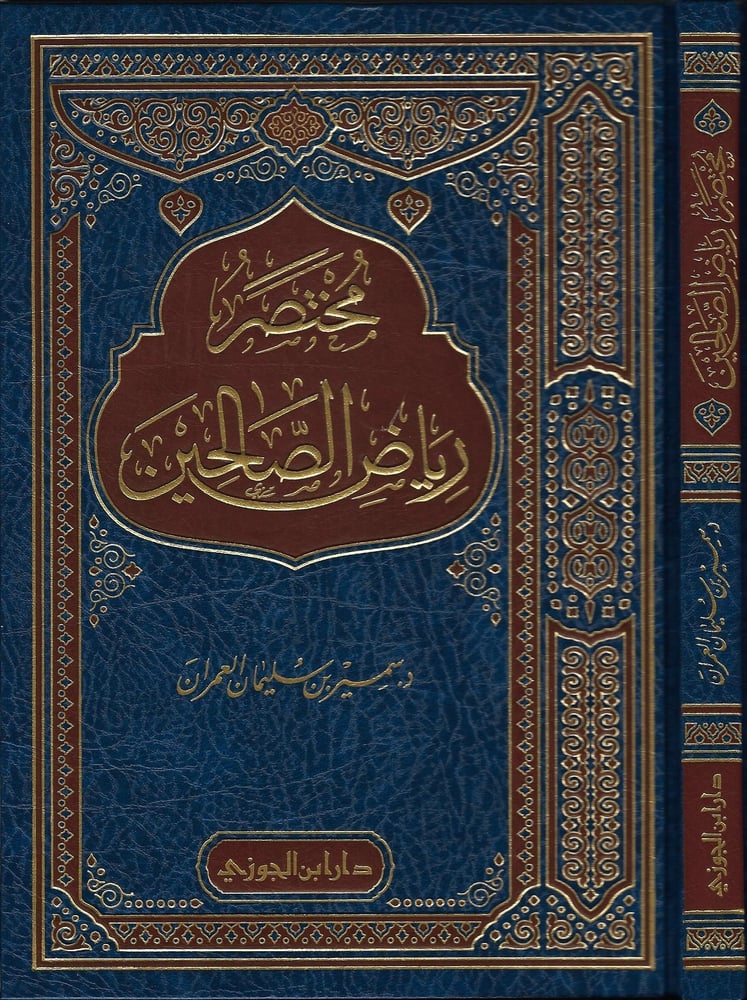


A brief summary of Riyad as-Salihin (Al-Imran)
11.50ر.س
Product description
Forward Najwid Samir Al-Omran
Introduction
Praise be to Allah, Lord of the worlds, and blessings and peace be upon the noblest of prophets and messengers, our Prophet Muhammad, and upon his family and companions all together;
And after:
Allah, the Most High, said in the clear decisive Book: ﴿And say, "My Lord, increase me in knowledge."﴾ [Taha: 114], so Allah did not command His Prophet or the nation following him to ask Him for increase in anything from worldly or religious matters except knowledge, and the best knowledge to seek is revelation (the Quran and Sunnah).
The book "Riyadh As-Salihin" from the words of Sayyid Al-Mursalin, authored by Imam Yahya ibn Sharf Al-Nawawi Al-Dimashqi, who died in the year 676 AH, is one of the books that, thanks to Allah, spread among Muslims in their homes and mosques since the year of its compilation until now. Imam Al-Nawawi gathered in it approximately two thousand hadith from the speech and actions of the Messenger of Allah, peace be upon him, and in few cases, he transmits some sayings and actions of the Companions, following the Prophet’s example, peace be upon him.
Due to the large size of the book and the repetition of some hadiths in wording and meaning, I saw it appropriate to summarize this book to facilitate reading for people in mosques after prayers, in family gatherings, and social meetings, and to serve as suitable material for Islamic education curricula; for Muslims in Muslim lands and beyond, and as a summarized method for teaching new Muslims their religion, virtues of good deeds, some of his characteristics, and his Sunnah.
The following methodology was followed in my summarization of "Riyadh As-Salihin":
1 - Selecting comprehensive hadiths that convey the intended meanings in each chapter and deleting repetitions.
2 - Merging some similar chapters within each book and renaming some chapters, making the summarized version divided into chapters instead of books and chapters.
3 - Judging the authenticity of hadiths that are not in the two Sahihs or in one of them by citing the opinions of late hadith scholars regarding the authenticity of the hadith, relying on Sheikh Al-Albani, may Allah have mercy on him, in case of differing opinions among hadith scholars, shown in bold within parentheses.
4 - Completing the verses mentioned at the beginning of chapters and abbreviating the repeated ones.
5 - Explaining unfamiliar words in the hadith that ordinary people may not understand through language dictionaries, shown in bold after the hadith is authenticated.
6 - Abbreviating the name of the companion narrator by using what is well-known from his name or nickname.
I ask Allah, the Most High, the Almighty, to benefit from it and to make it purely for His Face. Indeed, He is the Trustee and the Capable.
All praise is due to Allah, Lord of the worlds.
Written by:
H.E. Dr. Samir bin Sulaiman Al-Omran
Assistant Professor of Sunnah and Its Sciences
Formerly at King Fahd University of Petroleum and Minerals
Dhahran, on the first of Rabi’ al-Awwal, 1441 AH

From Dammam