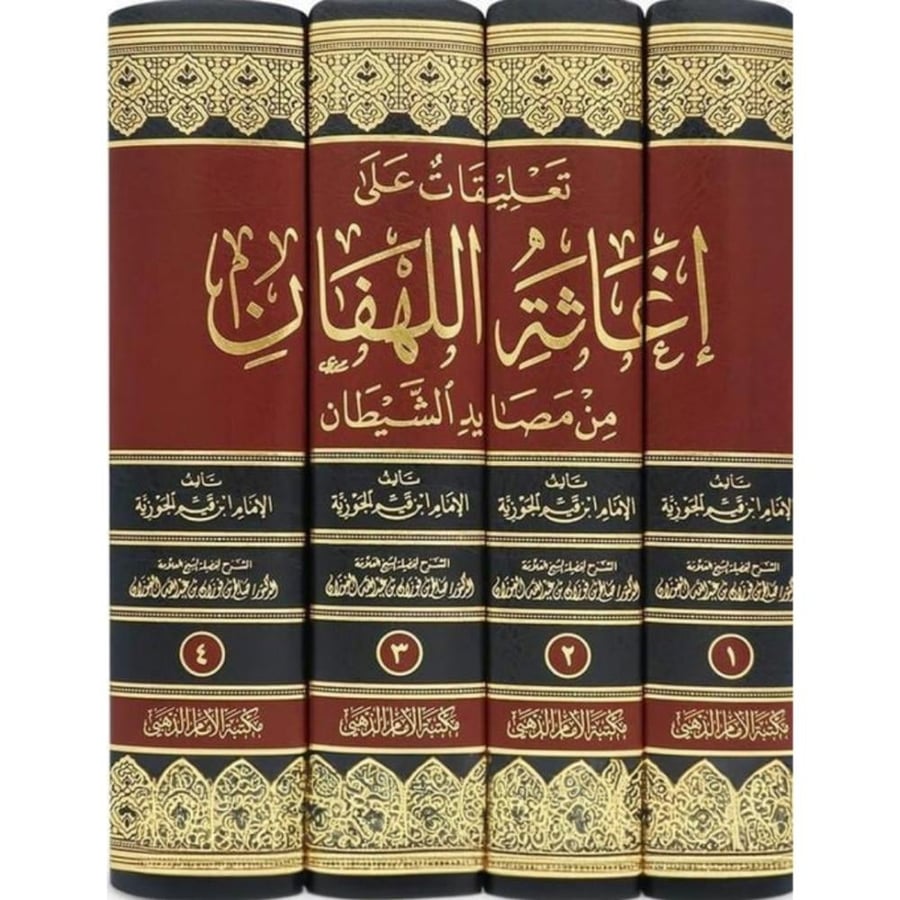

Comments on the Relief of the Desperate from the Traps of Satan 1-4
345ر.س
Product description
Took care of him and supervised his printing. Salman Jaber Othman Al-Majallam Al-Suweil comments on "Ighathat Al-Lahfan min Masayid Al-Shaytan" | Abu Abdullah Muhammad bin Abi Bakar bin Ayyub Ibn Qayyim Al-Jawziyya | Saleh bin Fawzan bin Abdullah Al-Fawzan.
"Ighathat Al-Lahfan min Masayid Al-Shaytan" is a book authored by Abdullah Shams Al-Din Muhammad bin Abi Bakar Zar'ei Al-Damishqi, known as Ibn Qayyim Al-Jawziyya, (691-751 AH), arranged into sixteen chapters, in which he presents the ailments of the human soul, their treatment, and the tricks of Satan who schemes against it. It contains many chapters with great benefits and significant usefulness, and scholars have testified to his precedence in serving knowledge and introducing religion to Muslims.
Book topics:
The book is divided into 13 chapters, which are:
- On the division of hearts into sound, diseased, and dead.
- On the state of the heart.
- On the divisions of heart diseases into natural and Shariah (religious).
- That the life and illumination of the heart are the material of all goodness in it, and its death and darkness are the material of all evil and fitnah in it.
- At the end of the heart's life, it only occurs when it perceives the truth, desires it, and prefers it over others.
- The heart does not begin to have pleasure, bliss, or righteousness unless its deity is its worshipped, and it loves it more than everything else.
- In the Noble Qur'an, containing remedies for all its diseases.
- On the purification of the heart.
- On the purity of the heart from its impurities and filth.
- On the signs of the health of the heart.
- On the treatment of the heart's disease from the domination of the soul over it.
- On the treatment of the disease caused by Satan.
- On the tricks of Satan who schemes against the son of Adam.
The author recently developed this chapter, stating that he wrote the entire book for this chapter, exhaustively detailing all the tricks Satan surrounds humans with.
He concluded: "This brief chapter about Satan's child and his simplicity among this nation (the Jews), does not recognize the Muslim, the Hanif, the blessing of Allah upon him, and the blessing of faith he possesses. And the guidance of knowledge for those whom Allah guides, and from Allah is peace and guidance to the straight path."
Author's approach in his book:
His method here does not differ from his approach in most of his books:
Presenting Qur'anic verses and Prophetic sayings as evidence for his explanations, such as his citation of the eloquent: "But their enjoyment was brief, and they forgot the remembrance, and they were a wicked people" [Al-Furqan: 18].
He also cites Hadith of the Messenger of Allah, peace be upon him, from Thawban, who used to say when he was distressed: "Allah is my Lord; I do not associate anything with Him," as evidence of affirmation of monotheism and reliance.
With the help of narrations from the Companions, Tabi'un, and Imams, in modifying texts within the book.
For example, he mentioned from Ibn Umar: "Spreading the ablution: cleanliness."
He often emphasizes and elaborates on these to help the reader benefit and apply the knowledge practically, making the application of the book easier.
For instance, when discussing adults in opposition to the United Nations, he uses an example of the Khawagim (a term possibly referring to certain groups or leaders), misleading their followers into believing that foods are only lawful if they use knowledge attributed to Moses, peace be upon him, which only they know.
In some of his writings related to the topic, he presented his ideas straightforwardly without elaboration, to avoid burdening the reader while enriching the benefit.
One such topic is listening (sama'), on which he wrote a separate book titled "Discussion on the Issue of Listening."
He also referenced it in "The Governance of the Seekers."
His focus during his writing period was to produce a book addressing the simple needs of Muslims, not just collecting ideas or information.
He paid great attention to the topic of tricks and rulings of Hiyal (deceptions).
Learnings from the book:
Expanding and repeating the topic of Hiyal and its rulings: He knew this well and aimed for it, writing in his book: "You might say: I have spoken at length on this chapter, and it was sufficient. But the greater matter, which is to eliminate existence, is what we mentioned, and the calamity of Islam and its trials are divided into two groups: the people of cunning, deception, and scheming in sciences, and the people of distortion, sophistry, and trickery among scholars, each in religion—and even in worldly affairs—originating from these two groups…"
Read a lot:
In it, Ibn Qayyim warns Muslims against many misguidances of sects so they do not fall into them.
He clarifies many tricks used by disbelievers to mislead Muslims.
He discusses in his book "The Tricks of Conflict" how Allah said: "And We said, 'O Adam, indeed this enemy is to you and to your wife an enemy'" [Taha: 117].
Ibn Qayyim extensively develops responses to these deceptions, making his book the best to master.
Difference between it and "Taleebis Iblis" (Deception of Iblis):
Although both books share the same subject—"Ighathat Al-Lahfan" and "Taleebis Iblis"—there are fundamental differences:
Ibn Qayyim preceded Ibn al-Jawzi in writing on this topic with his book "Taleebis Iblis."
Ibn al-Jawzi also divided his book into 13 chapters, the fourth of which discusses the obligation of the community, condemns innovation and the innovators, and explains the meaning of deception and illusion.
The other chapters elaborate on Iblis's deception in leadership, religions, scholars, and worshippers across their layers.
Ibn al-Jawzi extensively responded to Sufis, dedicating more than half of his book to them.
In "Ighathat Al-Lahfan," the focus is on Ibn Qayyim's treatment of heart diseases and their cures, and most of his books are dedicated to Satan's tricks used against humans.
Sources of the book:
Ibn Qayyim drew from many books and sources, including tafsir, hadith, language, history, and Sufism from other texts.
However, his references were often transferred improperly, and some important sources were omitted, such as:
- "Al-Zuhd" by Imam Ahmad.
- "Dham al-Dunya" (Disparagement of the World) by Ibn Abi Dunya.
- "Muhasabat al-Nafs" (Self-Accountability) by Ibn Abi Dunya.
- "Majmou'at al-Fatawa" (Collection of Fatwas).
- "Dham al-Waswas" (Disparagement of Whispers) by Ibn Qudamah.
- "Taleebis Iblis" by Ibn al-Jawzi.
- "Al-Mughni" (The Gainer) by Ibn Qudamah.
- "Rawdat al-Talibatain" (Garden of the Two Seekers) by Al-Nawi.
- "Ahkam al-Malaahi" (Rules of Amusements) by Abu al-Husayn Ibn al-Munadi.
- "Bayyan al-Dalil 'ala Batl al-Tahlil" (Clarification of the Proof Against the Invalidity of Permissibility).
- "Rawdat al-Muhibbin" (Garden of Lovers) by Ibn Qayyim.
- "Tareekh Saeed ibn al-Batriq al-Nasrani" (History of Saeed ibn al-Batriq the Christian).
- "Badh al-Juhud fi Ifhām al-Yahud" (Exerting Efforts to Confound the Jews) by Al-Samou'al.

From Dammam
Questions you might have