




But humorous
25.30ر.س
Product description
Authored by Imad Rajab Gharib
Introduction
In the name of Allah, the Most Merciful, the Most Compassionate
Praise be to Allah who created death and life so that life would not be upright without death; and blessings and peace be upon the best of those He sent to life with the purest and finest meanings of life; He, Glorious is His Majesty, said: O you who have believed, respond to Allah and the Messenger when he calls you to that which gives you life. And know that Allah intervenes between a person and his heart, and that to Him you will be gathered [Al-Anfal: 24]. And He, Glorious and Exalted, said: And O you who have believed, fear Allah and believe in His Messenger; He will give you twofold of His mercy, and make for you a light by which you walk, and forgive you. And Allah is Forgiving, Merciful [Al-Hadid: 28].
And after: The death of a believer is an exit from the pain of jihad to the splendor of harvest, and from the bitterness of patience to the gardens of bliss. He leaves for life the fruit of his striving, taking his reward and the grace of his Lord.
Therefore, death is not a danger threatening life, for Allah does not take a person from life while he has a need in life. While the danger remains lurking in most souls—the bitter, sullen face; the cracked glassy voice; the bitter, rotten speech; and the hand that flails in the cloud of your life—threatening, casting false tongues and fabricated accusations—these are all expressions of a soul in which selfishness has fermented and the filth of hatred and hatred has accumulated, exploding around it with disappointment, despair, harm, and corruption. It has hindered the role of humans in life, and life is in dire need of them.
We do not need to spend reason and argument to prove that hatred, frowning, and bad speech are more dangerous to life than death! It is enough for us to imagine the face of the father of Allah Ibrahim; and the face of the wife of Prophet Noah, Allah, and Prophet Lot; and the face of Pharaoh and the face of Abu Lahab, the paternal uncle of the Messenger of Allah, peace be upon him. We should contemplate those faces and those who have woven themselves into their ropes and blown into their bellows to see the spiders of frowning, the bats of hatred, the monsters of anger and wrath drawn between their eyes; and to hear the thunder of denial and arrogance roaring in their throats. Their rough hands, threatening and promising, raise whips of wrath and rejection of the call of truth—not because of a flaw they took on the call—God forbid—but because of a plot against the caller. The spiteful and the angry do evil as a plot against the people of goodness. No preacher has suffered more than what he suffers from those closest to him if he is tested with unpleasing souls that are never satisfied no matter how much he appeases them; and they hate him no matter how much he loves them.
Perhaps now we agree that frowning, wrath, hatred, and selfishness are not the negators of life but of death, and that humans, contentment, and pure smiling are roots and fruits of a conscience bubbling with streams of love among the radiant gardens of faith, overflowing with remembrance, certainty in accountability, and hope in the mercy of the Generous, Glorified be He. The frowning and smiling are seekers of pleasure and happiness. The frowning seeks life as a wife, but she refuses him, so he suffers from deprivation; or he marries her and experiences her misery, which can only be alleviated by death, so he suffers from victory. He is a poor man seeking happiness in a belly and a vagina, but his ability and desire for it only increase his incapacity and disinterest for a while...
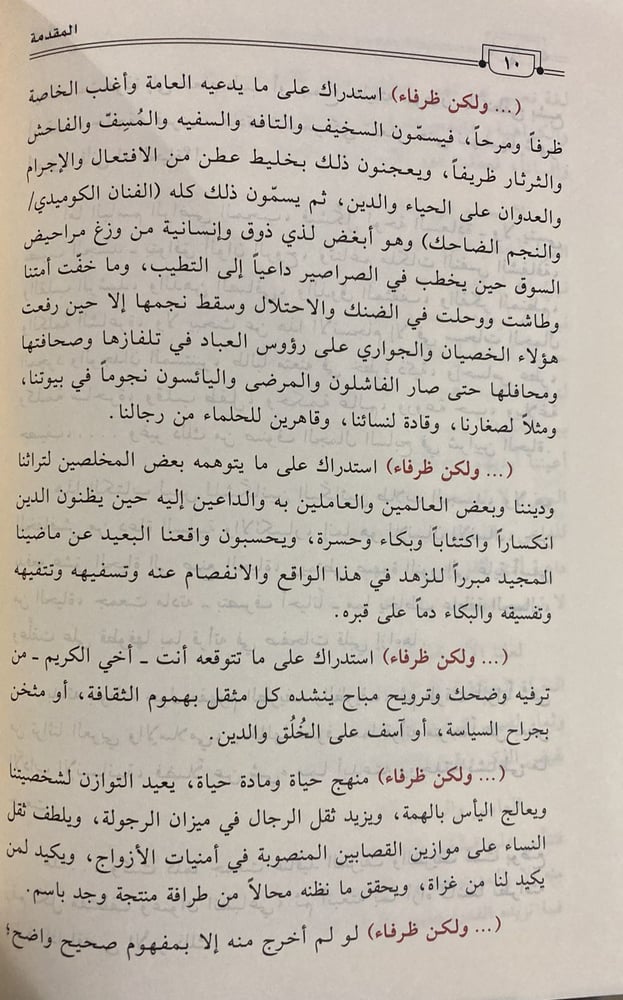
But (the witty ones) are a correction to what the common and most of the private call humor and joy, calling the trivial, insignificant, foolish, vulgar, obscene, and chatterbox funny, mixing that with a foul blend of pretension, crime, and aggression against modesty and religion. They then call all this (the comedic artist and the laughing star), which is more hated by taste and humanity than the filth of market toilets when he preaches to the cockroaches, calling for perfume. And our nation’s decline, chaos, and sinking into hardship and occupation, and the fall of its star, only increased when these eunuchs and maidens were raised on the heads of people on television and newspapers, making the failures, the sick, and the hopeless stars in our homes, and examples for our children, leaders for our women, and conquerors of our wise men.
But (the witty ones) are a correction to what some sincere people think of our heritage, our religion, and some scholars and workers in it and callers to it, when they imagine religion as defeat, depression, crying, and regret, and they consider our distant reality from our glorious past as a justification for renouncing this reality, alienating from it, and mocking it, crying tears of blood over its grave.
A message of attachment and love... But (the witty ones) are a correction to what you, dear brother, might expect—entertainment, laughter, and permissible amusement sought by everyone burdened with the worries of culture, or wounded by the wounds of politics, or regretful of the corrupt morals and religion... But (the witty ones) are a lifestyle and a material of life that restores balance to our personality, treats despair with determination, increases the weight of men in the scale of manhood, softens the burden of women on the scales of the butchers set in the hopes of husbands, and plots against those who plot against us from invaders, and achieves what we think impossible... But (the witty ones) if I did not emerge from productive humor and a clear, correct understanding, I would not have gained anything but a proper, clear concept.

From Dammam