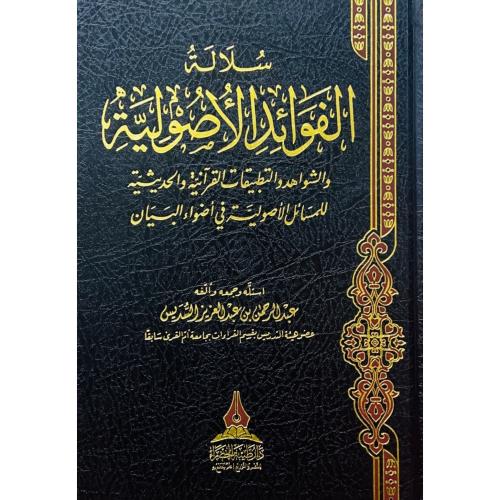
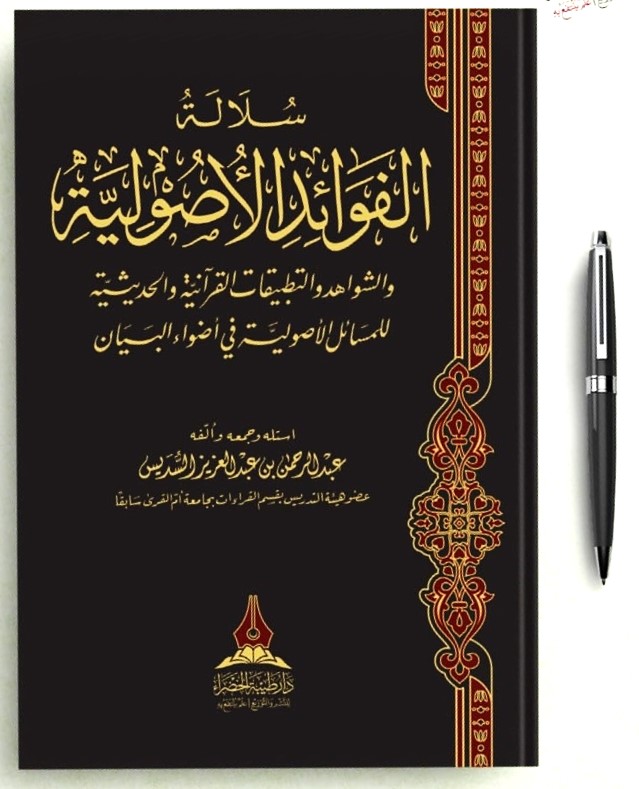
The lineage of fundamental benefits
69ر.س
Product description
Author's name: Abdulrahman bin Abdulaziz Al-Sudais
Publisher: Dar Taybah Al-Khadra
Book size: 17*24
Number of pages: 549
The book "Silsalat Al-Fawa'id Al-Usuliyah, Al-Shawahid, and Al-Tatbiqat Al-Qur'aniyah wa Al-Hadithiyah for the Usul issues in Anwar Al-Bayan" is of great importance as it contains, as the author indicates, numerous Qur'anic and Hadith evidences for the Usul issues presented as practical examples, which facilitates the student of knowledge's understanding and visualization of the issues.
The book includes an introduction, and the first chapter addresses disputed issues in the evidences of transmission, consisting of five sections:
The first discusses writing, with four topics:
The first topic addresses the criterion of irregular readings,
The second discusses the status of different readings,
The third covers the copying of the Qur'an with news of individual transmission,
The fourth includes additions to the text.
The second chapter covers the Sunnah, with two topics:
First: The proof of the Mursal Hadith,
Second: The actions of the Prophet (peace be upon him), their categories, and the extent of proof for each category.
The third chapter addresses consensus, with two topics:
First: The criterion of consensus,
Second: The types of consensus and the extent of proof for each.
The fourth chapter discusses the sayings of the Companion and the extent of proof from them.
The fifth chapter covers the legislation of previous nations and the extent of proof from it.
The second part deals with rational evidences and contains four chapters:
The first chapter discusses analogy, with topics:
The first topic covers the definition of analogy, a summary of its pillars, and its types based on the commonality between the branch and the original, including an introduction to types of ijtihad and the position of analogy among them;
The definition of analogy linguistically and technically,
The pillars of analogy,
The types of analogy based on the commonality between the branch and the original.
The second topic discusses the proof of analogy and refutation of its deniers.
The third topic covers the paths of the 'illah (effective cause) in analogy.
The fourth topic discusses the flaws in the validity of analogy.
The second section discusses the Mursal Maqasid (public interest) and the extent of proof from it.
The third chapter covers istislah (public interest), its types, and the extent of proof from it.
The fourth chapter discusses absolute and partial istinbat (derivation), and the extent of proof from each.
The third part addresses the indications of words, then the conclusion.

From Dammam