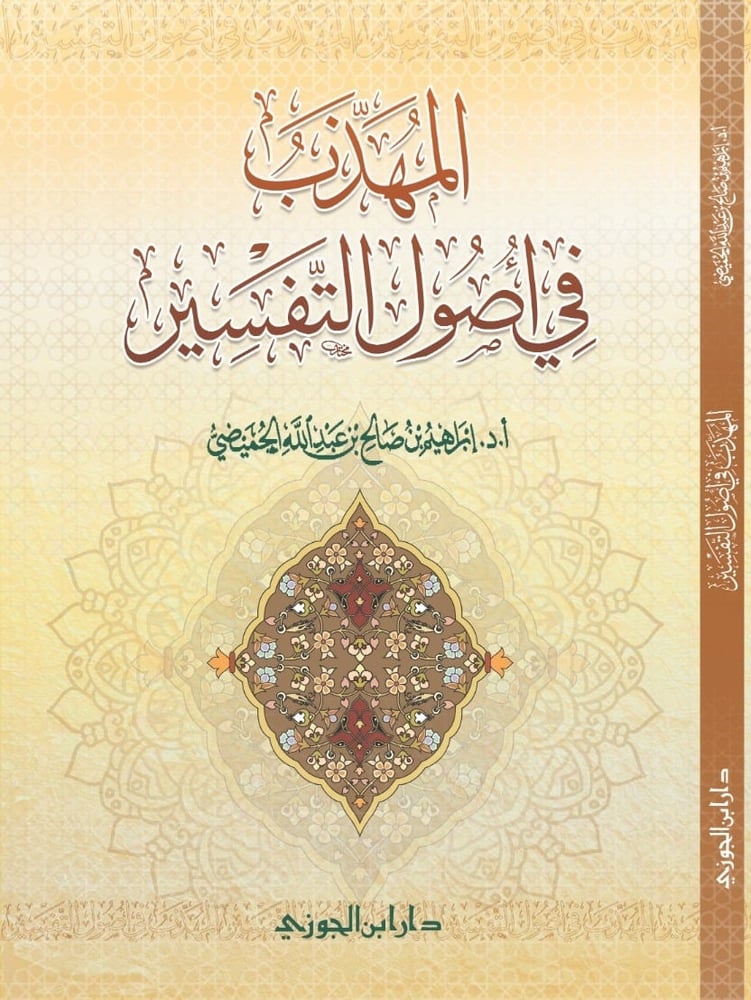
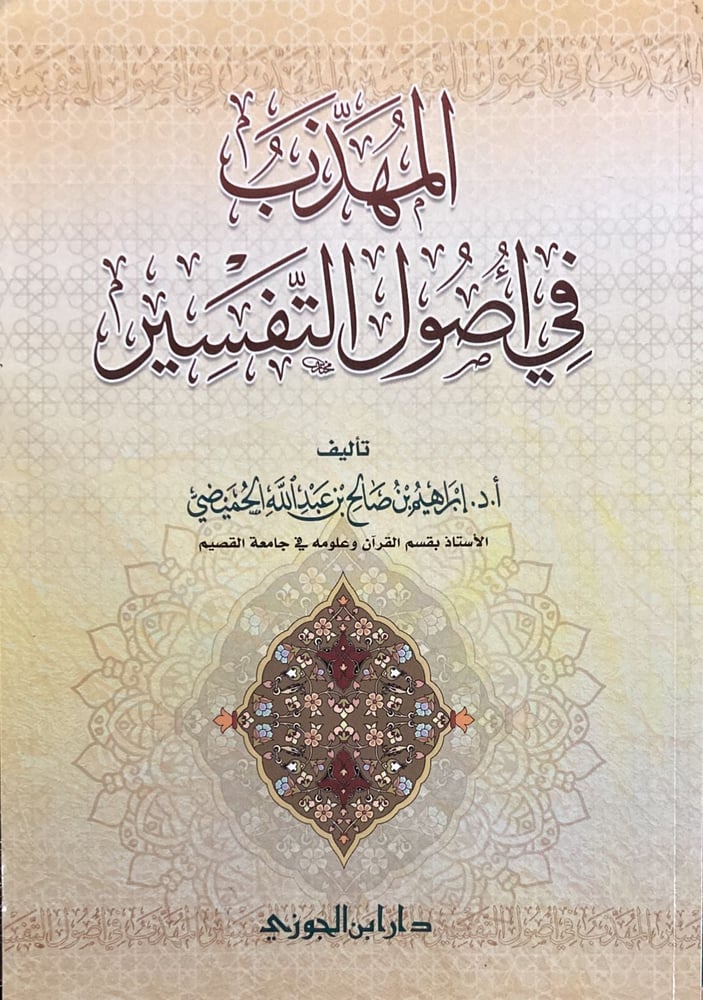


The polite in the principles of interpretation
35.60ر.س
Product description
Authorship Dr. Ibrahim Saleh Al-Humaidi
Introduction
Praise be to Allah, Lord of the worlds, who revealed His Book, the clear guidance, mercy for the believers, and blessings and peace be upon the noblest of prophets and messengers, our Prophet Muhammad, and upon his family and companions all together. To proceed:
The best and most noble of sciences, and the highest, is the science of Tafsir; due to its connection with the Book of Allah the Almighty, which is the best and most honorable of books absolutely.
This noble science has foundations, rules, and principles that must be adhered to, and observed when discussing, studying, and writing about it. Many writings have been authored on this science by contemporary scholars. After reviewing them and teaching some of them, it became clear to me that there is still a need for new writings that combine faithfulness to the topics of this science, their clarification, ease of presentation, and illustration.
I have benefited from what has been written on this subject, especially the individual studies on specific issues within it, which are very numerous, most of which are university theses, as they are more comprehensive and better edited than general books. I named this book "The Refined in the Foundations of Tafsir."
It contains five chapters, as follows:
Chapter One: An introduction to the science of the roots of Tafsir, its importance, and the most famous writings on it. It includes five sections, in which I defined the roots of Tafsir, its topics, the fruits of studying it, its virtue, and the importance of Tafsir, along with the most important writings in the science of the roots of Tafsir.
Chapter Two: Sources of Tafsir, including an introduction and seven sections. I discussed the six sources of Tafsir: the Noble Qur'an, the Sunnah of the Prophet, the sayings of the Companions, the sayings of the Tabi‘un, the Arabic language, and opinion. I also discussed the Isra'iliyyat (Jewish-Christian narrations) in Tafsir.
Chapter Three: Differences among interpreters, including an introduction and four sections. I addressed the stance on differing interpretations, types of differences in Tafsir, reasons for disagreement, and consensus in Tafsir.
Chapter Four: Conditions and manners of the Mufassir (interpreter), including two sections. I discussed the conditions and manners required of the Mufassir.
Chapter Five: Rules of Tafsir, including an introduction and three sections. I defined the rules of Tafsir, explained their importance, and provided examples.
These are comprehensive according to the standards of the National Authority for Assessment and Accreditation, set for this curriculum, with important additions.
The arrangement of these sections and the issues and branches included under them is subject to effort and judgment. I have endeavored to organize and classify them, considering importance, simplifying the information, and correlating related topics and issues.
I initially intended to combine the roots of Tafsir and the methodologies of the interpreters into one book, due to their overlap and shared aspects, to ease studying for those interested in both. However, some esteemed colleagues advised me to separate them, as they have become independent disciplines in this era. Therefore, I dedicated each to a separate book.
I hope that the student of this book, along with its counterpart "Methodologies of the Interpreters," will gain a comprehensive understanding of the fundamentals, rules, and regulations of Tafsir, reasons for deviation, knowledge of its methodologies and trends, and the ability to distinguish between sound and deviant interpretations, especially if their study is under a specialized scholar, with attention to practical aspects.
In the interest of brevity without neglect, I avoided detailed elaboration on some issues, only mentioning them briefly in footnotes, and referred the reader to relevant sources from old and contemporary books.
In this research, I adopted a descriptive and analytical approach, adhering to known scientific research procedures: I linked verses to their surahs, traced hadiths and reports, verified sources from original references, clarified ambiguous matters, summarized discussions, and simplified issues with clarification and examples. I also set general objectives for studying the book, added mind maps to clarify topics, and concluded each chapter with questions and practical exercises.
I have strived to gather, organize, review, and refine the topics of this book, consulting many sources from both early and later scholars. I also relied on the opinions of some of my teachers and colleagues on certain issues. I did not expect that this book—along with its counterpart "Methodologies of the Interpreters"—would take as much time and effort as they did, despite acknowledging shortcomings and deficiencies.
In conclusion, I thank Allah the Almighty for enabling me to complete this research. I pray that Allah benefits from it, makes it a treasure for me in serving His Noble Book, and I thank the esteemed colleagues who reviewed it before publication. I also ask my fellow readers, especially those involved in teaching, to provide me with their observations and suggestions for additions and improvements.
May Allah grant success, guidance, sincerity in speech and action, and help us understand His Book and act upon it. Indeed, my Lord is near, responsive.
Author
Dr. Ibrahim Saleh bin Abdullah Al-Humaidi
Professor in the Department of Qur'an and Sciences at Qassim University
12/8/1439 AH

From Dammam