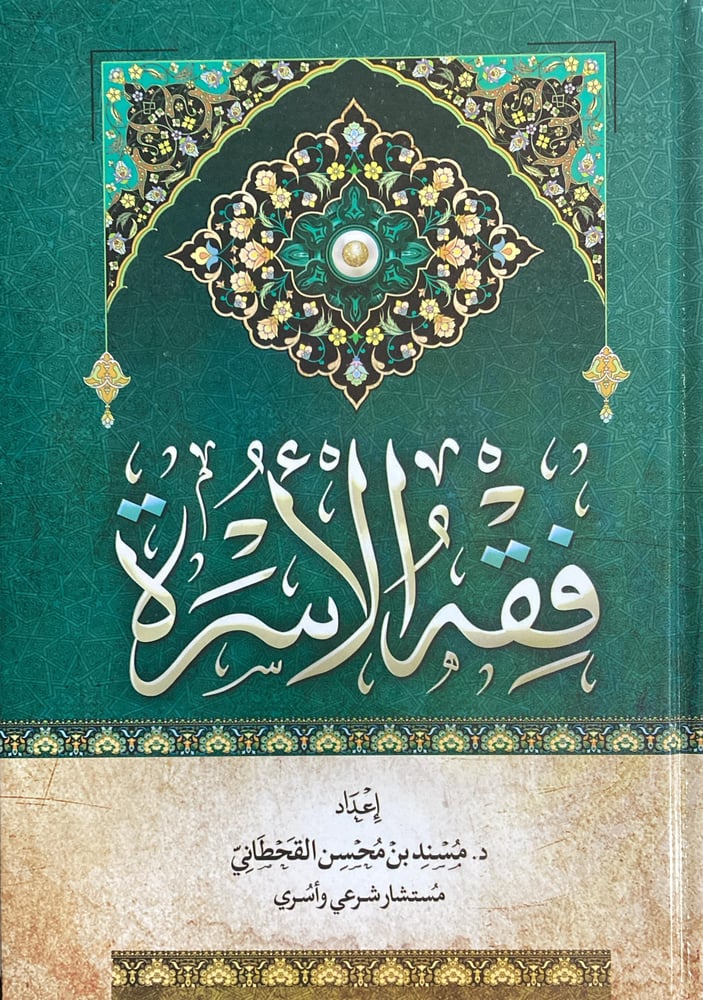


Family Jurisprudence
18.40ر.س
Product description
Dr. Masnad bin Mohsen Al-Qahtani
Praise be to Allah who completed for us the religion and perfected for us the blessing, and was pleased with Islam as our religion. And peace and blessings be upon our Prophet Muhammad, who was the best among us for his family. May Allah's peace and blessings be upon him, his family, and all his companions.
After:
Among the completeness and virtues of the Islamic Sharia is its comprehensiveness for everything a Muslim needs in worship and transactions, including rulings, manners, and regulations. Among these are the rulings related to marriage and what pertains to it, which are mentioned in the Noble Quran and not only in the Sunnah, as jurists, may Allah have mercy on them, have addressed in all books of jurisprudence with explanation and detail.
I have selected a group of these rulings from the book "Easy Fiqh," issued by the Ministry of Islamic Affairs, Dawah, and Guidance in the Kingdom of Saudi Arabia, prepared by a select group of scholars. It is concise, comprehensive, and easy to understand, supported by evidence from the Book and Sunnah. These rulings include: (marriage, dowry, the rights of spouses, divorce, irrevocable oaths, al-ziyad, mutual accusations, waiting periods, breastfeeding, guardianship, and expenses).
To enhance benefit, I have written brief and simple comments, mostly from the fatwas of the Permanent Committee for Scholarly Research and Ifta in the Kingdom, as well as from the Personal Status Law issued by the Kingdom under Royal Decree No. (M/73) dated 1443/8/6 AH.
I marked these comments with ( ) and kept the original margins of the book. I elaborated only on one issue: (the ruling on innovation in divorce) — due to the importance of this matter and its significant impact on the Ummah. I quoted from several scholars and researchers, both early and late, their opinion that such divorce does not occur, as you will see in this book.
May Allah reward the scholars of the Ummah who revealed this ruling and faced trials and hardships for its sake, such as: Sheikh al-Islam Ibn Taymiyah and his student Ibn al-Qayyim — may Allah have mercy on them — and reaching Imam Abdul Aziz bin Abdullah bin Baz — may Allah have mercy on him — the former Grand Mufti of Saudi Arabia, who declared this ruling since he was a judge in Al-Kharj in 1362 AH (1942 AD). He remained firm in his stance despite strong opposition until the Permanent Committee for Ifta adopted it, and it was recently incorporated into the Personal Status Law in Saudi Arabia.
This book is called "Family Fiqh"; it is a name agreed upon by many contemporary scholars for the selected rulings.
I ask Allah to grant us understanding of the religion, to make us guided and guides, not astray nor leading astray, and to grant us from our spouses and offspring comfort for our eyes. And to make us Imams for the righteous, forgive our parents and scholars.
All praise be to Allah, Lord of the worlds.
Written by: Dr. Masnad bin Mohsen Al-Qahtani
12/9/1445 AH
2024/3/22 AD

Questions you might have


