

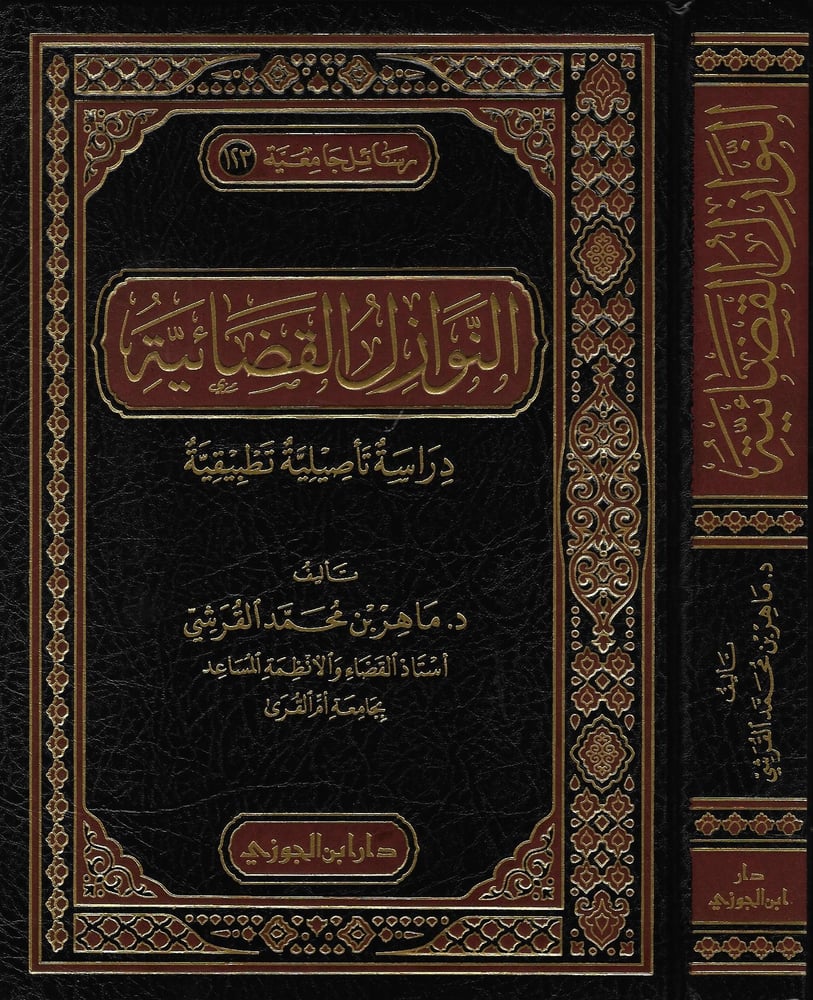
Judicial incidents: an analytical and applied study
60.95ر.س
Product description
Author's name: Maher Mohammed Al-Qurshidar
Publisher: Dar Ibn Al-Jawzi - Dammam
Book format: Artistic binding, suede paper
Publication date: 1441-2019 AH
Book size: 17×24
Number of pages: 560
Document type: Graduate thesis
Thesis title: Judicial issues, foundational and applied study
Subject: College of Arts and Humanities
Document language: Arabic
Abstract: The problem of the study: is that the reality of judicial issues and their study methodology have not received enough attention in academic studies, and even those studies that addressed judicial issues did not focus on the foundational aspect of this science and its research methodology.
Therefore, the problem of the research is summarized in these questions: What is the reality of judicial issues? And what is the difference between them and jurisprudential and legal issues? And what is the methodology for studying judicial issues? And how is the judicial issues methodology applied to new issues?
This study aims to: clarify the reality of judicial issues, explain the difference between them and jurisprudential and legal issues, demonstrate the scientific methodology in their study, and how to apply the judicial issues methodology to new issues.
The importance of this study is evident through the need to enrich the judicial library by foundationally studying new issues in the judicial sector.
The method followed in this study is the descriptive analytical method.
The study includes an introduction, three chapters, and a conclusion.
Chapter One: The scientific foundation of judicial issues, including three sections:
- Section One: The reality of judicial issues
- Section Two: The importance of ijtihad in judicial issues
- Section Three: Sources of judicial issues
Chapter Two: The scientific foundation for the methodology of researching judicial issues, including three sections:
- Section One: The examiner of the judicial issue
- Section Two: Methods of identifying the ruling on the judicial issue
- Section Three: The methodology of studying the judicial issue
Chapter Three: The applied study of judicial issues, including three sections:
- Section One: Issues in criminal punishment
- Section Two: Issues in civil punishment
- Section Three: Issues in administrative punishment
The most important findings of this study are:
First: Original judicial issues are new facts in worldly punishment that require a binding Sharia ruling.
Second: Subsidiary judicial issues are new facts in acts related to the judiciary that require a binding Sharia ruling.
Third: Jurisprudential issues are broader than judicial issues, as they cover all branches of jurisprudence, unlike judicial issues which are specific to transactions; jurisprudential issues focus on deriving the legal ruling in general, whereas judicial issues focus only on deriving the worldly punishment ruling.
Fourth: Legal issues are more specific than judicial issues in one aspect, which is applying the legal rule to specific facts, while judicial issues include researching the legal rule and applying it to specific facts, and are broader in another aspect, as they include various facts that do not require creating a new legal rule, whereas judicial issues are concerned only with new facts.
Fifth: The outcome of a judicial issue is clarifying the worldly punishment and obligating it, and the worldly punishment has three types: criminal, civil, and administrative. The worldly punishment is divided into substantive punishment and procedural punishment.
Sixth: The proposed methodology for researching judicial issues consists of four stages: starting with the subject of the judicial issue, then the outcome of the judicial issue, then classifying the judicial issue, and ending with formulating the judicial issue.
Based on the study results, the most important recommendations are:
First: The importance of establishing judicial councils where specialists in Sharia and law meet to discuss judicial issues.
Second: Benefiting from the proposed methodology in this study to research judicial issues.
Third: Guiding postgraduate students in the field of judicial studies to research types of worldly substantive punishment.
Fourth: Guiding postgraduate students in the field of judicial studies to research types of worldly procedural punishment.
Fifth: The importance of studying subsidiary judicial issues.
Sixth: The importance of foundational and applied legal studies.
Supervisor: Prof. Dr. Abdulrahman bin Nafi’ Al-Sulami
Type of thesis: Doctoral thesis
Year of publication: 1440 AH / 2019 AD

From Dammam