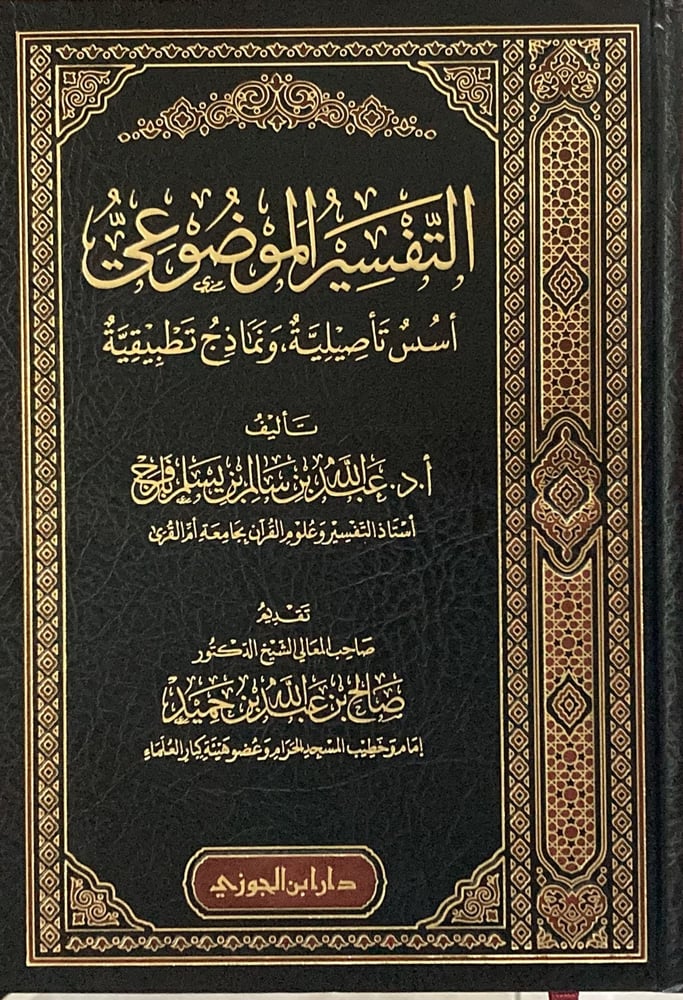



The thematic interpretation: foundational principles and applied models
70.15ر.س
Product description
Authorship Dr. Abdullah bin Salim Bafraj
Presentation by His Excellency Dr. Saleh Al-Humaid
Part of the introduction
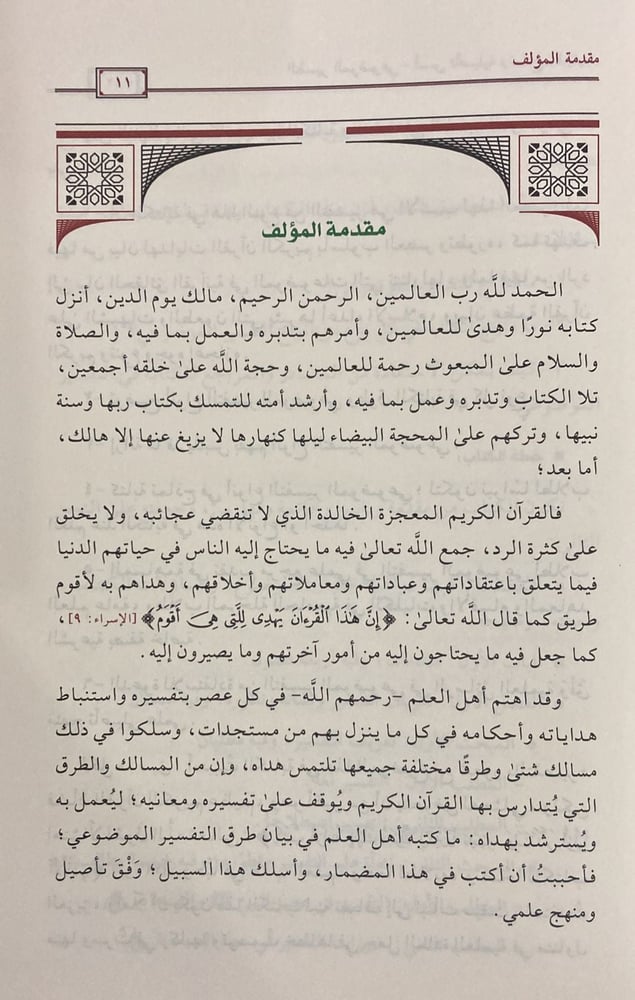
Praise be to Allah, Lord of the worlds, the Merciful, the Compassionate, the Owner of the Day of Judgment, He revealed His Book as a light and guidance for the worlds, and commanded them to contemplate it and act upon what is in it. Peace and blessings be upon the sent one, a mercy to the worlds, and the proof of Allah to His creation altogether. He recited the Book, pondered it, acted according to it, guided his nation to adhere to the Book of their Lord and His Sunnah, and left them on the white path, its night like its day, none deviates from it except the doomed.
As for after; the Holy Quran, the everlasting miracle, whose wonders never end, and which does not become old despite many responses, Allah Almighty gathered in it what people need in their worldly life concerning their beliefs, worship, transactions, and morals. He guided them to the straightest path, as Allah said: (Indeed, this Quran guides to that which is most suitable) [Al-Isra: 9]. It also contains what they need regarding their Hereafter and what they will become.
Scholars, may Allah have mercy on them, have taken care of interpreting it and deriving its guidance and rulings in every new matter that arises to them, using various methods and different approaches, all seeking its guidance. Among the methods and approaches used to study the Quran and understand its interpretation and meanings, the writings of scholars on the methods of thematic interpretation are highly regarded. I wanted to write about this field and follow this approach according to a scientific and foundational methodology.
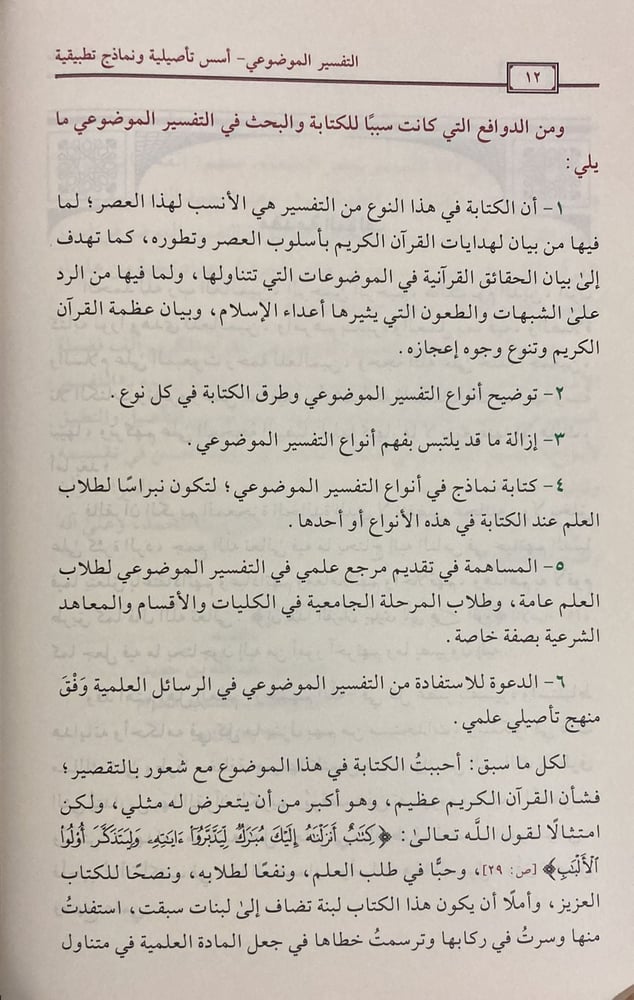
The motivations that prompted me to write and research in thematic interpretation are:
1- Writing in this type of interpretation is the most suitable for this era, as it clarifies the guidance of the Holy Quran in a style that matches the times and their development. It aims to clarify the Quranic facts on the topics it addresses, and to respond to doubts and accusations raised by enemies of Islam, as well as to demonstrate the greatness of the Quran and the diversity of its miraculous aspects.
2- Clarifying the types of thematic interpretation and methods of writing in each type.
3- Removing any confusion regarding the understanding of the types of thematic interpretation.
4- Writing models for the types of thematic interpretation to serve as a beacon for students of knowledge when writing in these types or one of them.
5- Contributing to providing a scientific reference in thematic interpretation for students of knowledge in general, and for university students in colleges, departments, and Islamic institutes in particular.
6- Inviting to benefit from thematic interpretation in scientific foundational research.
For all the above, I loved to write about this topic, despite feeling somewhat inadequate; the matter of the Quran is great, and it is beyond the capacity of someone like me to fully address it. However, in obedience to Allah’s saying: "A Book which We have sent down to you, blessed, that they may ponder over its verses and that those of understanding may be reminded" [Saad: 29], and out of love for seeking knowledge, benefiting its students, and sincerely advising the Holy Book, I hope this book will be a building block added to previous ones, from which I have benefited, and I have followed its footsteps, aiming to make the scientific material accessible to students. I titled it: "Thematic Interpretation: Foundational Principles and Practical Models."
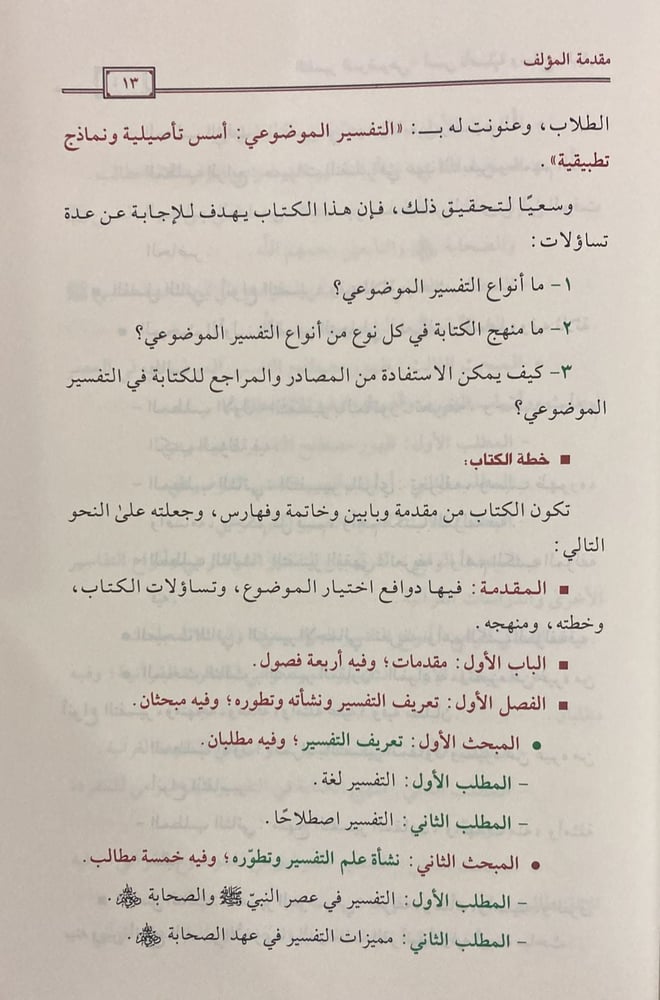
In pursuit of this, this book aims to answer several questions:
1- What are the types of thematic interpretation?
2- What is the methodology of writing in each type of thematic interpretation?
3- How can sources and references be utilized for writing in thematic interpretation?
Book plan:
It will consist of an introduction, two main parts, a conclusion, and indexes, arranged as follows:
Introduction: includes motivations for choosing the topic, the book’s questions, its plan, and methodology.
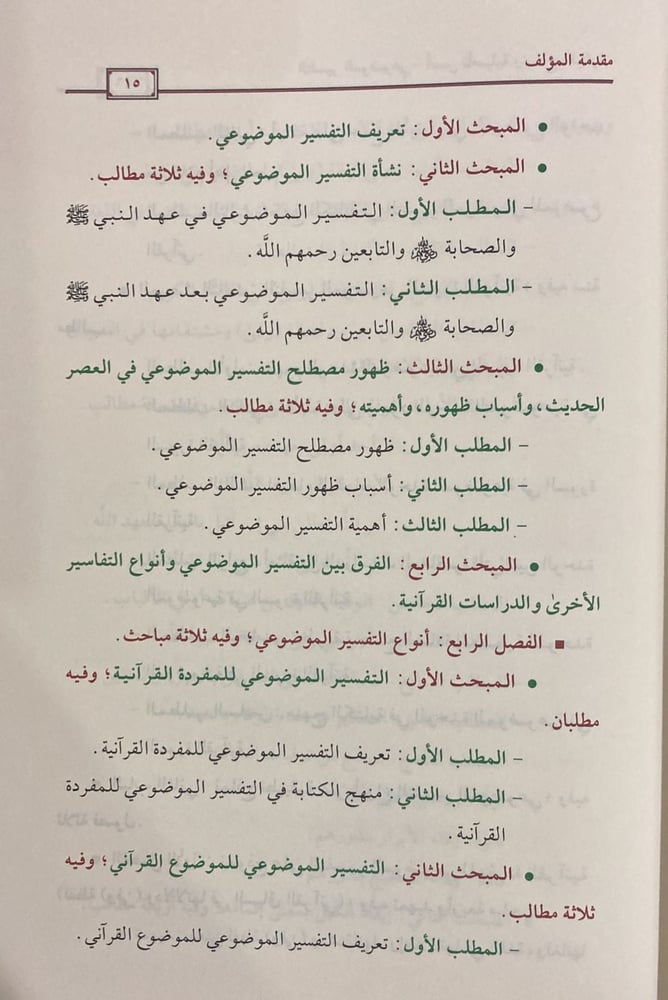
First part: Preliminaries; and it contains four chapters.
Chapter One: Definition of interpretation, its origins, and development; including two sections.
Section One: Definition of interpretation; with two topics.
- Topic One: Interpretation linguistically.
- Topic Two: Interpretation in terminology.
Section Two: The emergence and development of the science of interpretation; with five topics.
- Topic One: Interpretation during the time of the Prophet and the Companions.
- Topic Two: The features of interpretation in the era of the Companions.

From Dammam