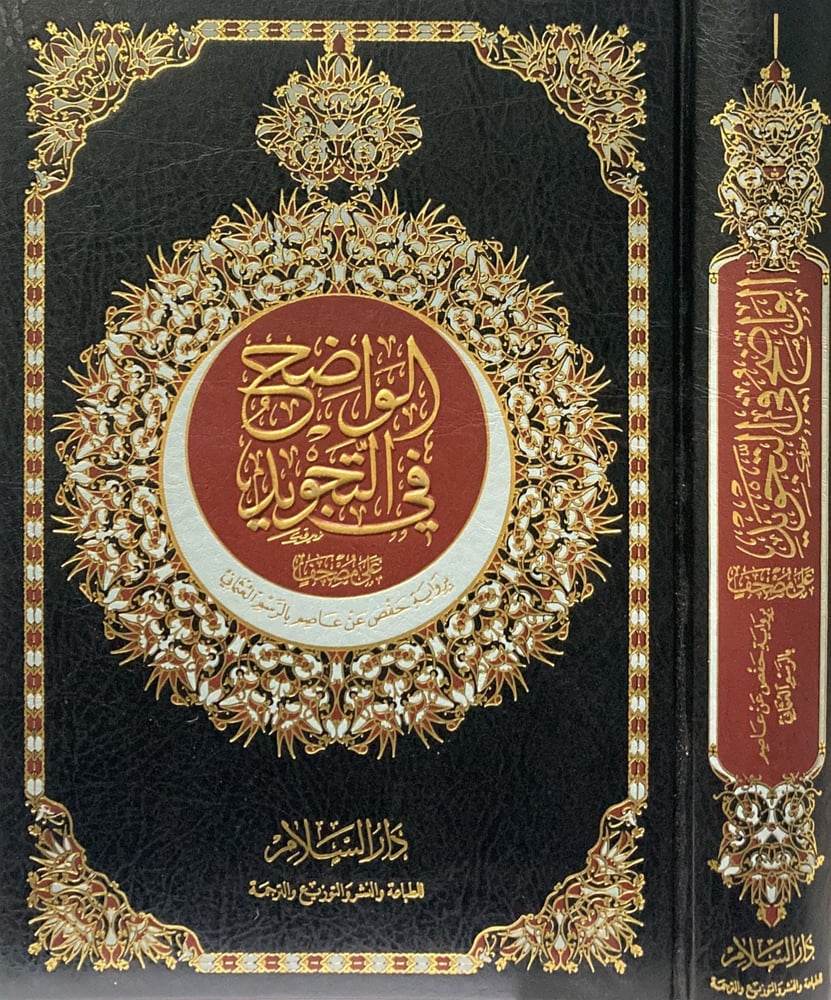
The clear in the intonation center 17*24
69ر.س
74.75ر.س-8%Out of Stock
Product description
Mohammed Naim Mohammed Hani Al-Saai
Clear in Tajweed on the Mushaf with Hafs narration from Asim
Clear in Tajweed on the Mushaf with Hafs narration from Asim in the Ottoman script and the most notable features of this blessed project, God willing:
1- Clarity and avoidance of concealment, with Tajweed rules explicitly indicated.
2- Avoidance of multiple colors, relying on a single color.
3- Maintaining the clarity of the Mushaf and distinguishing its verses from symbols and terminology, making the verses easy to read in isolation from all that.
4- Detailing the Tajweed rules related to the broken letters of the Qur'an at the beginning of Surahs, which previous experiments and projects lacked.
5- Specifying the locations of Tajweed rulings.
6- We considered in writing the rules the stopping at the heads of the Ayat without connecting, according to our preferred method.
7- We preserved the Ottoman script as it is, keeping all terminology in black ink without any change.
Idea: Mohammed Naim Mohammed Hani Al-Saai
Prepared by: Dar Al-Salam for Printing, Publishing, Distribution, and Translation
The most notable features of the clear Tajweed:
1- An idea that has become a reality: the idea is summarized in combining the preservation of the dignity and reverence of the Holy Qur'an and facilitating the learning of Tajweed rules.
2- One color: indicating Tajweed rules, where the letter related to the rule is colored blue.
3- Explicit in phrase: we relied on explicitly mentioning the Tajweed rules above the letter where the rule applies.
4- Places of whispering: the whispering letters are colored, provided they are silent, and the word "whisper" is placed above them, as well as if they are silent due to stopping at the heads of the Ayat.
5- Places of Qalqalah: the Qalqalah letters are colored, provided they are silent, and the word "Qalqalah" is placed above them, as well as if they are silent due to stopping at the heads of the Ayat.
6- Type of elongation: differentiation was made between obligatory and permissible elongation with numbers. If the elongation is obligatory, a number one is placed next to the word "Mad"; if permissible, two or more numbers are placed, separated, to indicate the reader's choice among the number of elongations.
7- Rules of the silent Nun, Tanween, and silent Meem: the silent Nun and Tanween are colored, and the type of rule is explicitly written above them, with the number (2) placed next to rules of concealment, assimilation with nasal sound, and reversal, as well as the silent Meem with concealment and assimilation, indicating prolonging the nasal sound for two movements.
8- Rules of the Raa (ر) of Tashdeed (emphasis) and Tafrigh (lightening): the silent heavy Raa (ر) is colored blue. As for the silent Raa that can be either heavy or light, we chose to emphasize it and colored it accordingly.
9- Elegant edition: we used a suitable color for the background of the Mushaf with a decorative frame in matching colors, and made the general text of the Mushaf in black, with the Tajweed rules highlighted in blue.

From Dammam