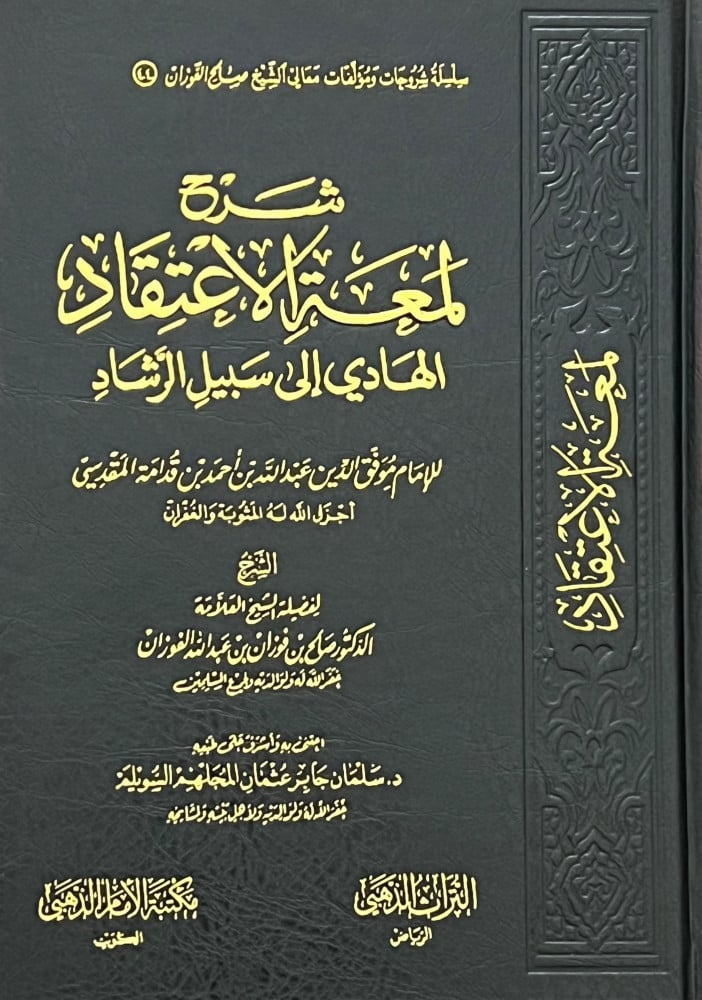
Explanation of the shining of belief guiding to the path of guidance
34.50ر.س
Out of Stock
Product description
Sheikh Saleh Al-Fawzan took care of him and supervised his printing. Salman Jaber Othman Al-Majli Al-Suweilem explained the luminous guide to the path of guidance | Muwaffaq Al-Din Abi Muhammad ibn Abdullah ibn Ahmad ibn Qudama Al-Maqdisi | Saleh ibn Fawzan ibn Abdullah Al-Fawzan. This is an intermediate explanation of the book "Luma'ah Al-Mustalah," a famous work by Manjuh Al-Din ibn Qudama, which contains a rich collection of specialized issues summarized briefly. Sheikh Saleh Al-Fawzan – may Allah preserve him – clarified this book and explained it to his students, in addition to clarifying and elucidating its issues and indicating their meanings. Then, the one who cared transcribed this explanation from the recorded tapes to make it a book that benefits widely and is easy to access, along with the well-known participation in the questions answered by the Sheikh for sharing. It is paired with their answers at the end of the book, along with diverse scientific indexes, and includes a brief biography of Muwaffaq Al-Din ibn Qudama – may Allah have mercy on him.
"Luma'ah Al-Mustalah," by the scholar Ibn Qudama Al-Maqdisi – may Allah have mercy on him. This treatise clarifies the creed of Ahl al-Sunnah wal-Jama'ah regarding names and attributes, predestination, the Day of Resurrection, what is obligatory towards the Companions, and the stance on innovators. It was compiled into a book that includes three topics:
1 – The introduction of the sects.
2 – Clarification of the method of the Salaf and the best generations in verses and Hadith of the edition.
3 – Warning against innovation in religion and following other than the method of the Salaf in names, attributes, and leadership.
Then, it has a chapter mentioning some of Allah’s attributes – glory be to Him – and mentions sixteen attributes of Allah, such as:
1 – The attribute of the face.
2 – The attribute of the hands.
3 – The soul.
4 – The coming.
5 – The coming (approach).
6 – The pleased.
7 – The love.
8 – The Messiah.
9 – The line.
10 – The hated.
11 – The descent.
12 – The admiration.
13 – The laughter.
14 – The sovereignty (Istawa).
15 – The highness (Al-‘Ulu).
16 – The speech.
17 – The vision of the believers on the Day of Resurrection.
18 – Then, the active attribute of what He wills, along with mentioning the attributes of will and power accordingly.
This is in terms of beauty, but specifically, it also mentions many verses of healing and a set of Hadiths, with twenty-eight descriptions of beneficial remedies. After mentioning a group of cures, it then reminds of the Salafi methodology in healing, which can be extended or summarized. It initially mentions thirteen descriptions, then follows with the methodology of the Salaf, which is the first level of complexity. Then, it returns again to mention some traditional methods, highlighting two important attributes often debated: the attribute of Al-‘Ulu (highness) to control the air, then returns to complexity again, mentioning the Salafi approach, quoting Malik’s method of the Salaf. Then, it discusses the attribute of speech for Allah – glory be to Him – and elaborates on it, then talks about the Quran at length, and discusses the attribute of will, then the believers on the Day of Resurrection, elaborating on that as well, before concluding with the verses and Hadiths mentioned.
What is noticeable about that – may Allah have mercy on him – is that when he discusses the wonderful technique of the following thinker:
1 – He emphasized affirming it, and that the Salaf affirm it and use evidence for that, and does not prohibit the doctrines of the Mu’attila (those who deny Allah’s attributes) regarding the technique.
2 – The treatment he mentioned at the end.
3 – He did not prohibit the ruling of those who deny an attribute through traditional methods.
4 – He does not respond to the sect of the Mu’attila, nor discuss their features.
Then, faith, then faith in the unseen, the virtues of the Messenger – peace be upon him –, virtues of the Islamic nation, virtues of some individuals of the nation, a chapter on who is in Paradise or Hell, issues related to the Imamate, issues of the Companions and their leadership, issues related to the wives of the Prophet – peace be upon him –, issues related to Muawiya – may Allah be pleased with him –, issues related to Imamate, issues related to innovation and the people of heresy, issues of affiliation and naming.

From Dammam