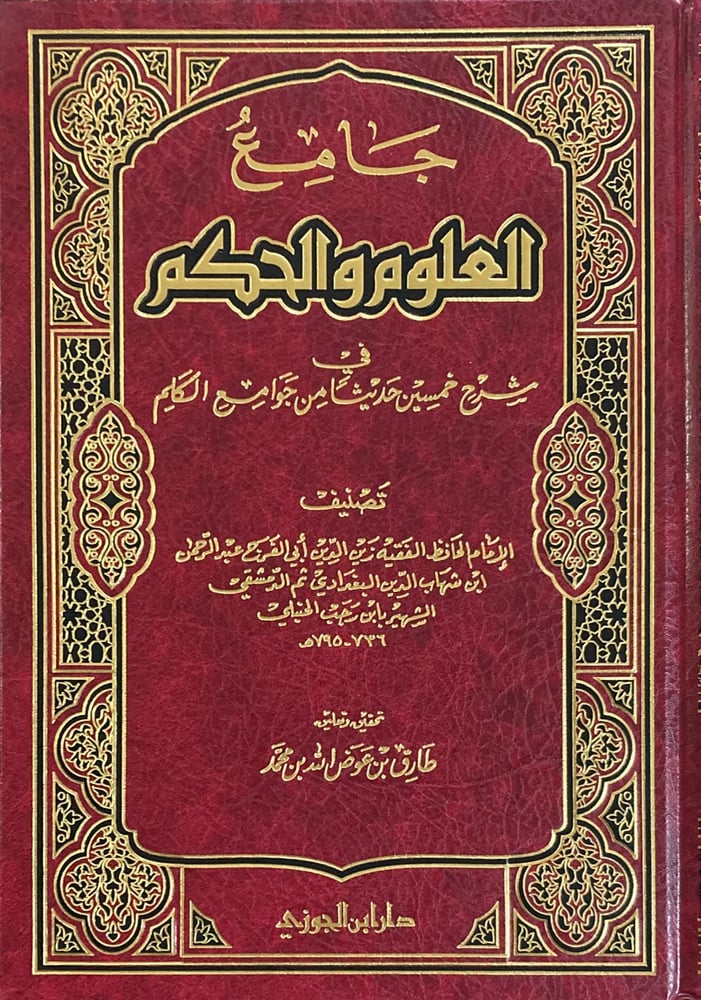



The Mosque of Knowledge and Wisdom "Tariq Awad Allah"
60.95ر.س
Product description
Forward son Rajab
Researcher Tariq Awad Allah
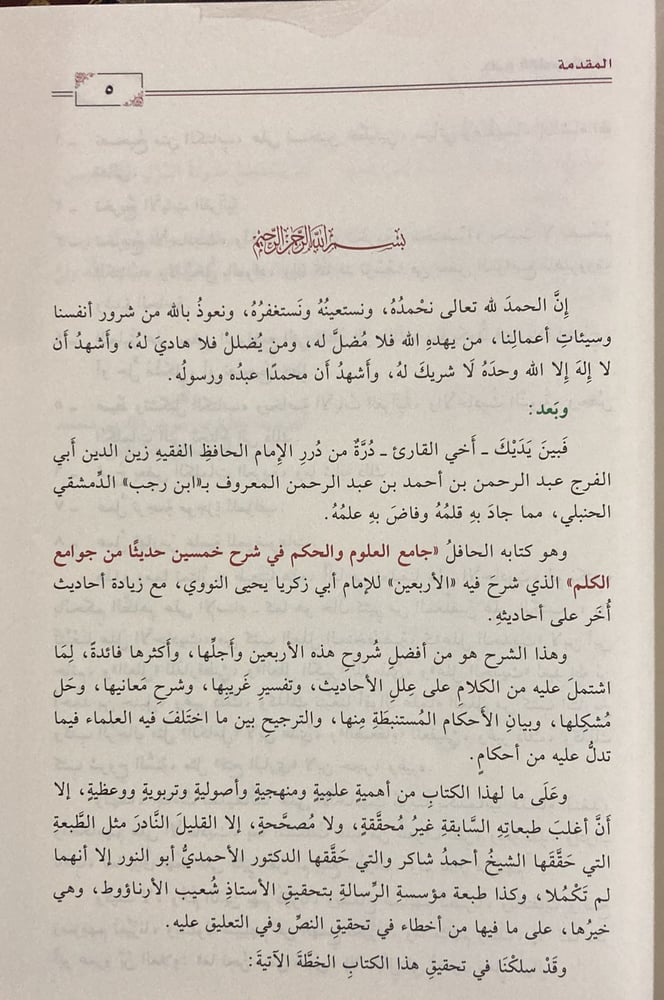
Introduction
In the name of Allah, the Most Merciful, the Most Compassionate
All praise be to Allah, we praise Him, seek His help, and ask for His forgiveness. We seek refuge in Allah from the evil of ourselves and the wickedness of our deeds. Whomever Allah guides, there is no misleader for him, and whomever He misleads, there is no guide for him. I bear witness that there is no deity but Allah alone, with no partner, and I bear witness that Muhammad is His servant and Messenger.
After:
Before you, my brother reader, is a pearl among the pearls of the Imam, the Hafiz, the jurist, Zain al-Din Abu al-Faraj Abd al-Rahman ibn Ahmad ibn Abd al-Rahman, known as "Ibn Rajab al-Dimashqi al-Hanbali," from what his pen has generously produced and his knowledge has overflowed with.
It is his comprehensive book, "Jami' al-'Uloom wal-Hikam fi Sharh Khamsin Hadithan min Jawami' al-Kalim," in which he explains the forty hadiths of Imam Abu Zakariya Yahya al-Nawawi, with additional hadiths beyond his own.
This explanation is among the best and most noble of the explanations of these forty hadiths, and the most beneficial, because it includes discussion of the weaknesses of the hadiths, explanations of their strange words, clarification of their meanings, solving their ambiguities, and demonstrating the rulings derived from them, as well as weighing the differences among scholars regarding the rulings they indicate.
Despite the scientific, methodological, foundational, educational, and admonitory importance of this book, most of its previous editions are neither verified nor authentic, except for a few rare editions, such as the edition verified by Sheikh Ahmad Shakir and the edition verified by Dr. Al-Ahmadi Abu Al-Nour, though both were incomplete. Also, the edition by the Maktabah al-Risalah, edited by Professor Shuaib al-Arna’ut, is better, despite some errors in verifying the text and commentary.
In our approach to editing this book, we followed the following plan:
1. Correcting the text of the book based on two handwritten copies, which will be described, God willing.
2. Extracting the Quranic verses.
3. Extracting the hadiths and most of the sayings, with a brief chain of narration, so as not to enlarge the book or to compromise its purpose, although we expanded in some places out of necessity and urgent need.
4. Commenting on some sections that require clarification, to add explanation, solve ambiguities, or correct errors.
5. Correcting and diacritizing the book, especially the Quranic verses, the Prophetic hadiths, and some words that need it.
6. Explaining some strange words and similar matters.
7. Preparing a brief biography of the author.
8. Creating scientific indexes for the topics.
This edition is distinguished by that in our commentary on the hadiths, we did not limit ourselves to the apparent judgment on the chain of narration—as many commentators on books do—but we traced the weaknesses of the hadiths from specialized books of weaknesses, such as "Ilal al-Hadith" by Ibn Abi Hatim, "Al-'Ilal" by Al-Daraqutni, "Al-'Ilal al-Kabir" by Tirmidhi, "Ilal al-Hadith" by Abdullah ibn Ahmad ibn Hanbal, and others. We also followed the opinions of scholars of weaknesses from history books and men’s books, such as "Al-Kamil" by Ibn 'Adi, "Al-Du'afa" by Al-'Aqili, and others, as well as the Sunnah, like "Fath al-Bari" by Ibn Hajar, and others.
Our comments on the hadiths are decorated with words of scholars of critique and their judgments on the hadiths, including insightful perspectives, precise critique, and sharp understanding, which are often beyond the grasp of many who have not reached their level.
And how could it be otherwise, when they are the ones through whom we are mentioned, and by their luminous light we see, and by following their clear traces we distinguish, and by their path we avoid barbarism. As Abu Amr ibn al-'Alā said: "We are nothing compared to those who have gone before us except like a stalk in the roots of tall date palms." And as the first said:
"And the son of Laban, when they lean in a horn, cannot reach the strength of the Buzl’s spear."
In conclusion:
I ask Allah, the Most Generous, to benefit people of knowledge and students with this book, and to make it, along with our other works, a treasure for us on the Day of Meeting Him. And may He not make it a burden upon us, by His grace and mercy. Indeed, He is the Guardian and the Capable.
And prayers and peace be upon Muhammad, his family, and companions.
Written by Abu Mu'adh Tariq bin Awad Allah bin Muhammad
Director of the Investigation Department at Dar al-Haramain

From Dammam