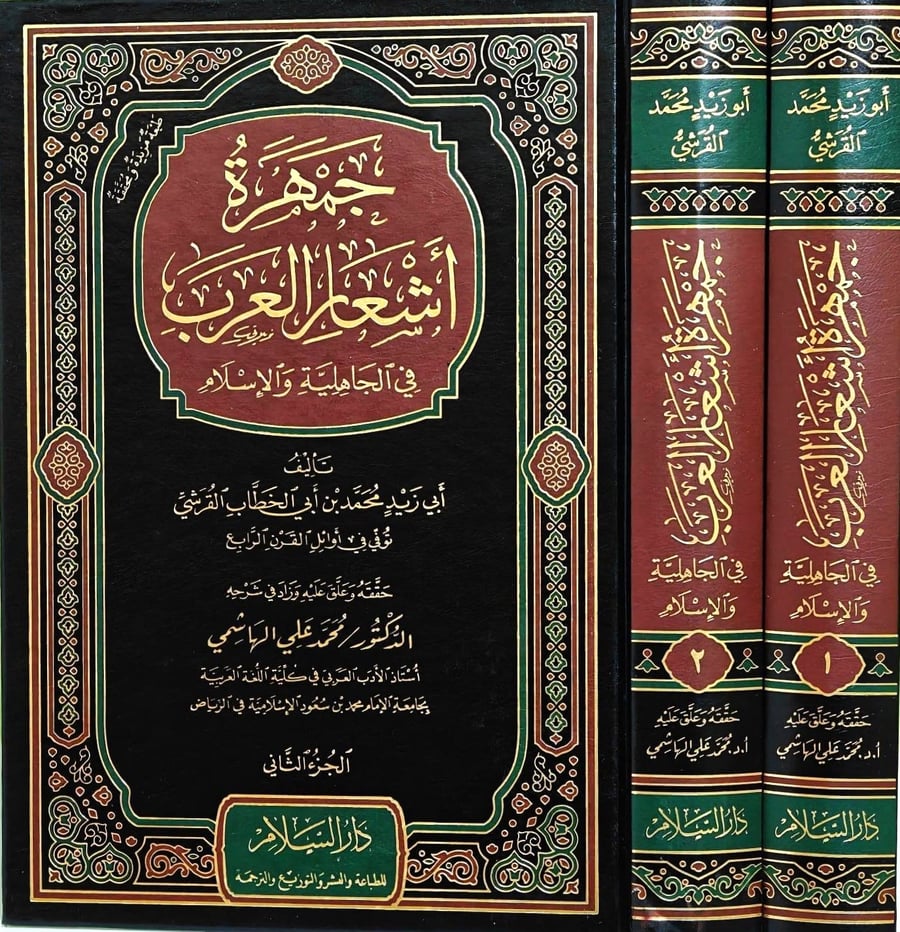
Collection of Arab poetry in the pre-Islamic era and Islam 1-2
103.50ر.س
Out of Stock
Product description
Collection of Arab poetry in the Pre-Islamic era 1-2, edited and commented on, with additional explanations by Dr. Mohamed Ali Al-Hashimi.
Note: Collection of Arab poetry in the Pre-Islamic era and Islam.
May Allah have mercy on him.
Authored by: Abu Zaid Muhammad ibn Abi Al-Khatab Al-Qurashi.
Edited and commented on by: Dr. Mohamed Ali Al-Hashimi.
Supervised by: Dr. Shukri Diif, may Allah have mercy on him.
Publisher: Dar Al-Salam.
Number of volumes: 2.
Printed in black ink, very clear script on white paper.
Delivery available to all provinces.
Book description:
*Book: (Jumhura Ash'ar Al-Arab) known abbreviately as (Al-Jumhura) by Abu Zaid Al-Qurashi.
An important author who compiled a selected collection of pre-Islamic, transitional, and Islamic Arab poetry, including poems that were not included in any previous book. It thus became a reference among the major books of Arabic literature and its foundations, preserving our rich library heritage of knowledge.
The reader discovers the reason for the book’s compilation immediately upon beginning to browse it, as Al-Qurashi states at the start of his literary introduction:
("This is the collection of Arab poetry in the Pre-Islamic era and Islam, those whose tongues the Quran was revealed in, and from whose words the Arabic language was derived, and whose poetry is used as evidence in the meanings of speech, and wisdom and morals are attributed to them. This is because, after them, no poet existed except that he was compelled to steal from the beauty of their words, and at that time, they alone were sufficient for others to know.")
The author entices the readers to continue reading his captivating introduction, which discusses the language of poetry and the language of the Holy Quran, explaining how the Quran aligned with the meanings of Arab words and poetry, and tracing the beginning of Arabic poetry.
In addition to his literary introduction, the book contains forty-nine poems from the finest pre-Islamic and Islamic poetry, arranged in seven groups, each consisting of seven poems, with each group ordered from the pre-Islamic era to the Umayyad period.
The book’s first group includes the owners of the Mu'allaqat, also known as "Al-Sumut".
The second group includes the owners of the Majmharat.
The third group includes the owners of the Muntaqiyat.
The fourth group mentions the owners of the Muthabbabat, including Hassan ibn Thabit, Abdullah ibn Ruwahah, Malik ibn Ajlan, Qais ibn Al-Khattim, Ahiha ibn Al-Hallaj, Abu Qais ibn Al-Aslat, Amr ibn Imru' Al-Qais.
The fifth group includes the owners of the Marathis, such as Abu Dhuaib Al-Hudhali, Muhammad ibn Ka'b Al-Gharnawi, Asha' Al-Bahla, Laqma Al-Himyari, Abu Zubayd Al-Ta'i, Mutammim ibn Nuwaira, Malik ibn Al-Reeb Al-Tamimi.
The sixth group features the Mushabibat, the transitional poets, including the poet Nabigha ibn Jadaa, Ka'b ibn Zuhayr, Al-Qatami, Al-Hutay'a, Amr ibn Ahamar, Tamim ibn Muqbil.
The seventh group includes the owners of epic poems: Al-Farazdaq, Jarir, Al-Akhṭal, Ubaid Al-Ra'i, Dhul-Rummah, Al-Kumait, and Turmāḥ ibn Hakim Al-Tai.

From Dammam