

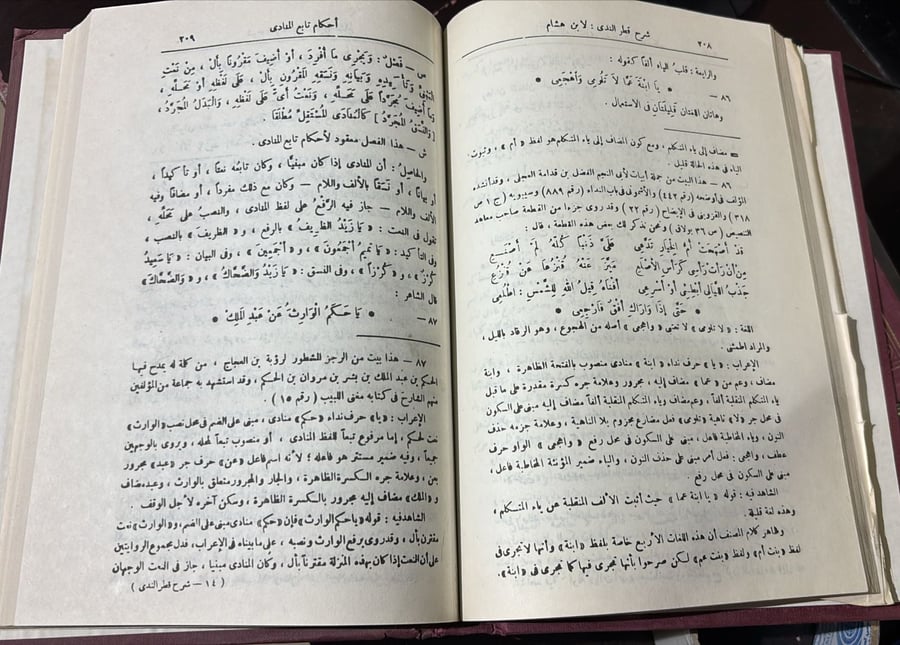
Dew قطر and echo's moisture old copies have a defect
5ر.س
28ر.س-82%Out of Stock
Product description
Book specifications:
Category: Abi Muhammad Abdullah Jamal al-Din ibn Hisham al-Ansari
Author: Muhammad Mahy al-Din Abdul Hamid
Number of pages: 657 pages
Book subject: Explanation of the book Qatr al-Nada wa Bal al-Sada by ibn Hisham al-Ansari in grammar
Book contents:
Introduction
Definition of the word and its types
Signs of the nouns
Division of the noun into mutable and fixed
Division of the verb and its signs
Past tense verb
Imperative verb
Present tense verb
The particle and its signs and that all are fixed
Definition of speech
Types of grammatical case
The six nouns
Dual and sound masculine plural and what is carried on them that does not decline
The five verbs
The present tense verb, its types, and signs of its grammatical case
Raising the present tense verb
Noun of the present tense verb
Permissible forms of the present tense verb
What makes one verb subjunctive
What makes two verbs subjunctive
Indefinite noun
Definite noun and its types
First section: explicit and hidden pronoun
Second section: knowledge and its division into name, nickname, and title
Third section: demonstrative pronoun
Fourth section: relative pronoun
Relative clause: nominal, verbal, and prepositional phrases
Fifth section: with tool
Sixth section: added (possessive)
The subject and predicate
Negatives of the subject and predicate
"Kan" and its sisters
"Ma" (not) and its sisters
"Na" (not) for negation of gender
"Li" (for) and its negation "La" (no)
"Wa" (and) and its sisters
"Lam" (not) and its sisters
"Yas" (perhaps) and its sisters
The agent and the agent's noun
Involvement (occupying)
Dispute (conflict)
Object and its types
Object of the verb
Addressee
Follow-up of the addressee
Diminutive of the known addressee
The one called for help and the one called upon
The absolute object
Object of benefit
Object of place (prepositional phrase) — names of time and place
Object of accompaniment
Status (adverbial)
Disambiguation (distinction) — two types: explanatory for singular and attributive for relation
Exception with "illa" (except)
Exception with "ghayr" (other than), "sawa" (equal), "khalā" (except), "ʿadā" (except), "ḥāsha" (except), "mā khala" (except), "mā ʿadā" (except), "laysa" (not), "lā" (no, not)
Nouns in the genitive case
Prepositions
The genitive case (accusative) + addition
What acts as the verb
First: noun of the verb
Second: مصدر (verbal noun)
Third: اسم الفاعل (active participle)
Fourth: examples of exaggeration
Fifth: اسم المفعول (passive participle)
Sixth: الصفة المشبهة (adjective resembling a noun)
Seventh: التفضيل (superlative)
Followers:
First: النعت (epithet)
Second: التوكيد اللفظي والمعنوي (verbal and semantic emphasis)
Third: العطف (conjunction)
Fourth: عطف النسق بالواو (coordinating with "wa")
Fifth: البدل (substitution)
Sixth: العدد (number)
Reasons for declension of the noun: nine
First reason: وزن الفعل (verb pattern)
Second reason: التركيب (composition)
Third reason: العجمة (foreignness)
Fourth reason: التعريف (definiteness)
Fifth reason: العدول (change)
Sixth reason: الوصف (description)
Seventh reason: العلة (cause)
Eighth reason: الزيادة (increase)
Ninth reason: التأنيث (feminization)
Eighth: التعجب (astonishment)
Stopping, hamza of connection

From Dammam