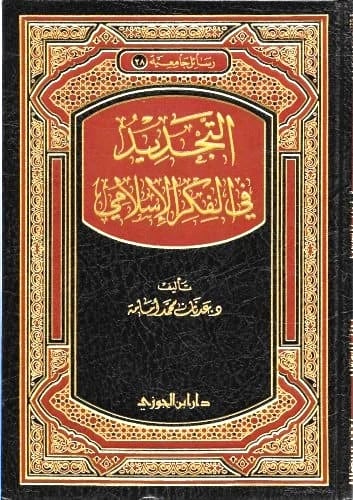

Renewal in Islamic thought
40.25ر.س
Product description
Dr. Adnan Mohammed Osama
Book Index
Introduction
Part One: Renewal in its Correct Concept
Chapter One: Definition of Renewal
Section One: Definition of Renewal linguistically and legally
Axes of renewal:
1. Reviving what has been obscured and lost from the features of the Sunnah
2. Suppressing innovations and newly invented matters
3. Applying rulings to what is found of incidents and events
Section Two: Why renewal?
Because the Sharia is eternal
Because the texts of the Sharia are limited and events are extended
Because the passage of time leads to the erasure of many features of religion
Because the Sharia is comprehensive
Section Three: Pillars of renewal
What is in the Sharia from combining the two qualities of stability and flexibility
Stability in beliefs and unseen matters
Stability in fundamentals and general principles
Stability in morals, acts of worship, and Hudood rulings
Stability in rulings of destiny and texts that do not allow multiple meanings
Flexibility in stating general rules without delving into details
Flexibility in safeguarding necessities, excuses, and exceptional circumstances
Flexibility through reasoning of Islamic rulings
Flexibility through considering the interests of the servants in the Sharia
Flexibility through considering the customs and traditions of people in the Sharia
Section Four: General fields of religious renewal
1. Preserving the original correct texts of the religion
2. Conveying the correct meanings of texts and reviving proper understanding
3. Ijtihad in new matters and finding solutions for them
4. Correcting deviations
5. Protecting religion, defending it, and striving in its cause
Section Five: The relationship between renewal, ijtihad, and innovation
The relationship between renewal and ijtihad
The relationship between renewal and innovation
Section Six: Conditions and qualities of the renewer
1. The renewer should be known for pure creed and sound methodology
2. He should be knowledgeable, not just a mujtahid
3. His renewal should include practical thought and behavior in society
4. His benefit should reach the people of his time
Chapter Two: About the Hadith of Renewal
Section One: Authenticating the Hadith and mentioning narrations
Narration of Abu Dawood
Narration of Al-Hakim
Section Two: Explaining the Hadith and mentioning benefits and derived lessons
General meaning of the Hadith
Detailed meaning of the Hadith
Explanation of "Allah sends"
Explanation of "at the beginning of one hundred years"
Is it a condition that the death of the renewer occurs at the beginning of the hundred?
Is the renewer of the century one or multiple?
The benefit of counting the renewers
The renewer is the religion of the nation, not the religion itself
Section Three: Similar Hadiths to the Hadith of Renewal
First Hadith: This knowledge will be inherited from every trustworthy generation
Three ways of distorting religion:
1. Extremism
2. Prioritizing reason over transmission
3. Ignorance of Sharia
Second Hadith: A group of my Ummah will remain victorious
Third Hadith: Jews split into seventy-one sects
Chapter Three: Models of Renewers
Section One: Umar ibn Abd al-Aziz and his role in renewal
Deviations that occurred in the caliphate system before Umar took over
Umar ibn Abd al-Aziz’s reforms and renewal efforts
Section Two: Imam Al-Shafi’i and his role in renewal
Most prominent virtues and achievements of Al-Shafi’i
His defense of creed
His compilation of Usul al-Fiqh (Fundamentals of Jurisprudence)
His support for the Sunnah
His establishment of principles of Hadith sciences
His reverence for the Sunnah and refutation of skeptics of its authenticity
His combination of narrating and understanding the Sunnah
His fairness, reliance on evidence, and lack of partisanship
His general knowledge and benefit to the people of Islam
Section Three: Imam Ahmad ibn Hanbal and his role in renewal
Features of renewal at Imam Ahmad
A. Features of scientific renewal
- His stance in the trial of the created Qur'an
- His status in the sciences of Sunnah, both understanding and narration
B. Features of scientific renewal
- The funeral of Ahmad ibn Hanbal
Section Four: Ibn Taimiyah and his renewal role
His name, birth, and upbringing
His scholarly status
Features of renewal at Ibn Taimiyah
His jihad and defense of Islam
- Jihad of the sword
- Jihad against the Baatiniyyah (extreme Sufis) and innovators
- His command to enjoin good and forbid evil
- Ibn Taimiyah’s status in the hearts of people
- His impact on his contemporaries and those after him
Part Two: Renewal in Islamic Sciences
Chapter One: Renewal in the Science of Creed
Section One: The historical journey of the science of creed
The innovation of the Khawarij
The innovation of the Shi’ah
The innovation of the Qadariyyah
The innovation of the Murji’ah
The impact of old sects and misguided groups on the beliefs of theological groups
1. Regarding the source of belief
2. Regarding the Qur'an and the attribute of speech for Allah
3. Regarding monotheism
Section Two: Renewal in the science of creed throughout history and today
Steps of renewal in the science of creed in the present time
Chapter Two: Renewal in the Science of Usul al-Fiqh
Section One: The emergence of the science of Usul al-Fiqh
Legal books in the method of the Mutakallimun (theologians)
Legal books in the method of the Fiqh scholars
Legal books combining both methods
Section Two: The emergence of the science of Maqasid al-Shariah (Objectives of Islamic Law)
Section Three: Renewal of Usul al-Fiqh in contemporary times
1. Isolating the science of Usul al-Fiqh from theological, hypothetical, and dialectical debates
2. Supporting the foundational rules with verses, Hadiths, and effects
3. Highlighting the science of Maqasid al-Shariah
Chapter Three: Renewal in the Science of Fiqh
Section One: The historical emergence of Fiqh
The wisdom of his effort, صلى الله عليه وسلم, and his permission for companions to exercise ijtihad
Ijtihad in the era of the companions
Ijtihad in the era of Tabi’un (successors) and their followers
Ijtihad in the era of Tabi’un and their followers (repeated)
Most prominent deviations that occurred in Fiqh throughout history:
1. Imitation of one of the four madhhabs and insisting on it
2. Closing the door of ijtihad
3. Sectarian fanaticism
4. Emergence of competition, envy, and name-calling among the madhhabs
5. Books filled with weak Hadiths
6. Books containing some wild statements
Section Two: Renewal of Islamic Fiqh today
Attitudes of scholars regarding deviations in Fiqh
Steps of renewing and reforming Fiqh:
1. Reopening the door of ijtihad
2. Easing the conditions of ijtihad and its division
3. Sincerity to the truth and avoiding seeking leniency or following people's realities
4. Reforming Fiqh education
Section Four: Renewal in the Sciences of the Sunnah
Section One: The historical journey of preserving the Sunnah
Beginning of recording the Sunnah
Protecting the Sunnah from foreign influence
1. Care for the sanad (chain of narration)
2. Care for the text (matn)
Section Two: Steps of renewing the science of the Sunnah in the present time
Chapter Five: Renewal in the Science of Tafsir (Qur'anic Interpretation)
Section One: Types of Tafsir and their history
1. The emergence of Tafsir by narration
2. The emergence of Tafsir by opinion
Arguments of those who prohibit Tafsir by opinion and ijtihad
Discussion of the evidence of those forbidding Tafsir by opinion
Tafsir by opinion that is praiseworthy
Tafsir by opinion that is blameworthy
Section Two: Renewing the science of Tafsir today
Chapter Six: Renewal in the Science of Tazkiyah and Sufism
Section One: The status of Tazkiyah and morals in Islam
Section Two: Deviations in the science of Tazkiyah and Sufism
1. Deviations in the source of transmission
2. Deviations in adopting the doctrine of the unity of existence
3. Deviations in acts of worship
Section Three: Renewing the science of Usul al-Fiqh in contemporary times
Steps of renewal in the science of Tazkiyah and Sufism today
Chapter Seven: Renewal in the Science of the Seerah (Prophetic Biography) and Islamic History
Introduction: Defining the Seerah and Islamic history
Section One: Sources of the Seerah and Islamic history
a. The Qur'an
b. Hadith books and their compilations
c. Books of Seerah
Sources of Islamic history
Section Two: Most prominent aspects of deficiencies in writing Seerah and history
Section Three: Foundations of renewal in Seerah and history
1. Interpreting events according to an Islamic perspective
2. Avoiding interpretation of events through historical projection
3. Not interpreting events under the influence of intellectual defeat
Part Three: Renewal and its relation to some sources of evidence
Chapter One: Renewal and understanding of the Salaf (pious predecessors)
Section One: Evidence for the necessity of following the Salaf
The rational evidence for the obligation to follow the Salaf in understanding religion
Section Two: The benefit of adhering to the methodology of the Salaf
Chapter Two: Renewal and the intellect
Section One: The status of the intellect and its role in transmission
Section Two: The historical path of deviation in prioritizing the intellect over transmission
Section Three: Responding to those who prioritize the intellect over transmission
Chapter Three: Renewal and Ijma’ (consensus)
Renewal and Ijma’
Definition of Ijma’
Types of Ijma’
Evidence for the validity of Ijma’
Rulings resulting from Ijma’
The ruling on those who deny Ijma’
Chapter Four: Renewal and Hadith of singular narrations (Ahad Hadith)
Definition of Ahad Hadith
Does the Hadith of Ahad establish certain knowledge?
First school: The Hadith of one narrator indicates knowledge if supported by evidence
Second school: The Hadith of one narrator does not indicate knowledge at all
Chapter Five: Renewal and the reasoning behind rulings
Section One: Schools of jurisprudence regarding reasoning behind rulings
Section Two: Examples of the companions’ reasoning behind rulings
1. The Hadith about praying in Banu Quraizah
2. The Hadith of the Treaty of Hudaybiyyah
3. Umar’s decision to allocate a share of the conquered lands to those with hearts inclined (Mu’allaf al-Quloob)
4. Umar’s refusal to divide the conquered lands among the needy
5. Abu Bakr’s fighting those who withhold Zakat
Section Three: Sources of evidence arising from reasoning behind rulings
1. Qiyas (analogical reasoning)
Examples of Qiyas
Conditions of Qiyas
Validity of Qiyas
2. Maslahah Mursalah (public interest)
Categories of Maslahah based on the Sharia’s testimony and non-testimony:
a. Considered interest
b. Abandoned interest
c. Unmentioned interest
Scholars’ stance on accepting Maslahah Mursalah
Evidence for the validity of Maslahah Mursalah
a. The real situation of the Companions
b. Acting upon Maslahah Mursalah makes the obligation fulfilled and thus obligatory
Conditions for acting upon Maslahah Mursalah
3. Looking at the consequences of actions (Ma’la al-Mashar’i)
Evidence for considering consequences
Rules under the consideration of consequences:
a. Blocking the means (Sadd al-Dhara’i)
Evidence for blocking the means
b. Invalidating tricks (Batil al-Hiyal)
Evidence for invalidating tricks
Scholars’ stance on tricks
Examples of contemporary tricks
c. Istihsan (preferential juristic reasoning)
Scholars’ stance on Istihsan
Choosing the lesser of two evils and inflicting the lesser harm
Rules for choosing the lesser of two evils:
a. The assessment of benefits and harms by Sharia, not by personal desire
b. Knowing the ranks of benefits and prioritizing the more important over the less
c. Giving precedence to public interest over private interest
d. Preferring certain benefits over others when they are certain or likely over those that are merely assumed
e. Considering the consequences when estimating benefits and harms
Chapter Six: Renewal and necessity
Definition of necessity
Cases where necessity occurs
Conditions of necessity
Chapter Seven: Renewal and custom (Urf)
Definition of custom
Legitimacy of custom
Categories of custom
Relationship of custom with Sharia
a. That custom is itself a legal ruling
b. That custom is the basis and related to the legal ruling
c. That custom is neither a legal ruling nor a basis for a legal ruling
Examples of custom
Relationship of custom with renewal
Part Four: The distorted concept of renewal
Introduction
Chapter One: Most prominent schools of distorted renewal
Section One: The old rational school (Mu'tazila)
Main principles of the Mu'tazila
Section Two: The modern reformist rational school
Most prominent features of the modern rational school
Intellectual roots of the modern rational school
The concept of secularism and its main goals
Chapter Two: The concept of religious renewal in the distorted renewal
The concept of religious renewal according to proponents of distorted renewal
Chapter Three: Renewal in the realm of beliefs
Introduction
Section One: Destroying religion entirely—creed, worship, and conduct
Section Two: Sanctifying reason and prioritizing it over transmission
Section Three: Denying unseen matters or interpreting them
Section Four: Removing barriers between faith and disbelief
1. Calling for the unity of religions
2. Advocating interfaith and intercultural dialogue
3. Gathering people based on homeland, wealth, or freedom
Section Five: Tolerance towards misguided sects and striving for unity with them
Chapter Four: Renewal in the field of Usul al-Fiqh (Foundations of Jurisprudence)
Introduction
Section One: Setting conditions for acting upon texts
a. Requiring mutawatir (mass transmitted) reports in creed matters
b. Requiring mutawatir reports in constitutional laws
c. Accepting scientific Sunnah without verbal (textual) evidence
d. Constraining the generality of texts
Section Two: Prioritizing the interest over the text
Section Three: Relying on the objectives and spirit of texts without detailed rulings
Section Four: Interpreting consensus (Ijma’) through popular consultation and daring to oppose it
Section Five: Abandoning the conditions and rules of Qiyas
Chapter Five: Renewal in the field of Sunnah
Introduction to the contemporary stance of modernists towards the Sunnah
Section One: Criticism of the Hadith transmitters and scholars and their accusations of fabrication and lying
Section Two: Contradicting the Sunnah with independent reasoning (Qiyas)
Section Three: Contradicting the Sunnah with generalities of the Qur'an
Section Four: Dividing the Sunnah into legislative and non-legislative types
Chapter Six: Renewal in the field of Fiqh
Introduction
Section One: The stance of modernists towards Fiqh and Fiqh scholars
Section Two: Methodology of modernists in preference and choosing
Section Three: Deviations of modernists in the field of Islamic punishments (Hudood)
Section Four: Deviations of modernists in the system of governance
1. Equating Muslims with others in rights and duties
2. Denying the obligation of killing the apostate and calling for intellectual freedom
3. Invalidating the jizyah imposed on non-Muslims
4. Claiming that Jihad in Islam is only defensive
5. Permitting rebellion against the Imam even if he does not show disbelief
Section Five: Deviations of modernists on women’s issues
1. Modernists’ stance on women’s hijab
2. Modernists’ stance on mixing between men and foreign women
3. Modernists’ stance on women’s guardianship
Various deviations on women’s issues:
a. Permitting Muslim women to marry the People of the Book
b. Allowing women’s testimony equal to men’s
c. Blood money (Diyah) for women
d. Restricting divorce, polygamy, and limiting offspring
Section Six: Deviations of modernists on Riba (interest) issues
Section Seven: Deviations of modernists in permitting the making of statues and images
Conclusion and main findings
Indexes
Index of Verses
Index of Hadiths
Index of Names
Index of Sources and References
Index of Topics

From Dammam