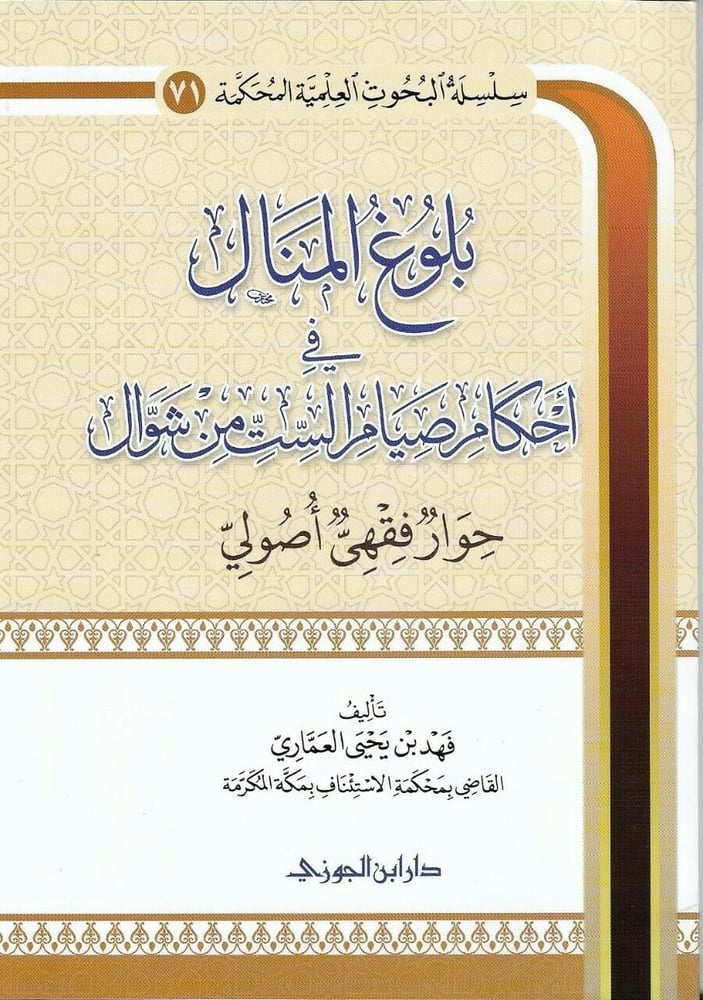
Achieving the goal in the rulings of fasting the six days of Shawwal
6.90ر.س
Product description
Fahad Al-Amari
The reaching of the goal in the rulings of fasting the six days of Shawwal (reading and definition)
Book title: The reaching of the goal in the rulings of fasting the six days of Shawwal
Author: Sheikh Fahad bin Yahya Al-Amari
Type of book: Fiqh dialogue, roots
Publisher: Dar Ibn Al-Jawzi - Dammam
Year of printing: 1440 AH
Number of pages: 100 pages
Introduction to the topic of the book
The author mentioned in his introduction that Allah has blessed this nation with many seasons of goodness and opportunities for obedience and worship, including what follows the Ramadan season of fasting the six days of Shawwal. He then discussed the stance of the scholars regarding the indication of the hadiths about fasting the six days of Shawwal, clarifying that it is a matter of disagreement, but that being a matter of differing opinions does not mean it should not be researched and scrutinized to find what is closer to the truth, supported and confirmed by evidence. The truth is not confined to one school of thought; rather, it is shared among all of them; sometimes it aligns with one, sometimes with another, depending on where the correct evidence, free from contradiction, leads.
This concise message, as the author - may Allah preserve him - stated, is a response to some questions, doubts, and objections raised regarding the ruling of prioritizing the fasting of the make-up days of Ramadan over the six days of Shawwal. The answer to these doubts is based on the fundamental principles of Islamic jurisprudence, deriving branches from the roots, because that is the most precise, firm, and farthest from confusion and contradiction, and most consistent with consistency, which is the exact standard in this matter.
The research was divided into three sections:
The first section included the following issues:
Issue one: Is it a condition for fasting the six days of Shawwal that it be after fasting Ramadan as a make-up for those who broke their fast in Ramadan? The two opinions of scholars were mentioned.
Issue two: Can the six days be fasted outside of Shawwal? Four opinions of scholars were mentioned.
Issue three: Are the six days' days to be made up?
Evidence for each opinion in the previous issues was presented, along with objections and discussions. The third section included applied principles of Islamic jurisprudence, explaining the wording of the hadith, clarifying its linguistic and Shariah meanings, both literal and metaphorical. The author built his discussion on a set of jurisprudential and foundational rules, including:
- The rule: Does generality of persons entail generality of places and times?
- The rule: What is considered the prevailing case?
- The rule: The original is to carry speech on its literal meaning.
- The rule: The concept of condition, time, and nickname.
- The rule: What is near something takes its ruling.
- The rule: Hardship brings ease.
- The rule: Obligation is better than supererogatory acts.
- The rule: Justification by reward.
- The rule: Permissibility of supererogatory acts that is not permissible in obligatory acts, and that supererogatory acts are more flexible.
All these were used as evidence and discussed for each of the two teams regarding the previously mentioned issues.
The conclusion and result:
That the most fortunate in action according to the textual evidence is the one who believes that fasting the six days of Shawwal occurs after completing the fasting of Ramadan. This is certain, and should not be left to doubt. The criterion in preference is to prioritize what involves caution over other options, and to prioritize certainty over uncertainty. Among the preferences: giving precedence to the most authentic over the less authentic in case of disagreement, and that the context of speech indicates the correctness of the statement, supported by what precedes or follows it, and that the meaning is what naturally comes to mind; this is evidence of its apparentness and preference. The original is to interpret speech according to its order and to carry speech on its literal meaning, and the apparent is preferred over the metaphorical.
Despite its small size, the book is beneficial and unique in its field.

From Dammam