





Documents of the issues 1/4
194.35ر.س
Product description
Authored by Muhammad Hussein Al-Jizani
Method of selecting and classifying documents.
Selection criterion: Since these documents were selected from hundreds of volumes and thousands of pages, the process of selection and filtering required a clear standard.
This standard was to focus on what is issued collectively by specialized scientific bodies.
I have exerted effort to encompass all decisions issued in this regard.
Eight scholarly councils and Islamic academies are:
1 - Islamic Research Academy in Egypt.
2 - Senior Scholars Committee in Saudi Arabia.
3 - Islamic Fiqh Academy in Mecca Al-Mukarramah.
4 - Fiqh Academy in Jeddah.
5 - Islamic Fiqh Academy in India.
6 - Islamic Fiqh Academy in Sudan.
7 - European Council for Fatwa and Research.
8 - Fiqh Council of Sharia Scholars in America.
Alongside this, there are other collective efforts, including recommendations and decisions issued by scientific seminars and conferences.
I have also added a select group of distinguished individual efforts; either because they are rare in their subject, comprehensive in their scope, or for other reasons.
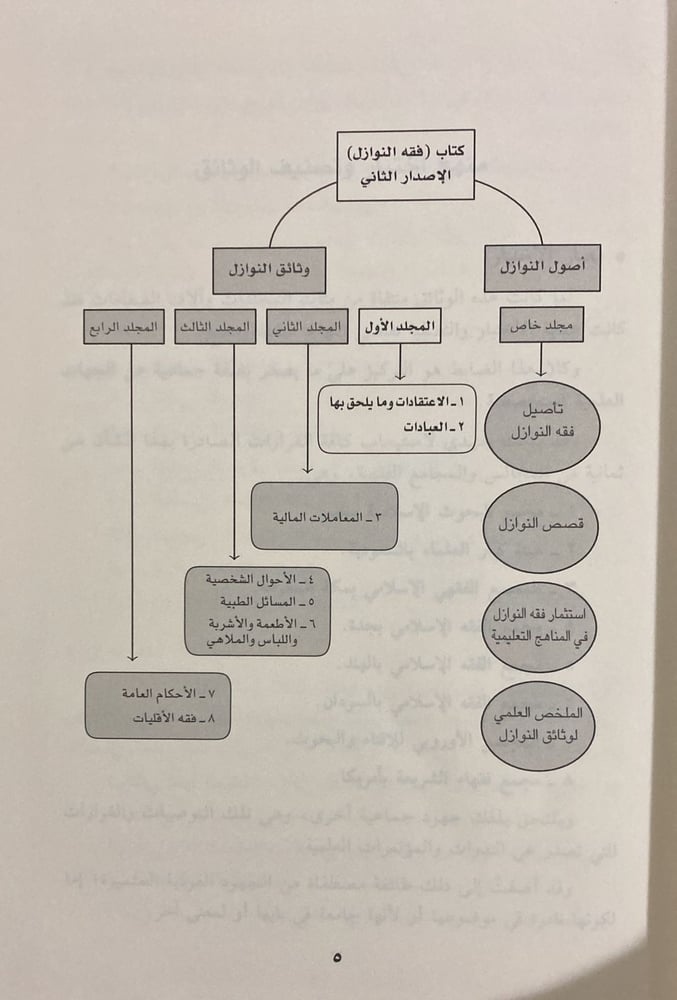
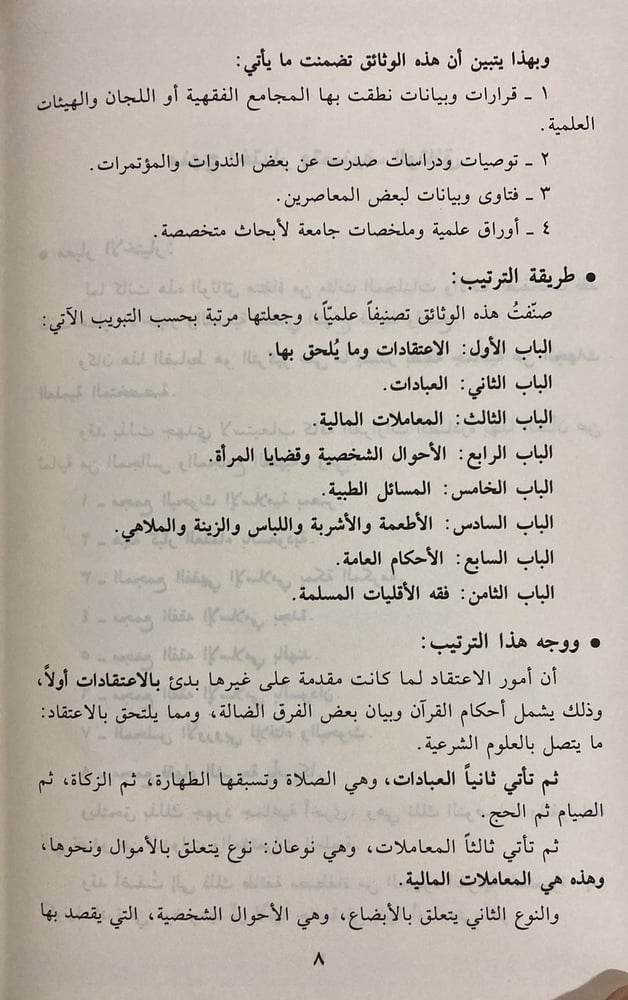
Thus, it is clear that these documents include the following:
1 - Decisions and statements issued by Islamic councils, committees, and scientific bodies.
2 - Recommendations and studies issued by some seminars and conferences.
3 - Fatwas and statements by some contemporary scholars.
4 - Scientific papers and comprehensive summaries of specialized research.
Method of arrangement:
These documents have been classified scientifically and organized according to the following categorization:
First chapter: Creeds and related matters
Second chapter: Acts of worship
Third chapter: Financial transactions
Fourth chapter: Personal status and women’s issues
Fifth chapter: Medical issues
Sixth chapter: Foods, drinks, clothing, adornment, and entertainment
Seventh chapter: General rulings
Eighth chapter: Fiqh of Muslim minorities
The reason for this arrangement:
Since matters of belief are given precedence over others, the chapter on beliefs comes first, including rulings of the Quran and clarification of some deviant sects.
What relates to belief also includes issues connected to Islamic sciences.
Then comes the second chapter on acts of worship, starting with purification, then prayer, followed by Zakat, fasting, and Hajj.
Next is the third chapter on transactions, which are of two types:
- One related to wealth and similar matters, i.e., financial transactions.
- The second related to personal status, i.e., marriage and related issues such as divorce.
It was appropriate to include contemporary women’s issues alongside this chapter, so the chapter on personal status and women’s issues was placed here.
It was also fitting that after marriage, the fifth chapter would address medical issues, given the significant impact of medicine in this era, especially regarding birth control and its modification, as the purpose of marriage is procreation.
Then comes the sixth chapter: foods, drinks, clothing, adornment, and entertainment, which include customs that preserve souls and minds, along with various entertainments such as media, recreation, and sports.
The seventh chapter covers general rulings related to the state or public interests, such as jihad, judicial matters, political issues, international relations, borders, crimes, endowments, and donations.
The final chapter concludes with the fiqh of Muslim minorities in non-Islamic countries.
Considering the historical aspect:
If there are multiple documents on the same topic, they are arranged chronologically according to their date of issuance.
Method of transmission:
The accepted method is to record these documents exactly as they are, without alteration, as they are texts transmitted from their authors.
Sometimes, only the necessary part of the document is cited, which is the relevant evidence, and anything beyond that is omitted.
What these documents contain reflects the opinions of their authors; therefore, I did not work on commenting on any of them.
It should be known that all notes, references, or clarifications in the margins of these documents are taken from the original source of the document.
Source of the documents:
These documents were taken from their original sources; the basis for establishing all these decisions and statements is the issuing authority itself directly, without intermediaries.
The same applies to the transmission of individual fatwas, with only rare exceptions where transmission was through intermediaries.

From Dammam