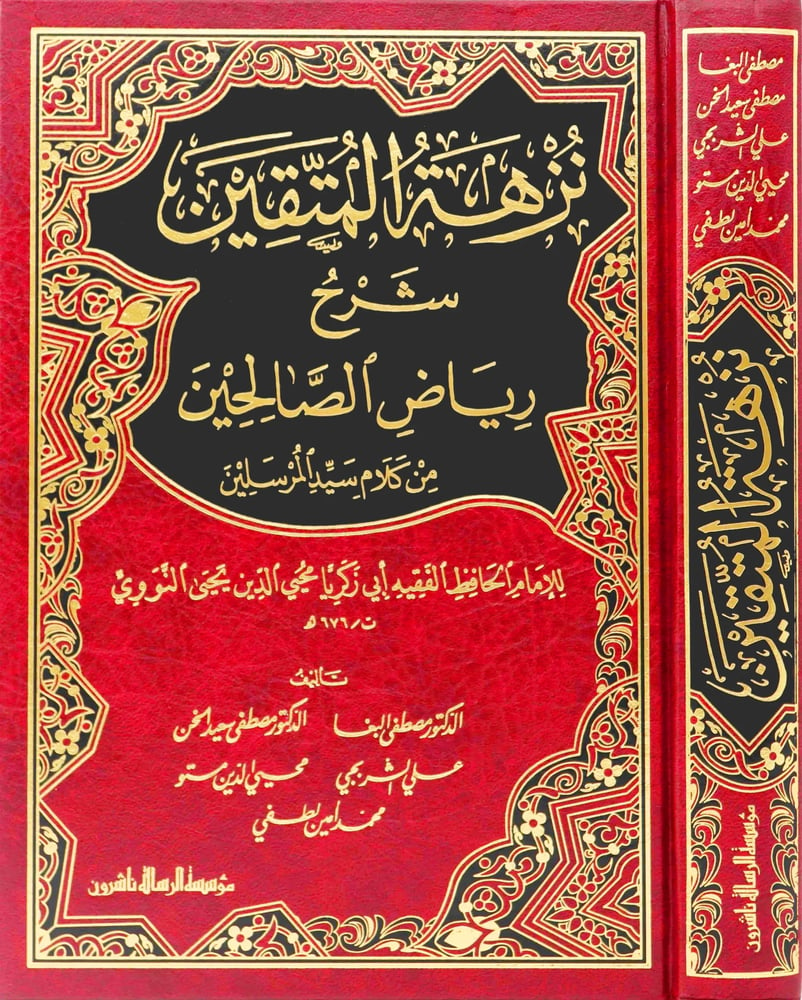
The outing of the pious, one volume
67ر.س
Out of Stock
Product description
Mustafa Al-Bgha - Mustafa Al-Khanaikhtar, the noble Imam Muhyiddin Abu Zakariya Al-Nawawi, may Allah have mercy on him, a collection of prophetic sayings on various topics in his book Riyadh Al-Saliheen, included two thousand hadiths selected from the book Mukhtar Al-Sihah and the trusted books in the Sunnah. It was explained by Imam Muhammad bin Al-Alaat in eight parts, and his explanation, may Allah have mercy on him, was sufficient for the needs of his era. The need for a scholarly explanation of Riyadh Al-Saliheen emerged, suitable for the requirements of current social conditions and modern educational methods, especially for those concerned with education, guidance, and training at all levels. The book was explained with the authentication of the verses that Imam Al-Nawawi mentioned at the beginning of each chapter, and the references for each hadith were listed so that the reader could verify its chains of narration and related matters, along with explanations of the linguistic vocabulary for each hadith, among other things that facilitate benefiting from Riyadh Al-Saliheen and make it easier for students. The preparation of this book was based on the "Guide of the Successful" and references from trusted books of Sunnah in tafsir, biographies, seerah, jurisprudence, and dictionaries.
The explanation of Riyadh Al-Saliheen, free from the words of the Master of Messengers, was needed to provide a scholarly explanation suitable for the requirements of contemporary social conditions and to avoid modern pedagogical approaches, especially for those involved in education, training, and guidance at all levels. The book was explained with the authentication of the verses that Imam Al-Nawawi mentioned at the beginning of each chapter, and references for each hadith were listed so that the reader could verify its chains of narration and related matters, along with explanations of the linguistic vocabulary for each hadith, among other things that enable benefiting from Riyadh Al-Saliheen and developing the students.
The life of the Imam — the universe of knowledge: Knowledge spread and reached Damascus for the third time today. The first: diligence in seeking and acquiring knowledge early in his youth, and he was serious about reading and memorization. It was said that he memorized the book "Al-Tanbih" in four months to complete it, memorized a quarter of worship from the book "Al-Muhtadhab" in the remaining year, and was able in a short period to gain admiration and the love of his teacher Abu Ibrahim Ishaq bin Ahmed Al-Maghribi, so he made him a teaching assistant in his circle. Then he taught at the Al-Ashrafiya Hadith House, and others. The second: the righteousness of his knowledge and culture, and he combined seriousness in seeking knowledge with abundant learning and communication. His student, Alaa Al-Din bin Al-Attar, narrated about his period of study and pursuit that he was a mixture of twelve lessons daily from scholars, explaining and correcting, strong in the book "Al-Waseet," and in the "Al-Muhtadhab," and a lesson in combining two Sahihs, and a lesson in Sahih Muslim, and a lesson in the book "Al-Luma" built on grammar, and a lesson in "Iṣlaḥ Al-Mantiq" for Ibn Al-Sikkit in language, and a lesson in morphology, and a lesson in the fundamentals of jurisprudence, sometimes in "Al-Luma" by Abu Ishaq, and sometimes in the book "Muntakhab" by Al-Fakhr Al-Razi, and a lesson in the names of men, and a lesson in the fundamentals of religion, and the entire book related to these lessons was a commentary on a copy, explaining the wording and grammatical correction. The third: his prolific output, as he paid attention to writing and authorship in 660 AH, and he was only three years old. Allah blessed him with his time and helped him, so the essence of his mind was poured into large and astonishing books and writings, in which ease of reading, clarity of evidence, clarity of expression, fairness in presenting the opinions of scholars, and more are evident.

From Dammam