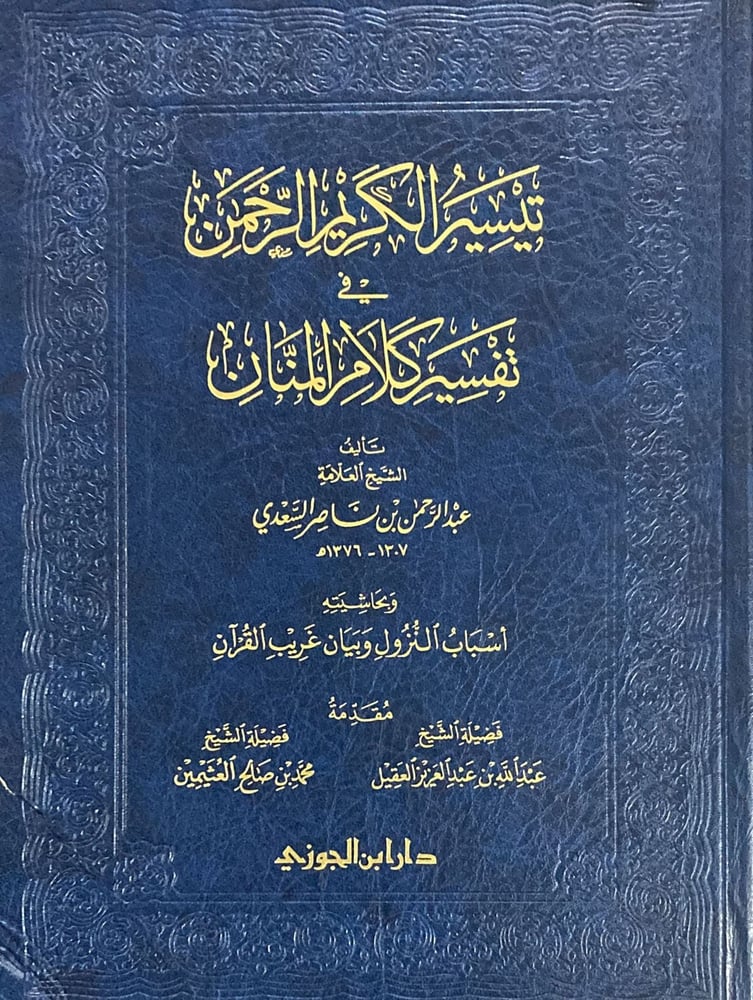
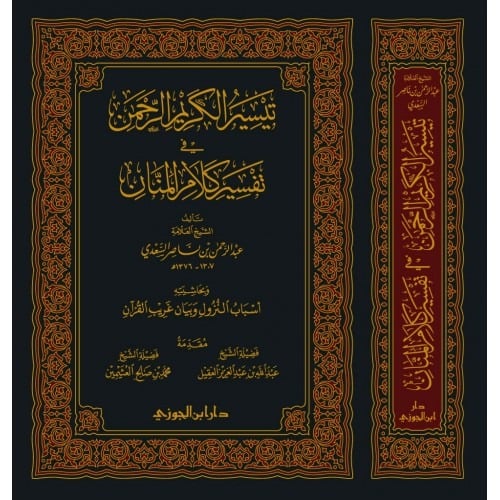
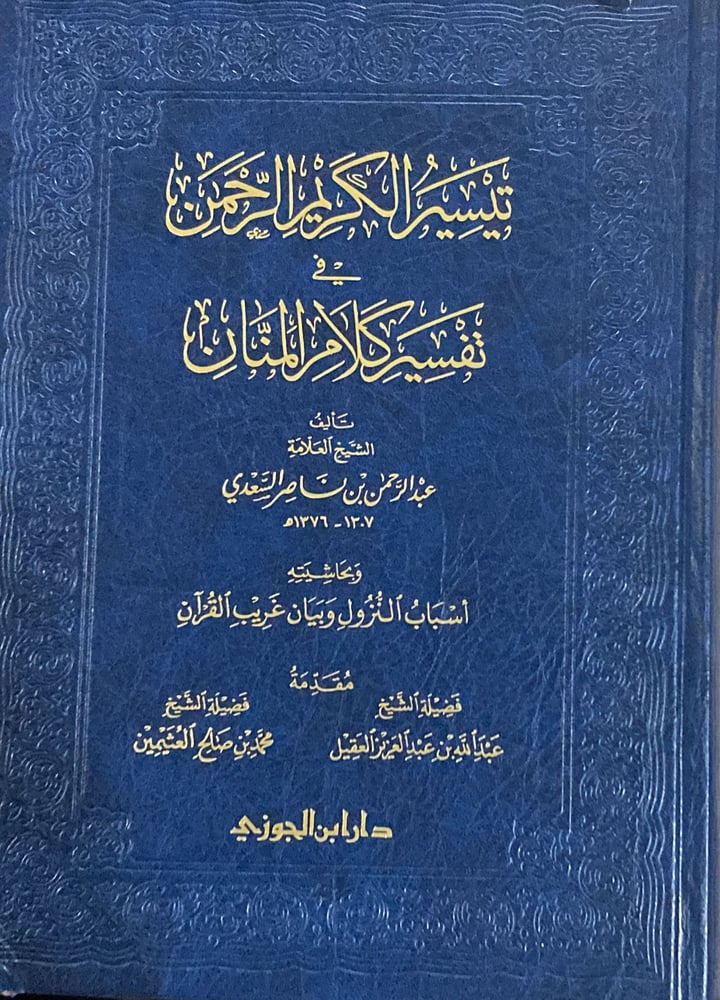


Taysir al-Karim al-Rahman, Tafsir al-Sa'di, and its footnotes, reasons for revelation, and the unusual words of the Quran, "Jawaami"
151.80ر.س
Product description
The compilation of Sheikh the scholar Abdul Rahman bin Nasser Al-Saadim
Introduction of Sheikh Abdullah bin Abdul Aziz Al-Aqeel
Introduction of Sheikh bin Uthaymeen
Care of Saad bin Fawaz Al-Samilt
Tafsir Al-Saadi and its marginal notes
Reasons for revelation and strange words of the Quran
"Juma'i"
Introduction
In the name of Allah, the Most Gracious, the Most Merciful
Praise be to Allah, we praise Him, seek His help, ask for His forgiveness, and turn to Him in repentance. We seek refuge in Allah from the evil of ourselves and from our bad deeds. Whomsoever Allah guides, none can misguide him; and whomsoever He misguides, none can guide him. I bear witness that there is no deity but Allah alone, with no partner, and I bear witness that Muhammad is His servant and Messenger. May Allah's peace and blessings be upon him, his family, and his companions, and many greetings.
To proceed:
The most deserving of what I dedicate my knowledge to is what Allah is pleased with in knowledge, and reaching the ultimate in understanding it. The knowledge that pleases Allah and guides to the straight path, and the most comprehensive of that is the Book of Allah, which has no doubt, and its revelation, which has no suspicion. The one who gains abundant reward and bright virtue is the one who recites it, which cannot be touched by falsehood from before it or behind it, a revelation from the Wise, the Praiseworthy.
Allah revealed it to His Prophet Muhammad, peace be upon him, in a clear Arabic language, as He said:
"And indeed, it is a revelation of the Lord of the worlds, descended by the Trusting Spirit, upon your heart, [O Muhammad], that you may be of the warners, in a clear Arabic language." [Ash-Shu'ara: 1962-179]
He conveyed, peace and blessings be upon him, the clear message to people, and Allah did not take his soul except after he had conveyed and clarified what was revealed to him in this Book, as Allah said:
"And We have sent down to you the Reminder that you may clarify to the people what has been sent down to them and that they may reflect." [An-Nahl: 44]
And He said:
"And We have not sent down the Book to you except that you may clarify to them that over which they differ, and as guidance and mercy for a people who believe." [An-Nahl: 64]
In explanation of this verse (3): Allah, the Exalted, says to His Prophet Muhammad, peace be upon him:
"And We have not sent down to you Our Book, and We have not made you a messenger to mankind except to clarify to them what they differ in of religion."
It is established that the companions received from the Messenger of Allah, peace be upon him, explanations of the Quran. It was said that each of them, when he learned ten verses, would not pass them until he knew their meanings and acted upon them. Abu Abdur-Rahman Al-Sulami, one of the great Tabi‘in, said:
"We were told by those who used to read to us that they used to learn from the Prophet, peace be upon him, and when they learned ten verses, they would not leave them until they acted upon what was in them. So we learned the Quran and acted upon it all together."
When something was unclear to the companions, they would ask the Prophet, peace be upon him. When Allah revealed:
"Those who believe and do not mix their faith with injustice" [Al-Anbiya: 107], the companions asked:
"Which of us does not wrong himself?" He replied:
"It is not as you say; they did not mix their faith with injustice."
Then he explained and clarified, the best of people in explanation, the most truthful in faith, and the most profound in knowledge (those upon whom the Book was established, and the Book was established by them, and the Book spoke through them, and they were granted by Allah knowledge and wisdom that made them superior to other followers of the prophets).
Those are his companions, whom Allah chose among the worlds for the companionship of His Prophet for twenty-three years. The Quran was revealed to them in their language, which they grew up speaking, aiding and acting upon it.
Among them was Abdullah bin Zubayr, may Allah be pleased with him, who was one of the most famous in interpretation: the Rightly Guided Caliphs, and Ubayy bin Ka'b, Zaid bin Thabit, Abu Musa Al-Ash‘ari, all of whom narrated from them.
Abdullah bin Mas‘ood, may Allah be pleased with him, said:
"By Allah, I do not read or know of any verse from the Book of Allah except that I know where it was revealed and to whom, and I do not know anyone more knowledgeable about the Book of Allah than I am. If I knew anyone more knowledgeable than me, I would ride to him."
Abdullah bin Abbas, the interpreter of the Quran, whom the Prophet, peace be upon him, prayed for, saying:
"O Allah, make him understand the religion and teach him interpretation."
Al-Mas‘ood said about him:
"Yes, the interpreter of the Quran is Ibn Abbas."
Then, after the companions, the interpretation passed to the Tabi‘in, especially those who were students of Abdullah bin Abbas in Mecca, such as Mujahid, Sa‘id bin Jubayr, and others. Mujahid said:
"I presented the Mushaf to Ibn Abbas three times, from the beginning to the end, stopping at each verse and asking him about it."
For this reason, Al-Thawri said:
"If the interpretation comes from Mujahid, suffice it."
Imam Ibn Taymiyyah, may Allah have mercy on him, said:
"That is why his interpretation is relied upon by Al-Shafi‘i, Al-Bukhari, and other scholars of knowledge. Likewise, Imam Ahmad and others who authored in interpretation often repeated the routes from Mujahid more than others."
Also, the companions of Abdullah bin Mas‘ood, such as Al-‘Aqlama and Misrūq, among others, said:
"I do not read or know anything except that Al-‘Aqlama reads it or teaches it."
Al-Hafiz Ibn Hajar, may Allah have mercy on him, compiled a comprehensive summary that the seeker of knowledge in the books of tafsir cannot do without, which details the status of those who transmitted interpretation from the Tabi‘in and beyond. It clarifies the condition of those who transmitted tafsir from the Tabi‘in and later.
The aim is to know that the companions and the Tabi‘in explained the Quran, clarified its words and meanings, and we should return to their sayings if we do not find interpretation in the Quran or the Sunnah. The disagreement among them is minimal, and most of what is authentic from them in disagreement is due to diversity, not contradiction. Sheikh Ibn Taymiyyah explained this in the introduction to his tafsir.
Then, scholars began to compile collections of the tafsir of the companions and the Tabi‘in, narrating it to them, such as Ibn Jareer Al-Tabari, Ibn Al-Mandhir, Ibn Abi Hatim, and ‘Abd bin Humaid. Ibn Hajar said:
"These four tafsirs rarely deviate from what is narrated from the Prophet, whether it is a hadith, a statement from the companions, or from the Tabi‘in."
Afterward, scholars continued to write tafsir with varying approaches according to their schools of thought, beliefs, and scholarly interests. Among those who wrote in this field were Abu Muhammad Al-Baghawi (d. 516 AH), Abu Al-Faraj ‘Abd Al-Rahman Ibn Al-Jawzi (d. 596 AH), Abu Abdullah Muhammad bin ‘Umar Al-Razi (d. 606 AH), Abu Abdullah Al-Qurtubi (d. 671 AH), Abu Abdullah Muhammad bin Yusif bin Hayyan Al-Andalusi (d. 745 AH), Hafiz Imad Al-Din Abu Fadhl Ismail bin ‘Umar bin Katir (d. 774 AH), ‘Abd Al-Rahman Al-Tahawi (d. 876 AH), Jala Al-Din ‘Abd Al-Rahman Al-Suyuti (d. 911 AH), Muhammad bin ‘Ali Al-Shawkani (d. 1250 AH), Mahmoud Shihab Al-Din Al-Alusi (d. 1270 AH), Muhammad Jamil Al-Din Al-Qasimi (d. 1332 AH), Muhammad Al-Amin bin Muhammad Al-Mukhtar Al-Jakni Al-Shanqiti (d. 1393 AH), and other Muslim scholars who authored in tafsir.
Ibn Jareer, may Allah have mercy on him, said:
"The most deserving of the interpreters to arrive at the truth in the interpretation of the Quran... the clearest in proof regarding what he interpreted and explained, is what was interpreted by the Messenger of Allah, peace be upon him, directly from him, from authentic reports... or from the indications established on its correctness; and among the most authoritative in argument—regarding what he interpreted and explained—are the sayings of the Salaf, the companions, the imams, and the followers from the scholars of the nation."
Among the works praised by scholars in this era and widely recognized, and which Allah granted acceptance among people, is the tafsir of Sheikh the scholar Abdul Rahman bin Nasser Al-Saad, may Allah have mercy on him, who died in 1376 AH. This was due to several distinguished features:
First: The author’s sincere effort to keep his tafsir focused on the general meaning, as many tafsir scholars either extended too much in explaining the Book of Allah or limited themselves to linguistic or jurisprudential aspects. Allah wanted the meaning to be the goal and the words a means to it, so that people could understand the meaning of Allah’s speech, be guided by His sciences, and adopt His morals and manners in the closest way.
Second: The choices of Sheikh Allah, which reflect his intelligence, purity of heart, and ease of understanding the sayings of the Salaf from the companions, the followers, and scholars of the nation, as if Allah gathered the sayings related to the interpretation of the verse and then shaped them with his well-known words.
Third: His tafsir is distinguished by simple words and clear expressions, with no pretense, complexity, verbosity, or excessive elaboration, making it accessible for scholars and those below them.
Fourth: Good composition and linking speech smoothly without difficulty in arranging phrases—this is a prominent feature of his tafsir, may Allah have mercy on him.
Fifth: The book contains a number of scientific and educational benefits derived from the Book of Allah, which the author pointed out within his tafsir, including various benefits related to monotheism, jurisprudence, biography, sermons, morals, and other benefits.
Sixth: The most important point:
1 - The book is free from false interpretations, desires, innovations, and Isra’iliyyat. The author, may Allah have mercy on him, adheres strictly to the texts of the Book and Sunnah and follows the traces of the righteous predecessors.
Practical aspects in the book:
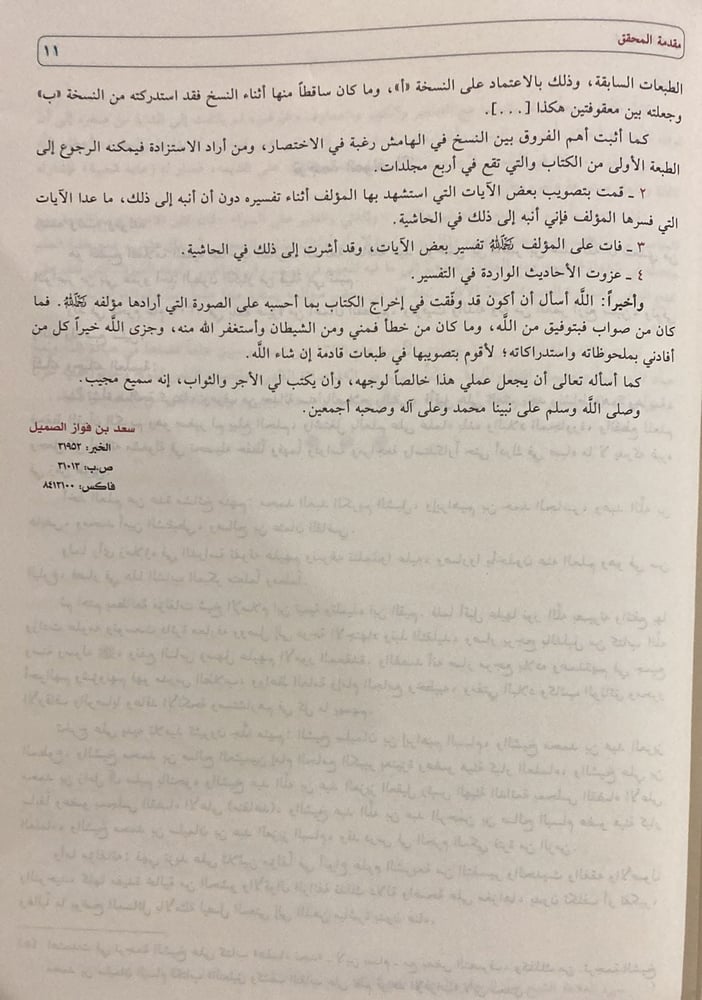
1 - I paid attention to accurately preserving the text of the Book, exerted effort to present it free from omission, distortion, or misprint that occurred in previous editions, relying on copy “A,” and what was missing from it during copying I restored from copy “B,” and placed it within brackets like this [...]. I also noted the main differences between the copies in the margin to keep it concise. Those seeking more detail can refer to the first edition of the book, which is in four volumes.
2 - I corrected some of the verses that the author cited during his tafsir without noting that, except for the verses he explained, which I pointed out in the footnotes.
3 - The author may have overlooked some verses; I indicated this in the footnotes.
4 - I attributed the hadiths mentioned in the tafsir.
Finally:
I ask Allah that I have succeeded in producing the book in a manner I believe to be in accordance with what its author, may Allah have mercy on him, intended. Whatever is correct is by Allah’s success, and any mistake is from me and Satan. I seek Allah’s forgiveness. May Allah reward all who benefited me with their observations and corrections, so I may correct them in future editions, God willing.
I also ask Allah that my work be purely for His face, and that He grants me reward and goodness. Indeed, He is the Hearing, the Responding.
And may Allah’s peace and blessings be upon our Prophet Muhammad, his family, and all his companions.
Saad bin Fawaz Al-Samilt
News: 31952

From Dammam