

The ambitions in grammar, morphology, and rhetoric
57.50ر.س
Product description
Dr. Muhammad Ibrahim Al-Hamd
In the name of Allah, the Merciful, the Compassionate
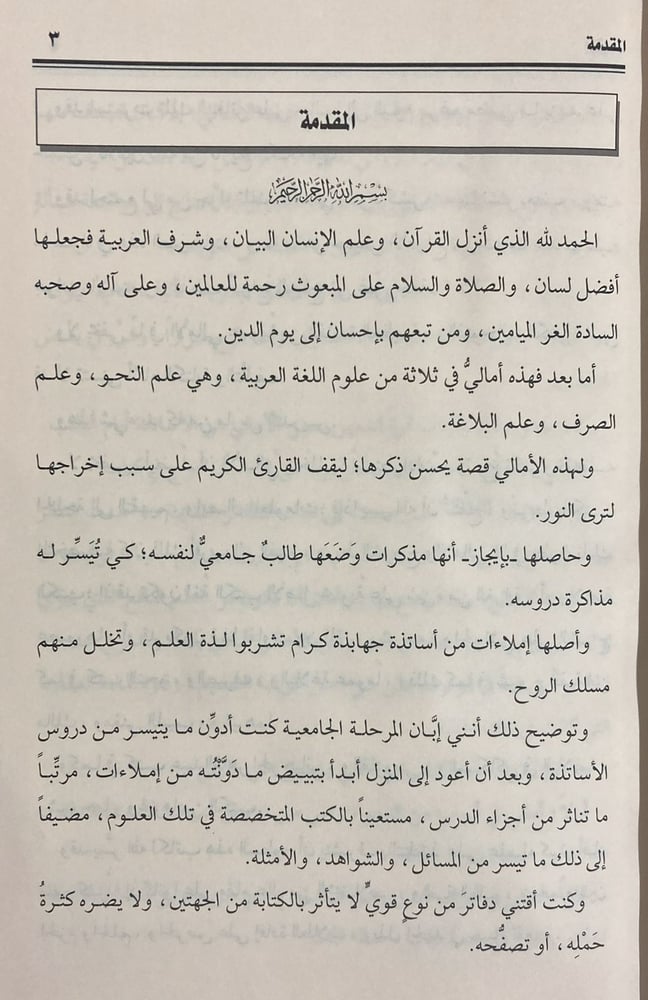
Praise be to Allah, who revealed the Qur'an and taught mankind expression, and honored the Arabic language, making it the best tongue. Peace and blessings be upon the one sent as mercy to the worlds, and upon his family and companions, the noble and virtuous, and upon those who follow them with goodness until the Day of Judgment.
To proceed, these are my hopes in three sciences of the Arabic language, which are: the science of grammar, the science of morphology, and the science of rhetoric.
And there is a story behind these hopes that is worth mentioning; so that the noble reader may understand the reason for their compilation and bringing them to light. The essence of it — briefly — is that they are notes written by a university student for himself to facilitate his review of his lessons.
Their origin is from dictations by great and noble teachers who imbibed the pleasure of knowledge, and from whom the spiritual path was infused. To clarify, during my university years, I would jot down whatever I could from the teachers’ lessons, and after returning home, I would begin to organize what I had written, arranging the scattered parts of the lesson, relying on specialized books in those sciences, and adding to that whatever was easy to include — questions, evidence, and examples.
I used to acquire sturdy notebooks that would not be affected by writing from both sides, nor harmed by frequent carrying or browsing. These notebooks have remained in their original state to this day, despite more than thirty-five years passing since I wrote in them.
From these hopes, I accumulated a lot of material, some of which has been published, and some you will see in these pages. Others are still hidden in drawers, and some have been lost to the winds of time, gone forever.
Great benefit and many openings are contained in these hopes, which may not be easily attained during writing and composition. This is something those who practice teaching understand well.
It is also clear that the hopes include digressions and repetitions necessary for clarification and conveying information. If Allah makes it easy to revise and connect them with specialized books, that would be closer to understanding and linking the explanations and hopes with what is in those books, as the language of the original texts may sometimes contain some oddities, or be suited to their eras, or there may be differences between the main text, its explanation, and the marginal notes on the explanation, as in books of grammar, morphology, and rhetoric in general, such as the explanations of Ibn Malik’s Alfiyya, Al-Mughni Al-Labeeb, and others. And as in the books of Abdul Qahir Al-Jurjani, Al-Qazwini, and Sakkaki in rhetoric, and their explanations, among others.
May Allah grant the writer of these lines the honor of studying under great scholars from whom he benefited greatly; for they were sincere, loving knowledge, combining firmness and patience, and eager to benefit students, exerting effort for their benefit.
He never thought in his life that these hopes would be published; as the goal when they were written was the desire to understand the prescribed lessons and to assist colleagues who wished to do so. He would refer to these hopes from time to time when needing to review a matter. Other than that, they held no significance for him except for the memories they carried.
Then, in the year 1426 AH, he thought of writing about the jurisprudence of language; Allah facilitated the writing of a book titled: "Jurisprudence of Language, Its Concept — Topics — Issues," which has been printed multiple times and taught at some universities.
Part of that book was the fruit of jotting down some hopes from teachers during his student days. The rest of the hopes, however, he never thought would be published in a book.
In the year 1443 AH, he revisited those old notebooks, reviewed them, and remembered those noble teachers, some of whom have passed away. He saw fit to publish those hopes, hoping to benefit from them, and wishing that they would be among the beneficial knowledge whose reward continues for him and for them, and as a contribution to reviving the art of hopes, which is almost extinct in our current era, and in order to observe some teaching methods and the strength of the scientific material from that period.
What is contained in this book of hopes includes the following:
First: Hopes in chapters of grammar, from the lessons of our teacher, Professor Dr. Abdullah bin Hamad Al-Khathran.
Second: Hopes in other chapters of grammar, from the lessons of our teacher, Professor Dr. Fayez Zaki Muhammad Diab — may Allah preserve him.
Third: Hopes in chapters of morphology, from the lessons of our teacher, Professor Dr. Amin Abdullah Salem Allah.
Fourth: Hopes in chapters of rhetoric, from the lessons of our teacher, Professor Dr. Mahmoud Safa — may Allah preserve him.
Before each of these hopes, there is an explanation of its topics and an introduction to the teacher of the subject, as much as I am able to do so.
All of that will be preceded by a brief introduction to the art of hopes, and Allah is the helper, and upon Him I rely.
Finally, I cannot help but thank Allah — Glorified and Exalted — for His facilitation and support.
I also thank everyone who assisted in producing this book, whether through writing, reviewing, correcting, or suggesting.
Special thanks go to the noble brothers: Professor Dr. Suleiman bin Abdullah Al-Natifi, Professor Dr. Ahmed bin Muhammad Al-‘Udayb, and Professor Dr. Saud bin Ahmad Al-Manea; who kindly read these hopes, provided valuable notes and corrections.
All praise is due to Allah, first and last.
Muhammad bin Ibrahim Al-Hamd
1443/12/16 AH
Qassim University, College of Sharia and Islamic Studies
Department of Creed and Contemporary Sects