
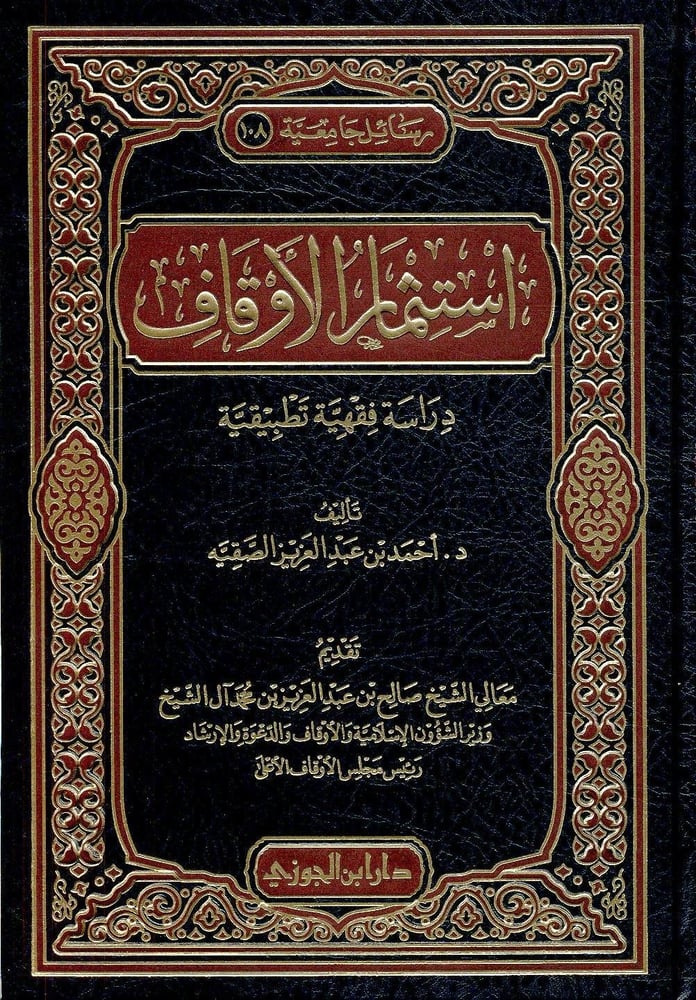
Investment of endowments: an applied jurisprudential study
44.85ر.س
Product description
Endowment Investment - Applied Jurisprudence Study
Ahmed bin Abdulaziz Al Saqiyah
Book Title: Endowment Investment - Applied Jurisprudence Study
Presented by: Saleh bin Abdulaziz Al Sheikh
Publisher: Dar Ibn Al-Jawzi - Dammam
Edition: First
Year of Printing: 1434 AH
Number of Pages: 439
Type of Book: Original book, a scientific thesis submitted by the author to obtain a doctorate in jurisprudence, from the College of Sharia at Imam Muhammad bin Saud Islamic University - Riyadh.
Introduction to the Book's Topic:
Endowment was legislated to achieve solidarity in the nation, and to earn reward and recompense for its individuals; it plays an important role in achieving prosperity and well-being, and also contributes to supporting many scientific, social, medical, and other institutions and activities. The endowment cannot fulfill its intended purpose except by caring for an important objective in Sharia, which is related to the sustainability of benefit through utilizing various investment means and their multiple forms, and this is the subject that this week's book will address.
The book consists of an introduction, a preface, two chapters, and a conclusion:
The introduction includes a discussion of the importance of the topic, reasons for its selection, its purpose, methodology, and other elements typically found at the beginning of scientific theses.
As for the preface, the author defines the endowment; after defining it linguistically, he chose from several technical definitions that of Imam Ibn Qudamah, may Allah have mercy on him, which is: "The binding of the original, and the dedication of the fruit." He then discussed the characteristics of the endowment, mentioning several:
1. The endowment is an act that combines dealing with Allah Almighty and with people.
2. The endowment is legislated by the Book and Sunnah.
3. The endowment is based on binding the original and dedicating the fruit, and it is from the ongoing charity aimed at sustaining benefit.
4. Since it has been established that sustaining benefit is a characteristic of the endowment, it must be said that investment is one of its characteristics.
Other characteristics are also discussed by the author.
The preface also mentions types of endowment, noting that it varies according to several considerations:
- Based on the subject of the endowment, it is divided into three types: charitable endowment, family endowment, and shared endowment.
- Based on the location of the endowment, it is divided into several types, including: real estate endowment, movable endowment, monetary endowment, benefit endowment, and intangible rights endowment.
- Based on the duration of the endowment, it is divided into two types: perpetual endowment and temporary endowment.
The author also mentions other considerations, under each of which he lists the categories included.
Then the author moved to the first chapter of the book, which contains three sections:
Section One: Discussed the reality of endowment investment, clarifying its intended meaning, which is: "Developing what has been endowed, and dedicating the fruit or its harvest through legitimate means," and also mentioned a set of related terms concerning endowment investment.
The author also discussed in this section the reasons for endowment investment and its types, stating that there are three pillars for endowment investment:
- First: The investor.
- Second: The invested money.
- Third: The method of investment.
The author clarified that endowment investment has several controls: controls for the fields of endowment investment, controls related to the endower, controls related to the beneficiary, controls related to the endowment trustee, controls related to the endowed asset, and under these titles, he listed what falls under each.
Section Two: Discussed the influencing factors on endowment investment, including:
- The impact of risk on the endowment's money in investment.
- The impact of ownership of the endowment asset on investment.
- The impact of perpetuity and temporariness on investment.
- The impact of the endowment in a specific direction or for a specific purpose on investment.
- The impact of the endower's condition on investment.
- The impact of replacing the endowment in investment.
- The impact of guardianship over the endowment in investment.
- The impact of the type of endowment on investment.
- The impact of guarantees on investment.
- The impact of insurance on investment.
In each of these topics, the author discussed in detail, presenting issues, scholars’ opinions, and his preferred view.
Section Three: Discussed the rights related to endowment investment, such as wages for workers involved, operational and maintenance costs, zakat on invested funds, and deducting part of the revenue for capital consumption.
The second part of the book discusses the rulings of endowment investment and its applications, beginning with a preface about the ruling of this investment, which has three cases:
1. The first case: where there is consensus on its permissibility, such as profit-generating lease.
2. The second case: where there is consensus on prohibiting endowment investment, which includes anything causing harm to the endowment and not serving its interest.
3. The third case: situations in endowment investment that serve the endowment's interest but are not among the contractual types of agreement, often represented by modern investment forms, including replacing what has not been exhausted from the investment if the benefit is greater with the replacement or part of it. This is the most common case when the term is used generally. The author clarified that there are two opinions regarding this case:
- The first opinion: the legitimacy of endowment investment in these forms, provided they comply with the previous controls and serve the endowment's interest.
- The second opinion: prohibition of endowment investment in these or some of these forms.
The author favored the opinion that generally, endowment investment is permissible, with detailed rulings for specific cases based on the realization of the controls.
He then proceeded to the chapters of this part, which are two:
First chapter: Discussed the rulings of old forms of endowment investment, such as leasing, partnership, farming, mixing endowment funds with other funds, selling the endowment or part of it, and other forms.
Second chapter: Covered the rulings of modern forms of endowment investment, such as endowment investment through decreasing partnership, investment in stocks, investment funds, manufacturing, or partnering with others, and other modern forms of endowment investment.
The author concluded the book with a conclusion summarizing the results he reached during his research, followed by a set of important appendices related to the topic, such as the appendix of the Supreme Endowment Council System, the appendix of the regulation of charitable endowments, and others.

From Dammam