






Jala' al-Afhām in the virtue of prayer and peace upon Muhammad the best of mankind Shamma
47.15ر.س
Product description
Classification for Imam Ibn Al-Qayyim, commented on and verified by Mashhoor Hassan Al-Salman. The book "Jala' Al-Afham." Praised and praised by scholars: Among the best books written to clarify the virtue, rulings, wisdom, and secrets of this obedience (1) is this book of Ibn Al-Qayyim. Al-Sakhawi said in "Al-Qawl Al-Badee' Al-'Alam" (p. 259) after listing some of its contents and mentioning our book: "As for the fifth - which is 'Jala' Al-Afham' - it is great in its meaning, but it contains much digression and verbosity as is the custom of its author," and he said after that: "In summary, the best and most beneficial of them is the fifth." I said: The words of Al-Sakhawi - may Allah have mercy on him - are correct, but the digression and verbosity he mentioned are justified and necessary, and there is no deviation from the subject of sending blessings upon the Prophet, peace be upon him. Rather, it contains unique benefits, pearls of preciousness, and the Imam Ibn Al-Qayyim - may Allah have mercy on him - explicitly stated that this book has no equal in its numerous benefits and richness. He said in "Zad Al-Ma'ad" in the section on naming it "Muhammad," that: "... as we have demonstrated with clear evidence in the book 'Jala' Al-Afham' in the virtue of prayer and peace upon the best of creation, and it is a unique book in its meaning, unparalleled in its many benefits and abundance" (2). And he said regarding the verse: ﴿Pray upon him and send peace and salutations﴾ in his book "Bada'i' Al-Fawa'id" (20/1): "We have mentioned some of the secrets and wonderful wisdom contained in this verse in the book 'Exalting the Status of Prayer and Peace upon the best of creation,' and we have brought forth benefits equivalent to a journey, among other things."
**Subject and contents:**
The author summarized the subject and contents of this book by saying: "We clarified in it the hadiths related to praying and sending peace upon him, and their authentic, good, and weak narrations, and explained the weaknesses in the weak narrations comprehensively. The secrets of this supplication, its honor, and what it contains of wisdom and benefits, then the times and places of praying upon him, and the difference among scholars regarding the obligatory parts, and the preference of the correct opinion, and the falsification of the false."
I said: It also mentions the meaning of praying upon the Prophet, and includes discussions on the types of supplication, the meaning of the Prophet’s name (Muhammad), (Ahmed), the difference between them, then it quotes texts from the Torah and their explanations mentioning his name, then discusses his family, his companions, and his wives, providing a comprehensive introduction. It raises a question about the hadith of Umm Habiba and her marriage to him, as narrated in Sahih Muslim, and the scholars’ responses to it. It also discusses the meaning of his progeny, then presents a strong section about Ibrahim and his virtues.
Then it mentions his family, his honor, virtue, and blessings, discusses the meaning of blessing and its reality, then the secret of ending the prayer with "Al-Hameed" and "Al-Majeed," and finally states a rule regarding supplications and remembrances narrated in various forms, emphasizing an important point that deserves attention.
At the end of the book, it presents the benefits and fruits obtained from praying upon him: forty benefits, and concludes the book with prayers upon other than the Prophet and his family, peace and blessings be upon them.
**The authenticity of attributing the book to the author and verifying its name:**
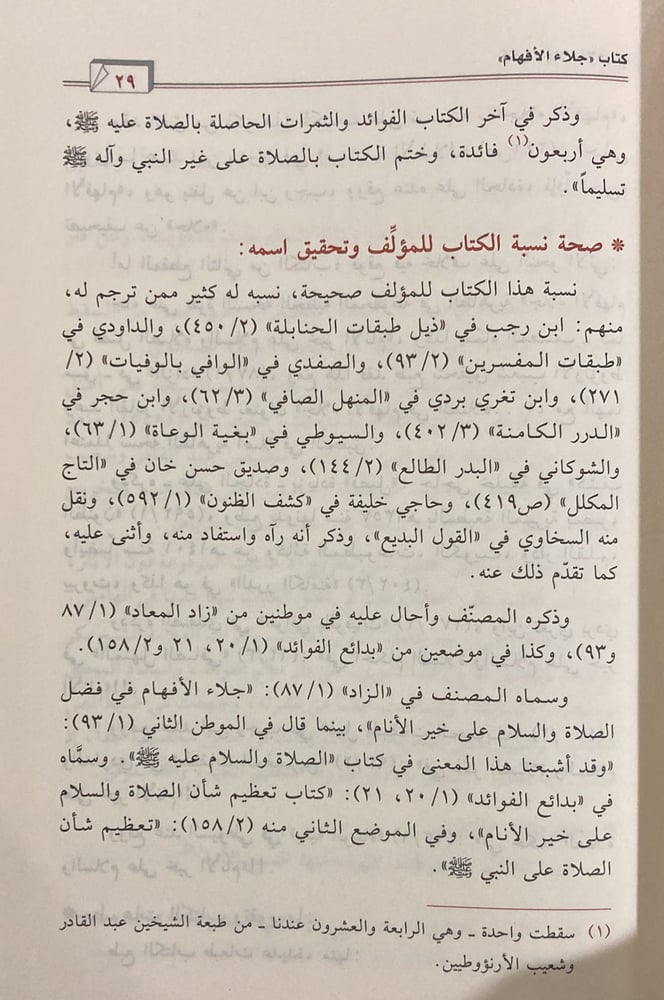
The attribution of this book to the author is correct, as many who translated him have stated, including Ibn Rajab in "Tabaqat Al-Hanabilah" (2/450), Al-Dawudi in "Tabaqat Al-Mufassirin" (9/932), Al-Safadi in "Al-Wafi Bil Wafayat" (2/271), Ibn Tughri Birdi in "Al-Manhal Al-Safi" (6/2), Ibn Hajar in "Al-Durar Al-Kamina" (4/402/3), Al-Suyuti in "Bughiyat Al-Wu'ah" (63/1), Al-Shawkani in "Al-Badr Al-Tali'" (144/2), Sidiq Hassan Khan in "Al-Taj Al-Mukallal" (p. 419), Haji Khalifa in "Kashf Al-Zunun" (592/1), and he also transferred from it Al-Sakhawi in "Al-Qawl Al-Badee'" and mentioned that he saw it, benefited from it, and praised it, as previously stated.
The compiler also mentioned it and referred to it in two places in "Zad Al-Ma'ad" (87/1 and 93), and also in two places in "Bada'i' Al-Fawa'id" (20/1, 21, and 158/2). The author named it in "Al-Zad" as "Jala' Al-Afham in the Virtue of Prayer and Peace upon the Best of Creation," while in the second place (93/1), he said: "We have elaborated on this meaning extensively in the book 'Prayer and Peace upon Him.'" He also named it in "Bada'i' Al-Fawa'id" (1/20, 21): "The book of Exalting the Status of Prayer and Peace upon the best of creation," and in the second place (158/2): "Exalting the Status of Prayer upon the Prophet, peace be upon him."
Everyone who mentioned this book agreed to name it "Jala' Al-Afham," except for Ibn Badran in "Munadhamat Al-Atlal" (p. 241): "Hilya Al-Afham," which he quotes from Ibn Rajab, and it appears in his work as "Al-Hilya," which is a typo for "Jala'."
**The second part of the book:**
There is a disagreement regarding it as follows:
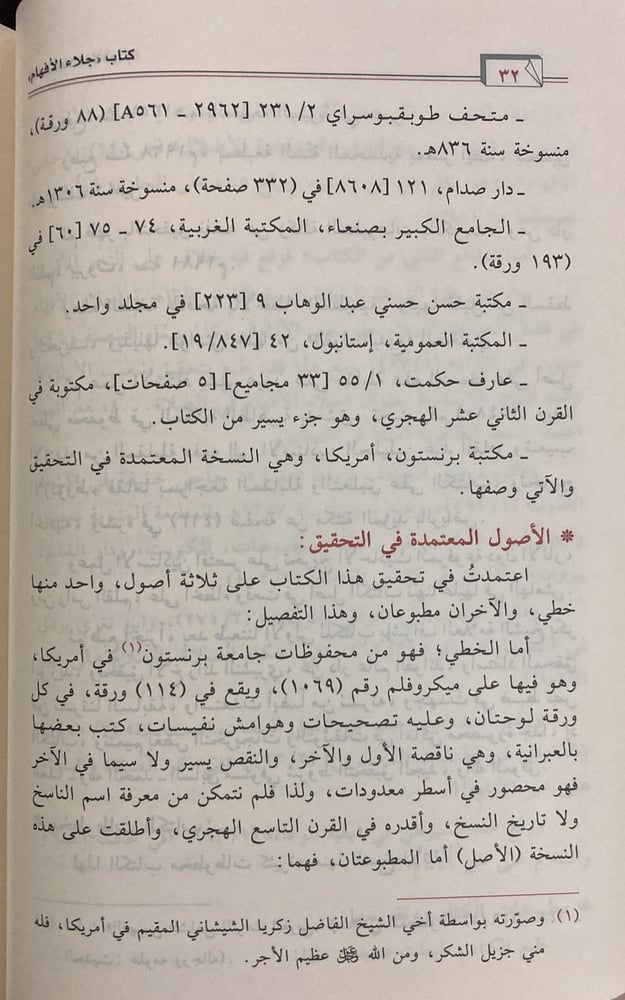
It appears in the preserved handwritten copy in the Dhahiriyah Library as "Jala' Al-Afham in the Virtue of Prayer and Peace upon the best of creation," and the author also named it as such in "Al-Zad" (87/1). However, it was printed with verification by Shuaib Al-Arna'ut and Abdul Qadir Al-Arna'ut under the title "Jala' Al-Afham in Prayer..." relying on the Dhahiriyah copy as the main source.
It is also correctly mentioned as "with the addition of 'Virtue'" by Haji Khalifa, even though they are the same, in "Kashf Al-Zunun" (592/1), and it was printed without it in 1357 AH at the Minia Printing House in Egypt, and also in 1401 AH by the Publications Agency, Kuwait, and Dar Al-Qalam Beirut, and it is also in "Al-Durar Al-Kamina" (402/3).
Al-Safadi mentioned it in "Al-Wafi Bil Wafayat" (212), and Ibn Tughri Birdi in "Al-Manhal Al-Safi" (62/3): "Regarding the rulings of prayer and peace upon the best of creation!!"
It also appeared in Ibn Rajab in "Tabaqat Al-Hanabilah" (450/2), Al-Dawudi in "Tabaqat Al-Mufassirin" (93/2): "Regarding prayer and peace upon the best of creation!!"
And in Al-Suyuti's "Bughiyat Al-Wu'ah" (63/1): "In the wisdom of prayer and peace upon the best of creation!!"

From Dammam