

A question and answer about following the four madhabs
30ر.س
Product description
The Mufti Ahmad bin Ali Al-Hanafi
Researcher Dr. Abdullah Al-Shamran
Question and Answer Regarding Following the Books of the Schools of Thought, by As-Safarini
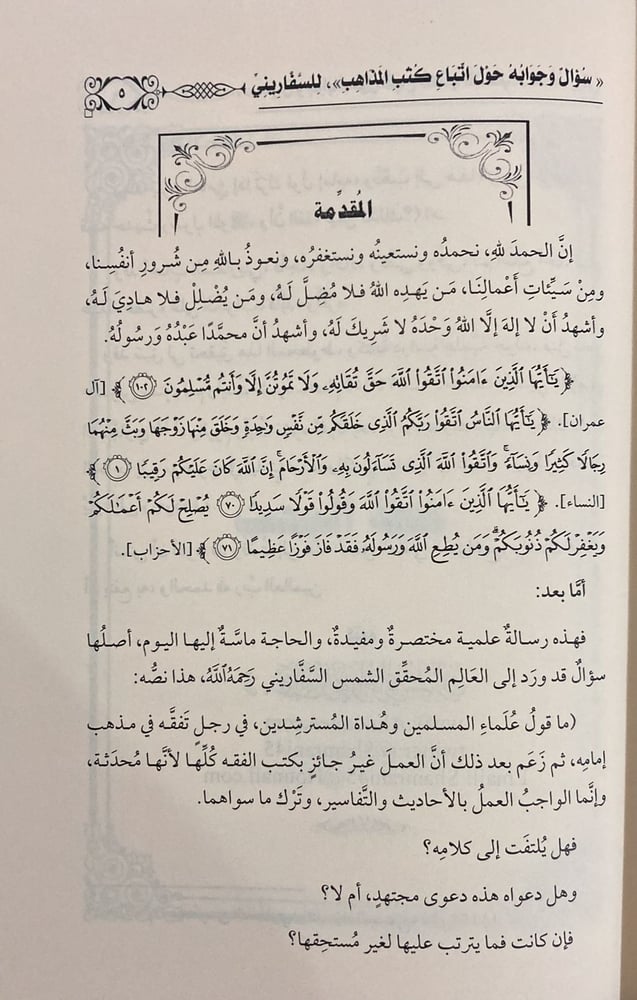
Introduction
All praise be to Allah, we praise Him, seek His help, and ask for His forgiveness. We seek refuge in Allah from the evil of ourselves and from the bad deeds we commit. Whoever Allah guides, there is no misleader for him, and whoever He leads astray, there is no guide for him. I bear witness that there is no deity but Allah alone, with no partner, and I bear witness that Muhammad is His servant and Messenger.
O you who believe, fear Allah as He should be feared, and do not die except as Muslims. [Al-Imran]
O mankind, fear your Lord who created you from a single soul and created from it its mate, and spread from both of them many men and women. And fear Allah, through whom you ask one another, and the wombs. Surely Allah is ever watchful over you. [An-Nisa]
O you who believe, fear Allah and speak words of appropriate truth.
He will amend for you your deeds and forgive you your sins. And whoever obeys Allah and His Messenger has certainly achieved a great victory. [Al-Ahzab]
As for what follows:
This is a brief and beneficial scientific message, and there is a pressing need for it today. Its origin is a question that was posed to the learned researcher, As-Safarini, may Allah have mercy on him. Its text is:
What do the scholars of Islam and guided leaders say regarding a man who studied in the school of his imam, then claimed afterward that working according to all the jurisprudence books is not permissible because they are newly invented, and that it is only obligatory to act according to the Hadiths and interpretations, and to abandon everything else?
Should his words be considered?
And is this claim of his an independent ijtihad, or not?
If it is, then what are the consequences for those who are not deserving?
And what are the conditions of ijtihad?
And what is incumbent upon the layperson if he abandons the opinion of his imam and turns to this man, claiming that his statement is a Hadith of the Messenger of Allah and that jurisprudence is not as such?
End of quote.
The Safarini answered, excelling and benefiting, sufficing and fulfilling. Then one of the great scholars of his time reviewed the answer, supported it, and approved it.
I have previously researched this manuscript and written a scientific study about it about twenty years ago. Later, I saw it published in 1435 AH as an appendix to my book "Al-Imam Al-Hajawi." Today, I saw it published separately after review and correction, due to the great need for its subject in our days and because it was buried in a large book of mine, which many may not notice.
I hope I have been successful in this humble scientific effort, and I ask Allah to benefit from it. All praise be to Allah, Lord of all worlds.

From Dammam