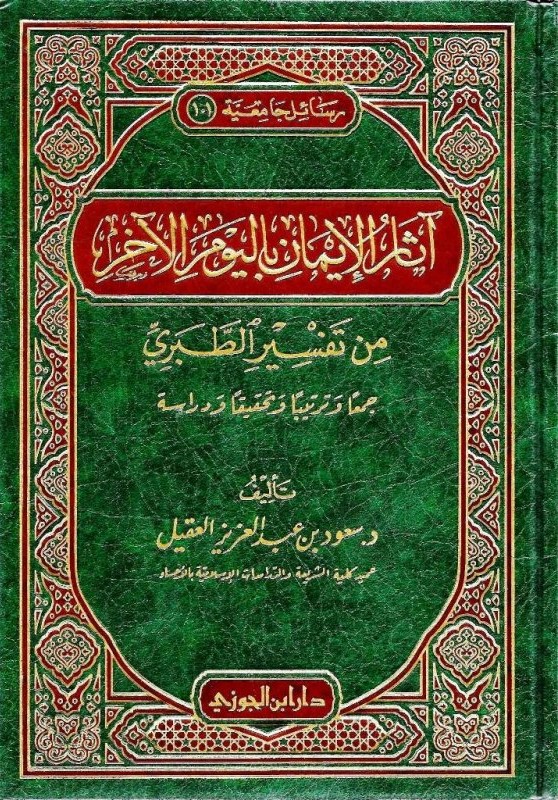

Effects of faith in the Day of Judgment from Tafsir al-Tabari
50.60ر.س
Product description
Saudi Abdulaziz Al-Aqeel
The origin of the book is a scientific message, submitted by the researcher to obtain a doctorate degree in Creed and Contemporary Sects, at the College of Fundamentals of Religion, at Imam Muhammad bin Saud Islamic University in Riyadh, and he obtained it, may Allah grant him success, with distinction, and with first-class honors, may Allah increase him in His favor.
The author clarified in the introduction of his book what prompted him to write on this subject, including:
1. The inclusion of Tafsir Al-Tabari — that is, Al-Tabari’s interpretation — contains a huge wealth of traditions from the Salaf, from the Companions, Tabi’un, and Tabi’ Tabi’un.
2. The desire to gather what was scattered in the book of many traditions from the Salaf regarding faith in the Last Day.
3. That these traditions relate to the interpretation of the Book of Allah, which is the primary source for receiving the creed among Ahl al-Sunnah wal-Jama’ah.
4. That this Tafsir is full of much of the speech of the Salaf concerning belief.
5. That its author is Imam Abu Ja’far Muhammad ibn Jareer Al-Tabari, the renowned scholar, and one of the great Imams of the Sunnah.
6. The great scientific value of Ibn Jareer’s Tafsir, and one of its most prominent features is that Ibn Jareer rarely narrated from those accused of innovation.
7. Some researchers have transmitted many traditions of Ahl al-Sunnah wal-Jama’ah regarding issues of belief from Ibn Jareer’s Tafsir.
8. That Ibn Jareer’s Tafsir is a source of defense for the Salafi creed.
As for the research plan, it is as follows:
* Introduction, including the importance of the topic, reasons for choosing it, the methodology of its author, and the research plan.
* The preliminary, in which the author included a brief biography of Imam Al-Tabari, then explained the meaning of the Last Day, its status in the Book and Sunnah, the ruling on those who deny it, and concluded the preliminary by clarifying the status of the sayings of the Companions and Tabi’un and their evidence in issues of belief.
* The first chapter: Traditions from the Salaf regarding death and the states of Barzakh.
The chapters of this section covered the topic of the angels taking the souls, then the resting place of the souls, and then the bliss and punishment of the grave.
* The second chapter: Traditions from the Salaf regarding the signs of the Hour.
The chapters included discussions about the minor signs of the Hour, then the major signs, and related issues.
* The third chapter: Traditions from the Salaf regarding resurrection.
The chapters included discussions about blowing the trumpet, the changing of the world’s conditions, the land of the gathering, accountability and recompense, the pond (Al-Kawthar), and the crossing of the Sirat.
* The fourth chapter: Traditions from the Salaf regarding Paradise and Hell.
The chapters discussed Paradise, Hell, and related issues.
* Conclusion.
* Indexes.
The book is approximately 780 pages long and is available in bookstores.
May Allah reward the author well, and benefit us and him with it. Indeed, He is the Hearing, the Responding.
Your brother, Abu Omar, Madinah Al-Munawwarah
18/1/1433 AH

From Dammam