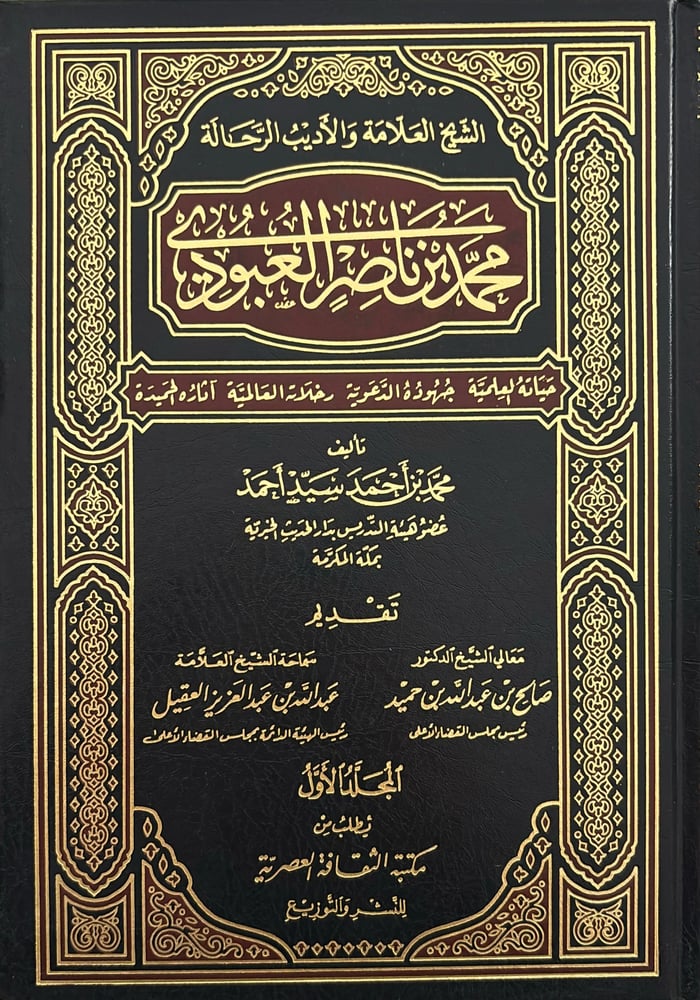
The scholar Muhammad Nasser Al-Aboudi his life his international journeys 1-2M
35ر.س
70ر.س-50%Product description
This is a brief translation of the Dean of Travelers, who surpassed Ibn Battuta in his journeys, and even in his scientific output, as he is a literary and encyclopedic scholar. His publications spread widely, and he moved among countries, families, lineages, language, and literature; gardens full of joy, and fruits planted for nearly a century. He traveled across countries, saw the civilizations of nations from diverse cultures, and charted his path for الدعوة in every place in accordance with the objectives and rulings of Sharia. He is easy and gentle in الدعوة, considers the minority Muslims, and senses their needs. He does not forget his nation’s issues, nor does he compromise on its sanctities. He is His Excellency Sheikh Muhammad bin Nasser Al-Oboudi.
His name and lineage: Muhammad bin Nasser bin Abdul Rahman bin Abdul Karim bin Abdullah bin Aboud bin Salem Al-Salem.
A literary, author, and traveler, born in the city of Buraidah on the last day of Rabi' al-Thani in the year 1345 AH.
His upbringing: He memorized the Qur'an proficiently under several sheikhs, received Islamic education from several scholars, including Sheikh Saleh bin Ibrahim Al-Kurdiis, Sheikh Omar bin Muhammad bin Saleem, Sheikh Saleh bin Ahmed Al-Khuraisi, Sheikh Saleh bin Abdul Rahman Al-Sukaiti, Sheikh Abdullah bin Muhammad bin Humaid, Sheikh Muhammad bin Ibrahim bin Abdul Latif.
His prominent qualities:
(1) Concern for utilizing time: The emphasis on time and making the most of its hours was the clearest trait of Sheikh Al-Oboudi, who moved through stations of greatness in education, reading, management, الدعوة, and subsequent responsibilities. The prevalence of such models in the nation is undoubtedly a sign of health and vitality, and that it still has the capacity to produce pioneering geniuses, nurturing them in lives of glory and dignity, taking the means of formation and upbringing, extending afterward to the places of creativity and foundation.
(2) High ambition: Raising high ambition is among the highest ranks of leadership, and a ladder to reach all origins. When Sheikh Al-Oboudi realized this important principle, he set out into life, practicing and experiencing the times, moving through several places without hesitation or fatigue, but rather with diligence and effort, and he did not relent. His ambition, which flows with his blood, is what led him early to join his sheikh Sheikh Abdullah bin Humaid—may Allah have mercy on him—when he was a young man not yet twenty, accompanying him in his travels and journeys, to drink from the fountain of knowledge and quench from the streams of great scholars.
His ambition qualified him to manage Al-Faisaliyah School at a young age, announcing the beginning of responsibility and trust at this early age. His ambition also drove him to be nominated to manage the second scientific institute in Saudi Arabia (in Buraidah), where he was selected from a distinguished elite of students, even those who had precedence over him in education.
His ambition took him to the Islamic University, where he was appointed its first employee, entrusted with the most difficult administrative and financial tasks. His success in previous stations and his high status were convincing reasons for his appointment to this emerging important position.
His ambition led Sheikh Al-Oboudi to the ranks of global scholars, with a list of great scholars, authoring in travels, reaching the number of published works to this extent.
His works and positions: He worked as a teacher, then managed the Scientific Institute in Buraidah, and became the Secretary-General of the Islamic University in Medina for thirteen years. He held other positions at the university, and finally, he was the Assistant Secretary-General of the Muslim World League. His participation in several scientific and literary committees, and his attendance at many scientific and literary conferences inside and outside the Kingdom, enriched his cultural background. His numerous observations and readings resulted in a record number of more than 160 books in travel literature. He was awarded the Merit Medal in Literature in 1394 AH (1974).
His الدعوة efforts: It is important to stand at a significant station in Sheikh Al-Oboudi’s journeys; despite their abundance, his travels were not mere tourism across the land of Allah, describing geographical features like mountains, plateaus, and seas, but carried noble الدعوة objectives, serving Islam and Muslims. He traveled the world with keen insight, sound mind, and deep religious understanding, aiming to elevate Muslims by supporting them and sensing their needs, especially in countries at the far east and west where Muslims are minorities. The Sheikh was proactive in all this, using his influence with officials and rulers to improve their conditions—building mosques, schools, الدعوة offices, charitable and relief projects, etc.
He was dispatched by the Muslim World League and served as a good ambassador for الدعوة to Allah with wisdom and good admonition. He succeeded in building bridges among Muslims and represented the Kingdom in the best way, earning the trust of officials, praise be to Allah.
Praise from scholars about him:
1- Praise from Sheikh Abdullah bin Humaid, may Allah have mercy on him: He said that Sheikh Muhammad bin Nasser Al-Oboudi is among the scholars who spent part of their lives studying Islamic sciences. Besides that, he is a virtuous scholar who received a medal for excellence in literature. His book "Nafahat min al-Sakinah al-Qur'aniyah" is clear to those who read it, especially those who have no prior experience with Tafsir books or knowledge of the terminology of interpreters. We ask Allah to reward the author Sheikh Muhammad Al-Oboudi and benefit from his book.
2- Praise from the Dean of Ministers Dr. Abdulaziz Al-Khuwaitir, may Allah have mercy on him: He said that brother Muhammad Al-Oboudi has a luminous knowledge among intellectuals, due to his cultural efforts and his contribution to the intellectual arena with abundant, beneficial, and delicious nourishment. He participated in efforts to inscribe the name of the Kingdom of Saudi Arabia on the map of achievement in culture, heritage, geography, and aspects of the Arabic language in our Arab library. It is difficult to limit or summarize this diligent and serious scholar’s achievements in few lines or pages; each aspect of his extensive intellectual achievement requires a long, careful review, which would result in a full book.
3- Praise from Dr. Muhammad Al-Shuwaier, may Allah have mercy on him: He said a famous saying by a poet: "I am not honored by my ancestors, but they honored me," which applies to Sheikh Muhammad Al-Oboudi: the traveler and writer; many people, especially abroad, know Sheikh Al-Oboudi as the preacher who travels across countries in successive scientific journeys, recalling the journeys of Ibn Battuta, but he is more widespread and more generous.
His publications: Most are in travel literature, including topics on الدعوة, language, and literature.
- "In Travel Literature" to South and North: Sweden, Fattani or South Thailand, Rajastan: Land of Kings (from the Indian travel series), and others about Mali, Kyrgyzstan, Taiwan, India, Vietnam, Guyana, Suriname, Laos, Cambodia, Angola, Cape Verde, Russia, Uruguay, Paraguay, Albania, South China, Niger, Bulgaria, Yugoslavia, Bengal, Muslim lands in Bukhara and beyond, Azerbaijan, Daghestan, Polish Muslims, journeys to the Indian Ocean islands, Myanmar, the Muslim lost lands, Nepal, Maldives, Ceylon, Africa, the racist countries, Brunei, Central America, the southern tip of the world, the far south of America, Africa memories, Caribbean islands, the Andes, South Pacific islands, Amazon coasts, Australia, Middle East, China, Eritrea after 36 years.
(In lineages) A genealogical dictionary of Qassim families, a large book containing several volumes:
- Dictionary of Buraidah families in 23 volumes.
- Dictionary of 'Uyaynah families.
- Dictionary of North Qassim families.
- Dictionary of South Qassim families.
- Dictionary of East Qassim families.
- Dictionary of West Qassim families.
(Arabic language) "Words that have passed," "Loanwords in our colloquial language," "The authentic roots dictionary of colloquial words" (13 volumes), "Dictionary of religion and piety in colloquial language," "Dictionary of hunting and shooting among the public."
(Seerah) His Excellency Sheikh Muhammad bin Ali Al-Harikan as he knew him, Sheikh Abdulaziz bin Saleh Al-Saleh, Imam of the Prophet's Mosque as he knew him, the great traveler Ibn Battuta: living witnesses to his truth, news of Hamad Al-Suqeebi, Sheikh Abdulaziz bin Baz as he knew him, Najdi Diaries (3 volumes), Sheikh Abdullah bin Humaid as he knew him (2 volumes), news of Qani: Abdul Karim bin Othman Al-Obeid 1271-1359, news of Al-Mulla bin Saif.
(Other fields) News of Abu Al-Aynaya Al-Yemami, colloquial proverbs in Najd, 5 volumes, "The Heavyweights," "Nafahat min al-Sakinah al-Qur'aniyah," popular sayings, literary impressions, heavy images, the Muslim world and the league, scenes from Buraidah, what I derived from people, King Fahd’s efforts may Allah have mercy on him for serving Islam and Muslims, Martinek and Barbados, relations between Saudi Arabia and Turkey, Puerto Rico and the Dominican Republic, Motawwa in Paris, the indebted, Moudi and her daughters, desert maqams, benefits extracted from his writings: "Lata'if min Rihlat Sheikh Al-Rihalah Muhammad bin Nasser Al-Oboudi" by Abdulaziz Al-Owaid, "Traveler in the Dictionary, a reading of the Dictionary of Buraidah Families" by Duraib bin Abdullah Al-Duraib.
Honors and awards: Al-Oboudi was honored by several entities in appreciation of his scientific and literary efforts, receiving numerous certificates, including:
- Ministry of Education in 1394 AH, awarded the Merit Medal in Literature.
- Abd Al-Masoud Khawaja’s Two-Nia in 1406 AH.
- Qassim Literary Club in 1421 AH.
- Al-Mashouh Tloos.
- Prince Salman bin Abdulaziz Award for Studies of the Arabian Peninsula in its third session 1429-1430 AH (2008-2009).
- His book "Dictionary of the Authentic Roots of Colloquial Words" won the Book of the Year Award from Riyadh Literary Club in its third session 1431 AH (2010).
- His book "Dictionary of Clothing in Popular Heritage" won the Ministry of Culture and Information’s Book Award for that year 1435 AH (2014).
- His book "Dictionary of the Earth's Surface and Related Features in Popular Heritage" won the King Abdulaziz Book Award in its second session 1436 AH (2015) in the category of books related to the geography of Saudi Arabia.
- He was honored on the 7th of Ramadan 1442 AH, corresponding to April 19, 2021, with the Cultural Personality of the Year Award in the National Cultural Awards Initiative from the Ministry of Culture in Saudi Arabia.
What has been written about his biography: Many of his admirers wrote about him during his life, and he himself said: "Although dozens of articles and research papers have been written about me by some admirers who think well of me and see that talking about me is beneficial, if I gathered them, they would fill volumes." A number of writers published books about my biography, including Dr. Muhammad bin Abdullah Al-Mashouh’s book titled "Muhammad bin Nasser Al-Oboudi: Dean of Travelers," printed in about 500 pages, and another in two volumes by Sheikh Muhammad bin Ahmed Sayyid, a teacher at the Makkah Dar Al-Hadith.
Among the anecdotes written about his biography: the book "Sheikh Muhammad Al-Oboudi through the Eyes of His Daughters," authored by three of his daughters.
His death: Sheikh Muhammad, may Allah have mercy on him, passed away on Friday, 2/12/1443 AH, after a life full of struggle and giving, leaving a vast intellectual legacy that enriches Islamic libraries. May Allah have mercy on him and admit him into His spacious gardens.

Questions you might have