
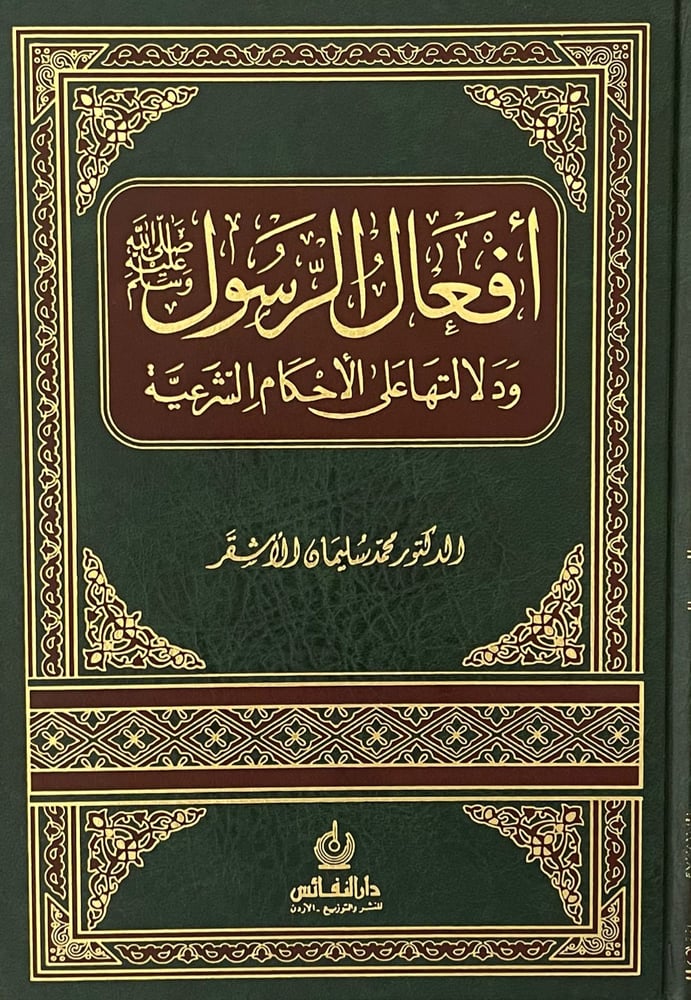
The actions of the Prophet and their indications on Islamic legal rulings volume
80.50ر.س
Product description
D - Muhammad Sulaiman Al-Ashqar
The Prophet's actions and their indication of Islamic rulings | Muhammad Sulaiman Al-Ashqar
The specialized researchers have long and recently written extensively on the subject of sayings, dedicating most of their works to specific topics. They wrote about command and prohibition, reality and metaphor, interpreting general texts, and addressing general and specific issues, among others.
The prophetic actions have been largely untouched by scholars, with only brief touches by the fundamentalists in their comprehensive foundational works.
Is this the true weight of actions? Have the actions been given their full rights and what they deserve?
A thorough review of the points of disagreement among jurists clearly shows that one of the reasons for their disputes is their differing interpretations of the rulings derived from actions.
It would not be an exaggeration to say that the disagreement over the rules of actions is the main cause of the broader jurisprudential disputes.
Some actions are disputed whether they are truly actions or not, such as leaving, writing, indicating, remaining silent, acknowledging, and are called in this book as non-explicit actions.
Other actions are clear in their effectiveness, such as prayer, fasting, jihad, bowing, prostration, eating, drinking, and sleeping, and are called in this book as explicit actions.
Chapter three deals with conflicts between actions and other evidence.
The introduction defines the Sunnah linguistically and terminologically, explains the authority of the Sunnah in general, its rank relative to the Qur'an, clarifies the prophetic essentials, and discusses the role of actions in performing them in the best way.
The first chapter, dedicated to explicit actions, is organized into nine sections and includes rigorous research, such as:
- Discussions related to actions to derive rulings from prophetic actions,
- The other section addresses objections raised against using actions as evidence and how to respond to them,
- A third section on transmitting prophetic actions.
The second chapter deals with non-explicit actions, which include writing, indicating, verbal expressions of saying, leaving, remaining silent, acknowledging, and the intention behind actions, each with its own section.
There are additional sections related to prophetic actions.
The third chapter addresses conflicts between prophetic actions themselves and between them and other evidence, divided into four sections, supplemented by a part of the message of Al-Hafiz Al-Ala’i titled "Detailing the Ambiguity in Conflicting Sayings and Actions," which was essential to include for those examining this research.

From Dammam