The rulings team
126.50ر.س
Product description
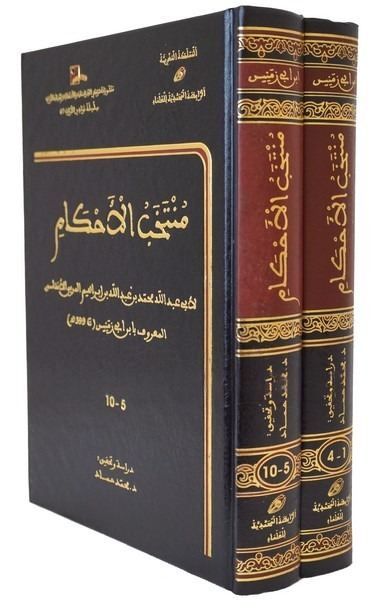
The book "Selected Judgments" belongs to its author Abu Abdullah Muhammad bin Isa bin Abi Zamanin Al-Ilbiri Al-Andalusi to a different type of authorship in Maliki jurisprudence, the author paid particular attention to collecting various judgments related to the topics of courts and selecting them, which earned this comprehensive work fame and acceptance among scholars. The author, may Allah have mercy on him, says: "This is a book in which I gathered some of the issues of courts and judgments, extracted them from the main sources, and selected them beautifully and well." The importance of the book also lies in its preservation of many texts and rulings of fatwas that are rarely found in other writings. It also provides a clear picture of the principles of fatwa and judiciary in the Maliki school in general, and in Andalusia in particular.
As for the topics addressed by the book, they are many and complex, demonstrating the author's extensive coverage and the sources he used. The reader finds that he does not leave out any major or minor issue from the various judgments and rulings. The author did well by organizing his work into parts that branch out from each book, with chapters and issues. It is enough here to mention the titles of his books to generally indicate what is contained under each of those chapters and issues.
The author divided his work into ten parts, as follows: issues of claims – issues of judgment – issues of co-ownership – issues of possession – issues of marriage – issues of divorce – issues of sales – issues of defects – issues of rental, then miscellaneous and scattered issues, as is customary among scholars of the school who often dedicate a special chapter called "Al-Jami'" for the scattered issues.
Regarding the author's methodology in his overall approach, he assigned each issue a title summarizing its branches and rulings. At the beginning of each issue, he mentions the sources he relies on, and clarifies what he has said himself by mentioning his name before it, saying "said Muhammad." He also refined and summarized issues whenever necessary, mostly preserving the wording of their original authors. He mastered this skill to an extraordinary degree.
The personality of the author is evident in every detail of the book. You find him explaining issues, guiding them according to the principles of the school, clarifying additions by some narrators over others, commenting, completing, and comparing opinions. Among the phrases that recur in the book, indicating the author's work, are: "The meaning of this issue is such," "This issue is used as evidence for such," "So-and-so added to this issue," "So-and-so said regarding this issue," "Some narrators mentioned such," "There is disagreement among Malik's followers on such," "There is dispute," "He did not give a clear answer in this issue regarding the disagreement," "Whoever contemplates what he said about this issue should follow their principles," "This is closest to their principles," "This is correct according to their principles," "So-and-so's opinion is more appropriate," etc.
The sources the author relied on and selected from are primarily the "Sahih Sahnun" (240 AH), to the extent that the book seems like a summary and refinement of it. Then comes the "Al-'Utbi" (the extracted) by its author Muhammad bin Ahmad bin Abdul Aziz bin 'Utbi (255 or 254 AH), followed by "Al-Wadih" by Abdul Malik bin Habib (d. 238 AH). These three well-known main texts formed the foundation of the author's work. There are other important sources as well, such as "The Civil Books" by Abdul Rahman bin Dinar (201 AH), "The Brief of Ibn Abd al-Hakam" (214 AH), "The Collection" by Ibn Sahnun (256 AH), the eight books of Abu Zaid Al-Qurtubi (258 AH), "The Book of Ibn Muzayn" (259 AH), "The Collection" by Ibn Abdous (260 AH), "The Muwaziyah" by Ibn Al-Muwazi (269 AH), and others. These are the main comprehensive Maliki jurisprudential writings that compile the sayings of the great scholars of the school and its most famous jurists. It is not surprising that "Selected Judgments" gained the fame, prestige, and widespread acceptance it did.
Imam Al-Dhahabi said in his history — when mentioning the works of Ibn Abi Zamanin: "The book 'Selected Judgments' spread across the horizons," and he described it in "Siyar A'lam al-Nubala": "Famous." The Qadi 'Iyad Al-Dhahabi preceded this statement when he said: "Its benefit became apparent, and its fame spread across the East and West." The speaker did not exaggerate when he described it as: "A book of judgments containing jewels of jurisprudence, a light of truth shining, guiding judges in every direction, and a source of support for the scholar and the judge."
Anyone who reads the book finds that it speaks a lot about rulings on issues presented in the current scientific arena, especially in the field of judiciary. It contains texts of great value, and it deserves study, teaching, and the pursuit of the knowledge and research it merits.
The first and second parts of the book were published with the verification of Dr. Abdullah bin Atiyyah Al-Ghamdi, issued by Al-Rayan Foundation – Beirut, first edition / 1998. The entire ten parts were published with verification by Dr. Muhammad Hammad by the Center for Studies and Research and Revival of Heritage affiliated with the Rabita Mohammadia of Scholars in the Kingdom of Morocco.

From Dammam