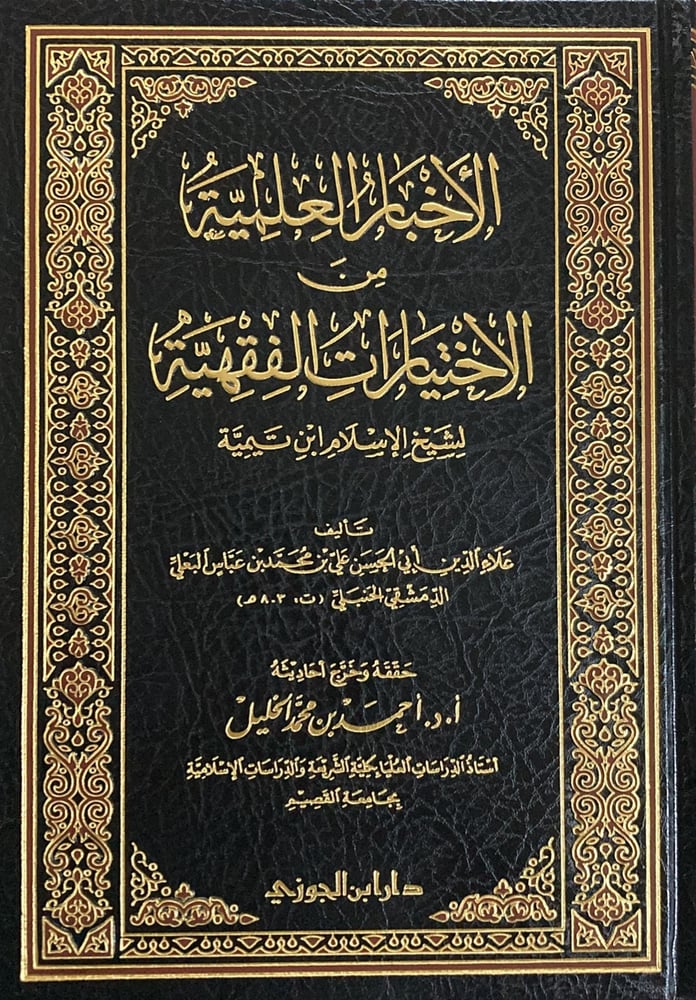




Scientific news in jurisprudential choices of Ibn Taymiyah
44.85ر.س
Product description
For Sheikh al-Islam Ibn Taymiyyah, authored by Alaa al-Din Abu al-Hassan al-Dimashqi, verified and annotated by A. D. Ahmad bin Muhammad al-Khalil. In the name of Allah, the Most Gracious, the Most Merciful.
Second edition introduction.
Praise be to Allah, Lord of the worlds, and prayers and peace and blessings be upon our Prophet Muhammad, and upon his family and all his companions. After:
This second edition of the book: "Scientific News from the Jurisprudential Selections" was issued after the copies of the first edition were exhausted in a short period, and many virtuous scholars asked about it and requested its reprint. And that is nothing but a pure favor from Allah, and a blessing from Him, as He facilitated its production, dissemination, and acceptance; so praise be to Allah, and thanks as He loves and is pleased with.
Some suggestions, corrections, and preferences have come to me among the handwritten copies where they differ.
I would like to record my thanks and gratitude to everyone who read the book and offered advice, correction, or suggestion, asking Allah to reward everyone with goodness and to grant them success.
Secondly, I mention that what I received of differing viewpoints, I will adopt what I see correct, and leave what I see contrary to correctness. And I believe that the sincere advisors’ hearts are wide enough to accept every issue where opinions differ, even if their words are not taken. I have taken much of what came to me from that and benefited from it in producing this edition more complete and accurate.
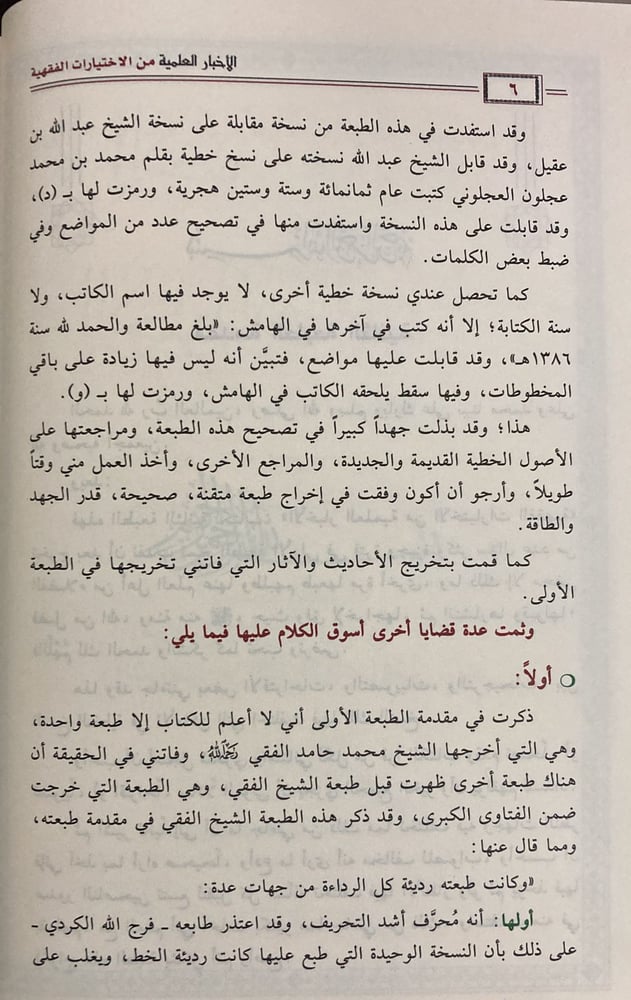
I benefited in this edition from a comparison copy based on Sheikh Abdullah bin Aqil’s copy, which he compared with handwritten copies written by Muhammad bin Muhammad Ajloun Al-Ajluni in the year 866 AH, marked as (D). I also compared and benefited from it in correcting some places and in ضبط some words.
Additionally, I have another handwritten copy without the author’s name or the year of writing, but at the end, it was written in the margin: "Reached reading, and praise be to Allah," in the year 1386 AH. I compared it and found no additions beyond other manuscripts, and it contains some omissions which the writer added in the margin, marked as (W).
I have exerted great effort in correcting and reviewing this edition based on old and new manuscript sources and other references. The work took a long time, and I hope I have succeeded in producing a precise and correct edition within my effort and capacity.
I also traced the hadiths and آثار (sayings or reports) that I missed in the previous edition, and there are several other issues I will mention below:
First: Representatives of it, but Allah mentioned in the introduction of the first edition that I know of only one edition, which was produced by Sheikh Muhammad Hamid al-Faqi. In fact, I missed that there was another edition that appeared before Sheikh al-Faqi’s edition, which was included in "Fatawa al-Kubra" (The Major Fatwas). Sheikh al-Faqi mentioned this edition in the introduction of his print, and he said about it:
"It was a poor edition in many respects:
First: It was heavily distorted, and its publisher—Faraj Allah al-Kurdi—apologized for that, claiming that the only copy it was printed from had poor handwriting. I suspect that the defect was due to his poor belief, as he was a Bahá'í, and an evil caller to his heresy. I believe that if he had been a Muslim, he could have produced the book with less distortion and fewer copies."
Second: The book was mutilated, making it very difficult to benefit from unless one is knowledgeable about Sheikh al-Islam Ibn Taymiyyah’s methodology and style of writing.
Third: The printer was not faithful in reproducing the original image of the book; it has been proven that he distorted some places that did not align with his desires.
Thus, the condition of this edition is bad, as you see, it is the worst of all editions.
Second: Some honorable brothers asked about the source of the title of the book. I say: the manuscripts carried the following titles:
- Manuscript (A): Titled "The Book of Selections," with the phrase "Shafatah Taimah" (likely a typo or misreading).
- Manuscript (B): Titled "Scientific News in the Selections of Sheikh al-Islam Ibn Taymiyyah and others."
- Manuscript (C): Titled "The Book of Selections."
- Manuscript (W): Titled "Scientific News in the Selections of Sheikh al-Islam Taqi al-Din Abu al-Abbas Ahmad ibn Taymiyyah."
Al-Dhahabi mentioned in "Shadharat al-Dhahabi" (p. 317) that among Buali’s works is "The Scientific News in the Selections of Sheikh Taqi al-Din Ibn Taymiyyah." The name chosen by Sheikh Muhammad Hamid al-Faqi was: "Scientific News from the Jurisprudential Selections of Sheikh al-Islam Ibn Taymiyyah."
And it seems—Allah knows best—that the phrase "jurisprudential" was added by Sheikh Muhammad Hamid al-Faqi because it does not exist in the handwritten copies, nor is it mentioned by the biographers of al-Ba'li.
I chose the title: "Scientific News from the Jurisprudential Selections of Sheikh al-Islam Ibn Taymiyyah" because:
- The first edition of the book was printed under this title and was known and recognized among scholars, so changing it might cause confusion and hesitation, as some might think it is a different book. Therefore, I found it more appropriate to keep the title it was famous for.
This title is an added knowledge, so I adopted it, and it appears that the other title is a summarized version of it.
Third: The author did not specify his methodology in the book; he did not clarify whether what he mentions is the literal text of Sheikh al-Islam Ibn Taymiyyah or the meaning of his words. He should have clarified this due to its importance in distinguishing between what the author understands from Sheikh al-Islam’s speech and what is directly quoted from Sheikh al-Islam, may Allah have mercy on him.
What appears—Allah knows best—is that he transmits texts from Sheikh al-Islam’s books and fatawa, which is indicated by:
1. The author often says after quoting a statement: "I said..." which indicates he differentiates between what is from Sheikh al-Islam and what is from himself.
2. Comparing the selections with "Majmū‘ al-Fatāwā" (The Collection of Fatwas), we find complete identical texts, word for word, and sometimes slight differences due to copy variations. This also indicates he transmits Sheikh al-Islam’s words verbatim, and the same applies to what he transmits from branches, where Ibn Muflih explicitly states it is from Sheikh al-Islam. It is either transmitted from "al-Furu‘" (the branches) or from a single source; in any case, it is Sheikh al-Islam’s speech, not the author’s.
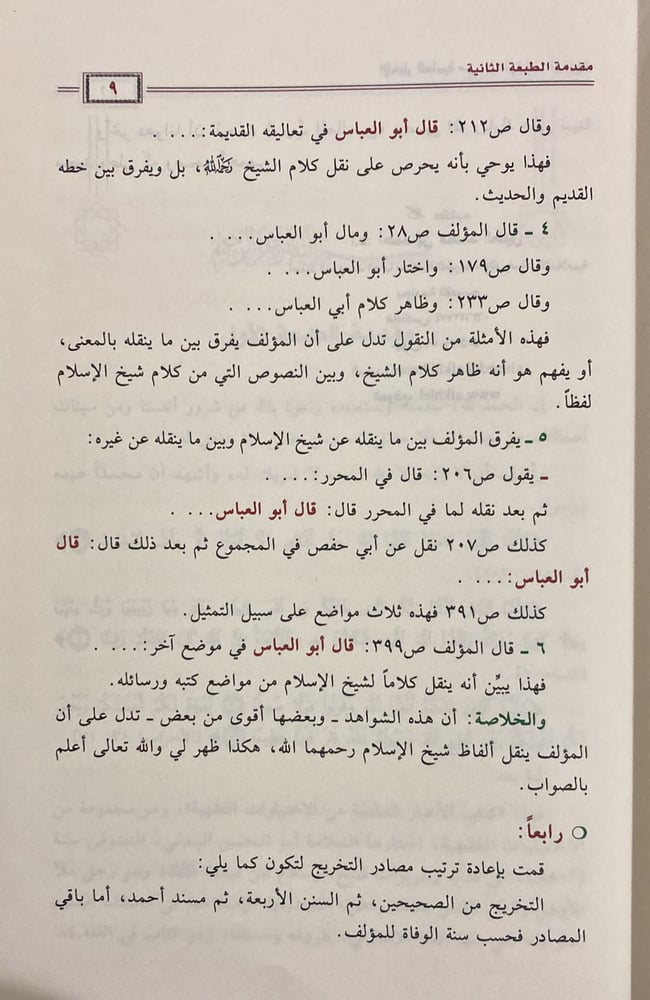
3. The author said on page 212: "And Abu al-Abbas in his old handwriting said..." which suggests he is keen on transmitting Sheikh’s words and differentiates between his old and new handwriting.
4. On page 28: "And Abu al-Abbas inclined..." and on page 179: "And Abu al-Abbas chose..." and on page 233: "And the apparent speech of Abu al-Abbas..." These examples indicate he distinguishes between what he transmits in meaning or what he understands as the apparent words of Sheikh and the texts that are verbatim from Sheikh al-Islam.
5. The author differentiates between what he transmits from Sheikh al-Islam and what he transmits from others:
On page 206: "He said in al-Muḥarrar..." and after quoting from al-Muḥarrar, he said: "Abu al-Abbas said."
Similarly, on page 207, he transmitted from Abu Hafs in "al-Majmū‘," then afterward said: "Abu al-Abbas said."
And on page 391, these three instances serve as examples.
6. The author said on page 399: "Abu al-Abbas said in another place..." which indicates he transmits words of Sheikh al-Islam from his writings and letters.
In summary: these examples—some stronger than others—indicate that the author transmits the words of Sheikh al-Islam, may Allah have mercy on them. This is what seems clear to me, and Allah knows best, and the correct is.
Fourth: I have reorganized the sources for the chain of narration as follows:
- From Sahihayn (the two authentic collections)
- Then the four Sunan (collections)
- Then Musnad Ahmad
Other sources follow according to the year of the author’s death.

From Dammam